Table of Contents
- Why Measuring Executive Presence in Performance Reviews Matters
- Step 1: Build a Behaviorally Anchored Rubric for Executive Presence
- Step 2: Gather Evidence Before the Review
- Executive Presence Performance Review Examples
- Executive Presence Feedback Examples
- Step 3: Use a Leadership Performance Review Template
- Performance Review Best Practices for Presence Ratings
- Step 4: Turn Ratings into a Development Plan
- Frequently Asked Questions
Last Updated: October 21, 2026
Why Measuring Executive Presence in Performance Reviews Matters
Most leaders can spot executive presence in a room but freeze when asked to rate it. That gap costs organizations real money.
Executive presence is the observable set of behaviors that make others trust a leader’s judgment, listen to their message, and follow their direction under pressure. It is not charisma, and it is not confidence alone.
The Cost of Leaving Presence Unmeasured
Unmeasured presence creates three problems. First, high-potential leaders get passed over because no one wrote down what they actually did. Second, confident but careless leaders get promoted on impression alone.
A behaviorally anchored approach fixes all three. The Society for Human Resource Management guidance on performance management stresses that ratings tied to specific behaviors hold up better in calibration and in appeals.
What Presence Is (and Is Not)
Presence is not personality. An introvert who runs a calm, clear crisis meeting has presence. A charismatic speaker who loses composure under questioning does not.
- Is: observable behaviors, repeatable under pressure, teachable
- Is not: extroversion, height, volume, or polish alone
- Is not: a proxy for business results
That distinction matters. If you rate presence and results as one thing, you cannot tell a strong operator with a weak boardroom manner from a smooth talker with weak numbers.
Step 1: Build a Behaviorally Anchored Rubric for Executive Presence
A behaviorally anchored rubric scores leaders on what they did, not on how they felt to be around. Most top-ranking guides stop at naming qualities like confidence and clarity. The gap is a rubric a reviewer can actually fill out. Build yours around four dimensions, then write anchored indicators for each rating level so two managers watching the same leader reach the same score.
The Four Dimensions: Composure, Clarity, Credibility, and Influence
| Dimension | What It Measures | Example Indicator |
|---|---|---|
| Composure | Steadiness under pressure | Stays measured when challenged in a meeting |
| Clarity | Message structure | States the recommendation before the detail |
| Credibility | Trust and follow-through | Delivers on commitments without reminders |
| Influence | Decision impact | Moves a room to a decision without forcing it |
Writing Anchored Rating Levels
Each rating level needs a sentence a reviewer could verify from notes or a recording. Avoid adjectives. Use actions. Write three levels per dimension: developing, effective, and strong.
Here is a worked example for the Clarity dimension. Notice that each level describes a different observable behavior, not a different feeling.
- Developing: “Buries the recommendation in background and leaves the room to infer the ask.”
- Effective: “States the recommendation first, then two supporting reasons, then the ask.”
- Strong: “States the recommendation, names the trade-off, and pre-empts the most likely objection before it is raised.”
Repeat the pattern for the other three dimensions.
A Worked Anchor Set for Composure
- Developing: “Raises voice or speeds up when challenged, and the meeting loses its thread.”
- Effective: “Pauses, restates the challenge in one sentence, and answers the question asked.”
- Strong: “Names the tension out loud, separates the decision from the emotion, and keeps the meeting on schedule.”
Write your indicators from real meeting notes, not from memory. Pull three recent examples of the behavior first, then write the level description around what you actually saw. A rubric built from real examples survives calibration; one built from adjectives does not.
Keeping the Rubric Defensible
A rubric is only as good as its anchors. Second, the job-relatedness test: every indicator should trace to a behavior the role actually requires, which is the standard the EEOC guidance on employment assessments and selection procedures applies to evaluation criteria.
This is the core of any leadership performance review template worth using. A template without anchored levels is just a list of adjectives with a score attached.
Step 2: Gather Evidence Before the Review
Evidence beats impression every time. Collect examples across the review period before you assign a single rating. Start with the leader’s self-assessment, then add manager, peer, and stakeholder input.

Multi-Rater and Stakeholder Feedback
Multi-rater feedback gives you a fuller picture than one manager’s view. Ask a small, fixed group the same three questions so answers are comparable.
- Describe a moment this leader stayed composed under pressure.
- Describe a time their message was clear and easy to act on.
- Describe a time you trusted their judgment without being asked to.
Peer feedback and stakeholder feedback often surface patterns a manager misses. Keep the group consistent cycle to cycle so trends mean something.
Rating presence from a single high-stakes meeting is the most common mistake we see. One bad board presentation can sink a fair rating. Gather evidence across at least three months.
Executive Presence Performance Review Examples
Here are executive presence performance review examples you can adapt. Notice each one names a behavior, a context, and an outcome.
- “In the Q3 budget review, stayed composed when challenged on the forecast, restated the assumptions, and kept the meeting on schedule.”
- “Opened the all-hands with the decision first, then the reasoning. Questions dropped and follow-up emails fell.”
- “Flagged a delivery risk two weeks early, proposed a fix, and owned the outcome when it slipped.”
Each example is specific enough to defend in calibration. That is the test.
Executive Presence Feedback Examples
Good feedback points to a behavior and a next step. Here are executive presence feedback examples for the conversation itself.
- “Your content is strong. Lead with the recommendation, then the detail. Try opening with the answer in the next leadership update.”
- “You stayed calm in a tense client call. Keep that composure, and name the trade-off out loud so others can follow your logic.”
- “You have credibility with your team. Extend it upward by summarizing your team’s wins in one paragraph each month.”
Feedback lands when it is concrete and forward-looking. Vague praise and vague criticism both fail.
Step 3: Use a Leadership Performance Review Template
A leadership performance review template keeps ratings consistent across managers. Structure it in four blocks: objectives, presence ratings, evidence, and development actions.
Executive Presence & Leadership Brand Guide →
Sample Review Questions and Evidence Prompts
Use the same questions every cycle. This is a practice the U.S. Office of Personnel Management performance management resources supports: consistent criteria make ratings fairer and easier to defend.
- Composure: Describe a high-pressure moment. What did the leader do?
- Clarity: Point to a message that landed. What made it clear?
- Credibility: Name a commitment kept or missed. What was the impact?
Pair each question with an evidence prompt: “Attach one example with a date.” Evidence prompts turn opinions into records.
The template does the heavy lifting. If the questions and evidence prompts are fixed, calibration becomes a conversation about examples, not about who argues hardest.
Performance Review Best Practices for Presence Ratings
Consistency, context, and separation from results are the three best practices that keep presence ratings fair. But fairness only holds if you can calibrate raters, document evidence, and run the cycle the same way twice. That implementation layer is where most programs quietly fail, and it is the piece the top-ranking guides leave out.
Calibration: Align Raters Before Scores Go Final
Calibration is a meeting, not a memo. Before ratings are finalized, bring reviewers together and walk through the same three or four examples against the rubric. The goal is not consensus on every leader. The goal is a shared reading of what each anchor level looks like.
A workable format runs about sixty minutes for a team of five to eight leaders:
- Each reviewer brings one example per dimension, dated and sourced.
- The group reads the example aloud, then each reviewer independently assigns a level.
- Where levels diverge by more than one step, the group rewrites the anchor, not the rating.
A common pattern is that the first calibration session produces two or three anchor rewrites. The Society for Human Resource Management guidance on performance management notes that ratings tied to specific behaviors hold up better in calibration and in appeals, which is exactly why the anchor, not the impression, should be the unit of debate.
Documentation: Turn Opinions into Records
Every rating needs an evidence trail a third party could follow. Keep the record short and structured:
- Behavior: what the leader did, in one sentence.
- Context: the meeting, decision, or presentation where it happened.
- Date: when it happened, so the review period is defensible.
Five fields per example is enough. The discipline is attaching at least one dated example to every dimension before a rating is assigned. Evidence prompts do this work: “Attach one example with a date” turns a conversation about impressions into a conversation about records.
Bias, Inclusion, and Cultural Context
Presence cues vary by culture, background, and communication style. A leader who speaks quietly and deliberately may read as “low energy” to a reviewer used to volume.
- Rate the behavior, not the delivery style.
- Ask whether the same behavior would be rated the same in a different person.
- Include reviewers from different backgrounds in calibration.
This is where many programs quietly fail. The EEOC guidance on employment assessments and selection procedures is a useful reference for keeping evaluation criteria job-related and consistent. A rubric that rewards a single communication style is neither.
Separating Presence from Business Outcomes
Presence and results are different measures. A leader can hit targets and still damage trust. Another can build enormous trust and miss a number. Rate them separately, then discuss both.
- Presence rating: how they showed up.
- Results rating: what they delivered.
- Development plan: where the two diverge.
Separating them stops you from rewarding polish over performance, or the reverse. It also gives you a clean sentence for the review conversation: “Your results are strong; your presence rating is effective, not yet strong, and here is the one behavior that closes the gap.”
Running the Cycle: A Repeatable Sequence
A review cycle that holds up year over year follows the same sequence:
- Collect: self-assessment, manager notes, peer input, and stakeholder feedback, all dated.
- Rate: assign a level per dimension using the anchored rubric.
- Calibrate: align raters on divergent examples and revise anchors as needed.
- Document: attach the evidence trail to each rating.
- Discuss: separate presence from results in the conversation.
- Plan: convert each low score into one micro-habit and one observable measure.
- Revisit: re-rate only the targeted dimensions at the ninety-day check-in.
Calibration, documentation, and a fixed cycle sequence are what turn a rubric into a defensible process. Without them, presence ratings drift back toward impression, and the loudest voice in the room wins again.
Step 4: Turn Ratings into a Development Plan
Ratings only matter if they change behavior. Convert each low score into one micro-habit and one measure.
- Composure: pause three seconds before responding in tense meetings
- Clarity: open every update with the recommendation
- Credibility: track commitments in a simple log
Set a 90-day check-in. Re-rate only the dimensions you targeted. Progress measures should be observable, not felt.
Coaches and managers running review cycles for small teams who need a consistent, defensible process without a large HR system.
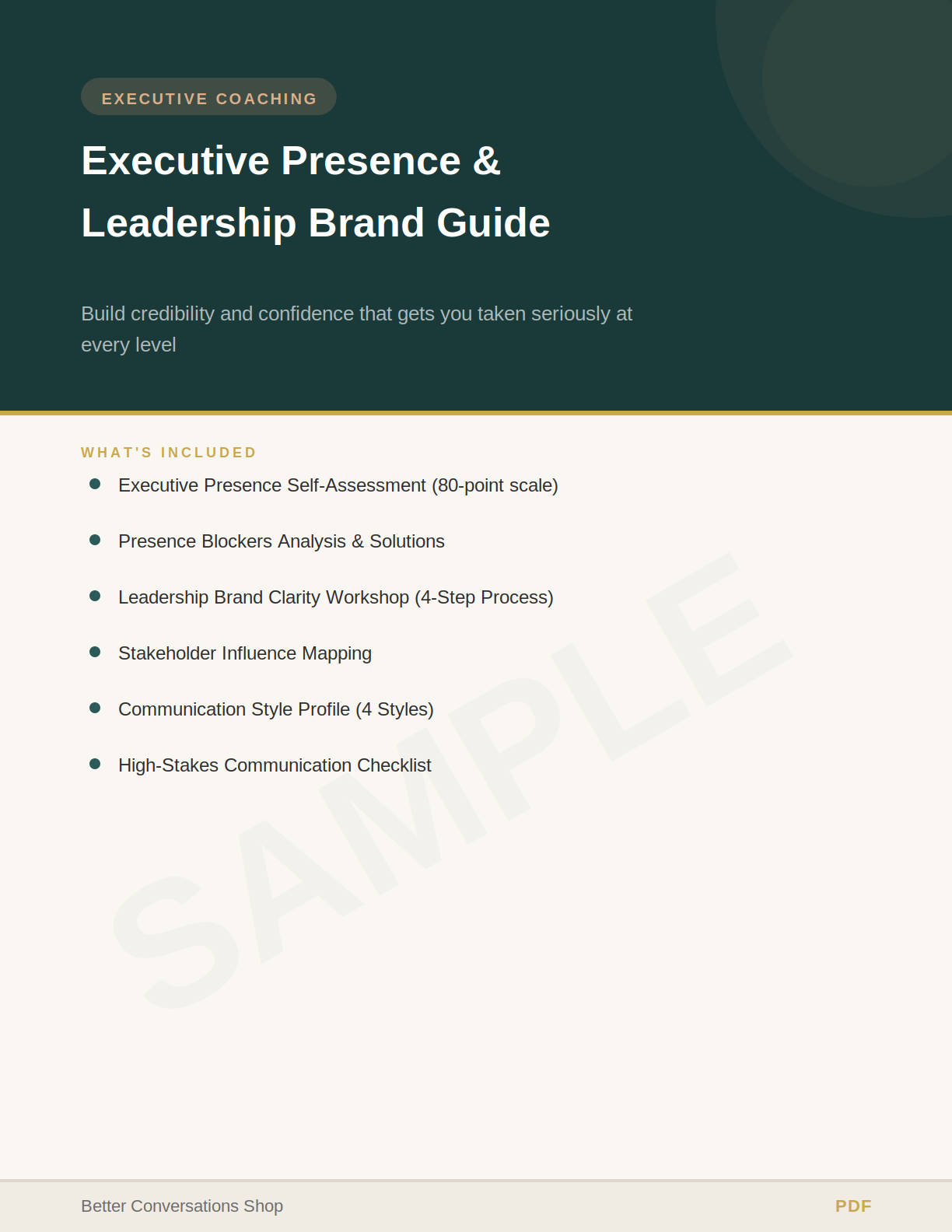
If you want a ready-made structure, our Performance Review Conversations Toolkit includes scripts, a calibration scorecard, and printable templates. Pair it with our Executive Presence & Leadership Brand Guide for the self-assessment and 90-day plan side of the work.
Frequently Asked Questions
How can you measure executive presence in a performance review?
Measure executive presence through observable behaviors, not impressions. Build a rubric with four dimensions: composure under pressure, clarity of message, credibility with stakeholders, and influence on decisions. Rate each dimension on a 1-5 scale anchored to specific behaviors, then gather evidence from stakeholder and peer feedback. This turns executive presence into a structured assessment that can be discussed, documented, and developed over time.
What are examples of executive presence in a performance review?
Strong executive presence performance review examples include: staying composed during a hostile board question and responding with a clear recommendation; restructuring a complex update so a decision gets made in ten minutes; and building credibility by following through on commitments across three quarters. Each example should describe the situation, the observable behavior, and the impact, so the rating is tied to evidence rather than personality.
How do you give specific feedback about executive presence?
Use the Observation-Impact-Change model. State what you observed in a specific setting, describe the impact on the room or the decision, and propose the change you want to see. For example: ‘In Tuesday’s steering committee, you opened with three minutes of background before the recommendation; the room lost focus. Lead with the recommendation next time, then give context.’ This keeps executive presence feedback examples concrete and actionable.
How do you turn executive presence feedback into a development plan?
Pick one or two dimensions from the rubric, set a measurable performance objective for each, and attach a 90-day action. For composure, the action might be a rehearsal routine before high-stakes meetings; for clarity, a message-structure template for every executive update. Review progress at the 30-60-90 day checkpoints and update the leadership performance review template with new evidence so the next cycle starts from data.
Measuring executive presence in performance reviews is hard because presence feels subjective until you anchor it to behavior. The Method Lab builds the frameworks that make that shift practical: client-ready PDFs, structured conversation guides, and evidence-based tools that hold up in calibration. Get your free toolkit and turn a vague impression into a fair, defensible rating.