Table of Contents
- The Hidden Cost of Unresolved Team Conflict in Small Businesses
- Common Causes of Workplace Conflict in Small Teams
- How to Lead Difficult Conversations Without Making Things Worse
- Conflict Resolution Strategies for Managers Who Want Lasting Results
- Workplace Conflict Resolution Scripts You Can Use This Week
- Remote and Hybrid Conflict: The Dynamics Most Small Businesses Miss
- The Legal and HR Boundaries Every Small Business Owner Should Know
- Frequently Asked Questions
Last Updated: September 16, 2026
The Hidden Cost of Unresolved Team Conflict in Small Businesses
Unresolved team conflict is the expense small business owners rarely see on a balance sheet, and team conflict resolution is the fix that compounds faster than almost any other operational problem. This guide from The Method Lab breaks down why team conflict resolution matters, where the real costs hide, and how to fix disputes before they drain your best people.
Productivity Loss and the Numbers Behind It
Productivity loss from conflict shows up as missed deadlines, rework, and stalled decisions. One unresolved dispute between two key employees can slow an entire workflow, since lean teams have no redundancy.
- Projects stall when collaboration breaks down between two people who must work together
- Managers lose hours to informal mediation that never resolves the root issue
- Good employees quietly reduce effort rather than risk becoming a target
- Decisions get delayed because no one wants to trigger the conflict again
Employee Morale, Retention, and the Ripple Effect on Culture
Employee morale and retention are where conflict does its most expensive damage. Employees rarely quit over a single argument; they quit when the environment never improves and management does nothing.
Ignoring a visible conflict teaches your team that management will not intervene. The consequence is not just one damaged relationship; it is a culture where people stop raising problems at all.
Common Causes of Workplace Conflict in Small Teams
Workplace conflict in small teams usually traces back to a short list of predictable triggers rather than personality clashes alone. Naming the cause is the first step toward resolving it.
The most common drivers:
- Competing priorities where two people believe their task should come first
- Role ambiguity where no one is sure who owns a decision
- Personality differences that become friction under deadline pressure
- Resource scarcity over budget, headcount, or credit for wins
- Communication style mismatches where one person is direct and another reads that as hostile
The Structural Conflict Diagnostic
Before you schedule a mediation, run the dispute through three structural questions. If any answer is yes, the conflict is a design problem wearing a personality costume.
- Do both people believe they own the same decision? Overlapping authority is the most common structural cause in teams under fifteen people. When two people can each say “I thought that was mine,” every disagreement becomes a status fight.
- Does one person’s output depend on another’s input without a defined handoff? Undefined handoffs create a permanent blame loop: the downstream person is always waiting, the upstream person always being chased.
- Are two roles measured on metrics that pull in opposite directions? A sales role measured on close rate and an operations role measured on delivery cost will collide on every custom order, no matter how well the two people get along.
Why Small Teams Feel Structural Conflict Faster
In a larger organization, process absorbs structural friction: an escalation path catches overlapping authority before it becomes personal. A five-person team has no such buffer, so the same flaw that causes a mild slowdown at a big company becomes a full-blown interpersonal rupture.
The Responsibility Map Fix
For any recurring conflict, write one page listing the disputed decisions with a single named owner each, not a committee. Where two people must collaborate, define the handoff: who produces what, by when, and who reviews it. Circulate it and ask for objections in writing. Most structural conflicts end here because the ambiguity that fed them is gone.
When the same two names show up in friction across three different projects, stop treating it as a relationship problem. Pull out the responsibility map and look for the overlap. The overlap is almost always the real cause.
When It Really Is Personal
Not every conflict is structural. Genuine personality clashes show up as a pattern across contexts: the same person rubs multiple colleagues the wrong way. The tell is whether the conflict moves with the work or with the person. If it moves with the work, fix the structure. If it moves with the person, that is a performance or conduct conversation, not a mediation.
How to Lead Difficult Conversations Without Making Things Worse
Leading a difficult conversation well starts with preparation. Managers who walk in without a plan tend to either avoid the real issue or escalate it.

A Five-Step Preparation Routine for Managers
Use this routine before any high-stakes conversation. It takes about twenty minutes and prevents most of the damage caused by improvising.
- Write down the observable behavior, not your interpretation. “Missed three handoffs this month” beats “doesn’t care.”
- Identify your own stake in the outcome so you do not lead with a hidden agenda.
- Separate positions from interests. The position is “I want this project.” The interest is usually recognition, security, or control over workload.
- Draft your opening sentence and read it aloud. If it sounds like an accusation, rewrite it.
- Plan the reset point. Decide in advance what you will say if emotions rise, so you are not improvising under pressure.
Write your opening sentence the night before and say it out loud once. Managers who rehearse the first thirty seconds stay noticeably calmer when the other person reacts defensively, because they are not composing and delivering at the same time.
Conflict Resolution Strategies for Managers Who Want Lasting Results
Conflict resolution strategies for managers work best when they address the system, not just the incident. A conversation that ends the argument without changing the conditions produces the same argument again within weeks.
Three approaches that hold up in practice:
Conflict Mapping & Resolution Worksheets →
- Interest-based negotiation, where both parties state what they actually need and you look for overlap
- Structured mediation, where a neutral third party guides the process and both sides commit to a resolution pathway
- Team reset workshops, where the whole group rebuilds agreements about how they will work together
Workplace Conflict Resolution Scripts You Can Use This Week
Workplace conflict resolution scripts give managers exact language for moments when improvising goes badly. These are starting points, not rigid lines; adjust the wording to your voice.
| Situation | Script to Use | What It Prevents |
|---|---|---|
| Opening a tense conversation | “I want to understand what is getting in the way” | Defensive shutdown |
| Rising emotions mid-talk | “Can you tell me what you are hearing?” | Escalation into blame |
| Entrenched positions | “What does this protect for you?” | Surface-level agreement |
| Wrapping up | “We check in next Friday” | Unresolved drift |
Remote and Hybrid Conflict: The Dynamics Most Small Businesses Miss
Remote and hybrid conflict is harder to spot because the signals managers rely on in person disappear. You cannot read a room over a video call, and written messages lose tone entirely.
Three dynamics that catch small businesses off guard:
- Asynchronous misreads. A blunt Slack message lands differently than the same words spoken, and the recipient often fills the silence with the worst interpretation.
- Visibility gaps. Remote employees may feel their contributions go unnoticed while in-office colleagues get credit by proximity.
- Delayed escalation. In-person friction gets addressed in passing. Remote friction sits unspoken for weeks, then surfaces as a resignation.
The Legal and HR Boundaries Every Small Business Owner Should Know
Legal and HR boundaries matter because a poorly handled conflict can become a legal problem, not just a personnel one. Managers should know where their authority ends and where a formal process must begin, a line most small business owners have never been shown.
The Federal Statutes That Turn a Conflict Into a Legal Matter
These are the laws that convert an internal dispute into legal exposure. You do not need to be a lawyer to know which ones are in play; you need to know when to call one.
- Title VII of the Civil Rights Act of 1964 prohibits employment discrimination and harassment based on race, color, religion, sex (including pregnancy, sexual orientation, and gender identity), or national origin. It applies to employers with 15 or more employees (Title VII of the Civil Rights Act of 1964).
- The Age Discrimination in Employment Act (ADEA) covers age discrimination against workers 40 and older, and applies to employers with 20 or more employees.
- The Americans with Disabilities Act (ADA) covers disability discrimination and the duty to provide reasonable accommodation, and applies to employers with 15 or more employees.
- The Equal Pay Act prohibits sex-based wage discrimination and applies to virtually all employers.
- The Occupational Safety and Health Act (OSHA) covers workplace safety, and retaliation for reporting a safety concern is itself a violation.
The Retaliation Trap
Retaliation is the claim small business owners most often walk into without realizing it. An employee reports a concern, the owner moves them to a less desirable shift or excludes them from a project, and the original complaint may or may not have had merit, the retaliation claim stands on its own regardless. The Equal Employment Opportunity Commission (EEOC) pursues retaliation charges at a high rate, and the triggering conduct is often subtle: a schedule change, a withdrawn assignment, a colder tone in writing.
When to Stop Mediating and Start Documenting
Stop mediating and move to a formal process the moment any of the following appears:
- A complaint involving harassment, discrimination, or retaliation
- Any threat of physical harm or a safety concern
- Conduct that could constitute a crime
- A pattern of complaints about the same person from multiple employees
- Any mention of a lawyer, an agency, or a filing
Mediating a harassment complaint as if it were a personality clash is one of the fastest ways a small business creates liability. The moment a protected concern is raised, the conversation is no longer yours to run informally.
The EEOC Charge Process, Briefly
Managers should mediate interpersonal friction. They should escalate anything touching harassment, discrimination, retaliation, or safety. Confusing the two is where small businesses get into real trouble. Know your headcount against the federal thresholds, check your state law, and document the moment a protected concern is raised.
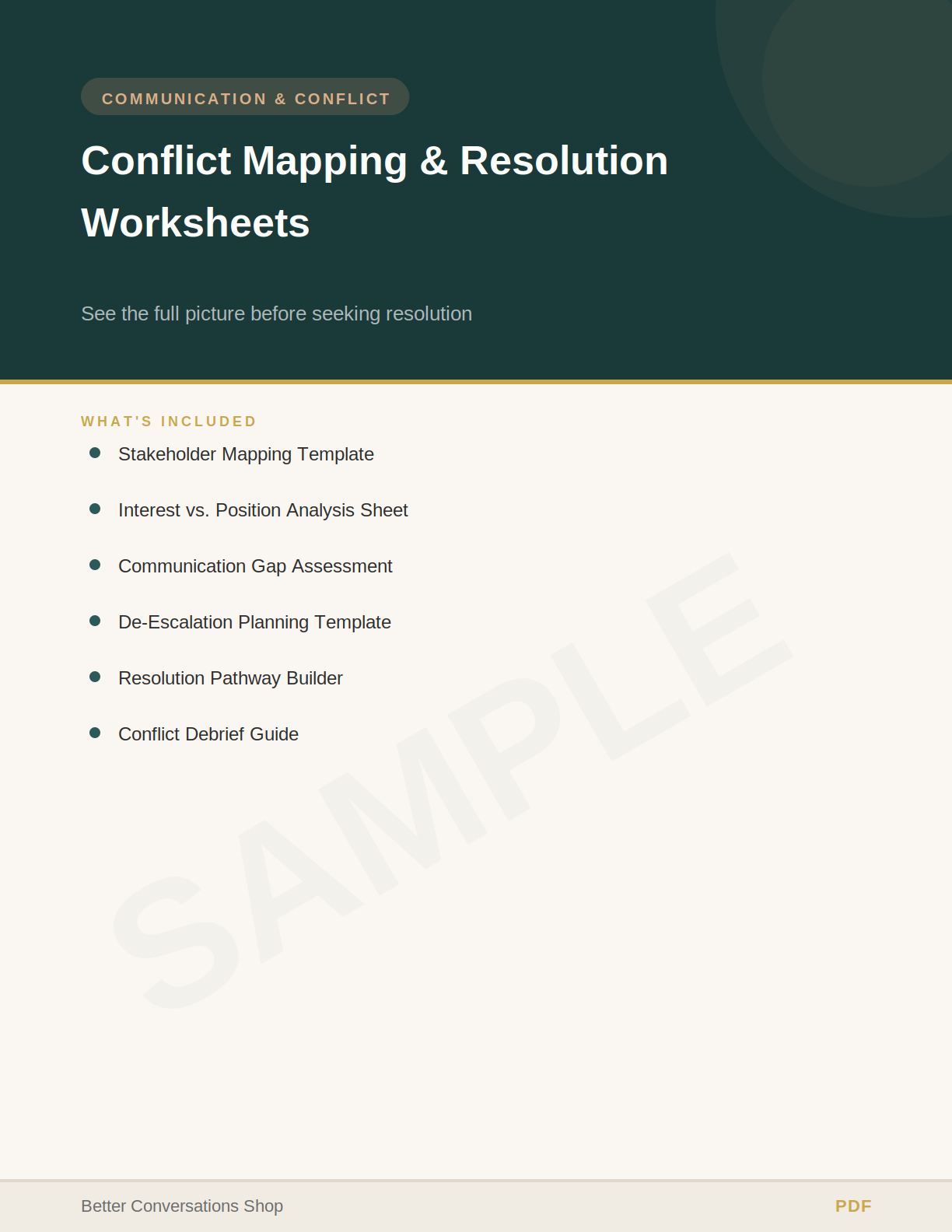
For complex disputes that stay on the interpersonal side of the line, structured tools help you map the situation before you intervene. The Method Lab’s Conflict Mapping & Resolution Worksheets let you separate positions from underlying interests and plan a de-escalation pathway on paper before the conversation happens.
Frequently Asked Questions
How does unresolved conflict impact small business productivity?
Unresolved conflict drains productivity because employees spend time replaying arguments, avoiding colleagues, or managing stress instead of working. In small teams, a single strained relationship can slow every project that touches it. Managers often see missed deadlines, longer handoffs, and more sick days before they see the actual disagreement. Addressing team conflict resolution early stops that drain and keeps output steady.
What are the most common causes of workplace conflict in small teams?
Personality differences, competing priorities, unclear roles, and scarce resources cause most small-team disputes. In businesses with fewer than 50 people, there is often no HR buffer, so interpersonal friction reaches the owner directly. A structured conflict resolution strategy for managers starts by naming the cause out loud, then separating the position each person holds from the interest underneath it.
How can leaders identify early signs of team friction?
Watch for shorter replies in group chats, people copying managers on messages they used to send directly, and meetings where the same two people never agree. Missed one-on-ones and sudden schedule changes are also signals. When you spot two or more of these, treat it as a prompt to use a difficult conversations framework before the issue hardens into a formal complaint.
What is the role of emotional intelligence in conflict resolution?
Emotional intelligence helps a manager read the temperature of a room before speaking. It means noticing that someone is defensive, pausing, and choosing a question instead of a judgment. In practice, that looks like asking what someone needs rather than telling them what they did wrong. Managers who build this skill see faster de-escalation and stronger team cohesion after disputes.