

Last Updated: October 22, 2026
Quick Summary
To master 1:1 meetings for leadership impact, build trust and psychological safety first, then let the employee own a shared agenda that covers priorities, blockers, feedback, and development. Protect the meeting, review cadence quarterly, and track follow-up completion, agenda ownership, and blocker latency instead of attendance.
- Weekly 30-minute check-ins suit most direct reports, especially new hires and fast-changing roles.
- The employee fills in the shared agenda document first, and the manager adds items second.
- Deliver corrective feedback within 48 hours rather than waiting for the next scheduled meeting.
- Never cancel a 1:1 to attend another meeting; reschedule it instead.
- Review cadence with each direct report once a quarter by asking if the frequency still works.
Table of Contents
- Why 1:1 Meetings Are the Highest-Use Habit a Leader Has
- Build Trust and Psychological Safety Before You Build Structure
- How Often to Have One-on-One Meetings: Cadence by Context
- The 1:1 Meeting Agenda for Managers That Employees Actually Own
- One-on-One Meeting Questions for Managers That Go Beyond Status Updates
- How to Give Feedback in a One-on-One Meeting Without Triggering Defensiveness
- Handle Difficult Conversations and Measure Whether Your 1:1 Meetings Work
- Frequently Asked Questions
Why 1:1 Meetings Are the Highest-Use Habit a Leader Has
Most managers treat one-on-one meetings as a calendar obligation. The best leaders treat them as the single highest-use hour on their schedule. That gap explains why so many teams feel managed but not developed.
A 1:1 meeting is a recurring, private conversation between a manager and one direct report, focused on that person’s priorities, growth, and obstacles rather than task reporting. The purpose is simple: build a relationship strong enough to carry honest feedback. Teams with consistent, well-run 1:1s move faster because problems surface early.
The payoff shows up in retention, engagement, and how quickly people grow into bigger roles.
If you only protect one meeting on your calendar each week, protect the 1:1. It is where trust, feedback, and career development actually happen.
Build Trust and Psychological Safety Before You Build Structure
Trust comes first. A rigid agenda dropped onto a wary employee reads as surveillance, not support.
Psychological safety is the belief that you can speak up without punishment (What Is Psychological Safety, Really?). Leaders earn it through small, repeatable moves:
- Start with a personal check-in, not a task list
- Ask open-ended questions and then stay quiet
- React to bad news with curiosity, not blame
- Follow through on what you promised last time
Active listening matters more than any template. When someone raises a problem, resist solving it in the first ten seconds. Ask what they have already tried.
A common mistake is treating vulnerability as weakness. In practice, a manager who says “I got that wrong” gives the whole team permission to be honest.
How Often to Have One-on-One Meetings: Cadence by Context
The right cadence depends on the person and the moment, not on a company-wide policy. Weekly 30-minute check-ins suit most direct reports, especially new hires and anyone in a fast-changing role. But cadence is a lever, not a rule, and most leaders never revisit it.
Start with this baseline, then adjust deliberately:
| Situation | Cadence | Length | Why |
|---|---|---|---|
| New hire (first 90 days) | Weekly | 30-45 min | Context is thin; small misunderstandings compound fast |
| New manager | Weekly | 30-45 min | They need a safe place to think out loud about people problems |
| Steady performer, stable role | Biweekly | 30 min | Weekly can drift into status updates; biweekly forces prioritization |
| Struggling or under pressure | Weekly | 45 min | More contact, more follow-up, more early warning |
| Senior leader or remote report | Weekly | 25-30 min | Distance hides context; short and frequent beats long and rare |
| Returning from leave or a setback | Weekly | 30 min | Rebuilding trust and re-establishing priorities |
The trade-offs behind each cadence
Weekly gives you the fastest feedback loop and the strongest early-warning system. The cost is calendar load and the risk of ritualization, a weekly meeting with no agenda becomes a status report.
Biweekly forces both parties to prioritize. It suits stable roles where the work changes slowly, and it frees calendar space for deeper project work. The cost is latency: a blocker raised on a biweekly cadence can sit for 13 days before it gets airtime.
Monthly or ad hoc is rarely enough for a direct reporting relationship. It tends to survive only where a strong weekly team rhythm already exists and the 1:1 is genuinely developmental rather than operational.
When to change cadence
Change cadence when the context changes, and say so out loud. A new hire who has hit their stride can move from weekly to biweekly; a steady performer who takes on a stretch project should move the other way. Announce the reason: “You’re settled in, so let’s try biweekly and see if anything slips.” That framing turns a schedule change into a signal of trust rather than a withdrawal of attention.
Two rules of thumb:
- Never cancel a 1:1 to attend another meeting. Reschedule it. Cancelling teaches the employee where they rank on your list.
- Never stretch cadence as a punishment. Moving someone from weekly to biweekly because they are struggling reads as abandonment and removes your best early-warning signal.
Remote and hybrid teams benefit from more frequent, shorter 1:1 meetings. Distance hides context, so you need more contact, not less, and a 25-minute video call is easier to protect than a 45-minute one.
Review cadence with each direct report once a quarter. Ask a single question: “Is this frequency still working for you?” The answer changes more often than most managers expect.
The 1:1 Meeting Agenda for Managers That Employees Actually Own
A strong 1:1 meeting agenda for managers is a shared document the employee fills in first. The manager adds items second. That order signals whose meeting it is.
A workable structure:
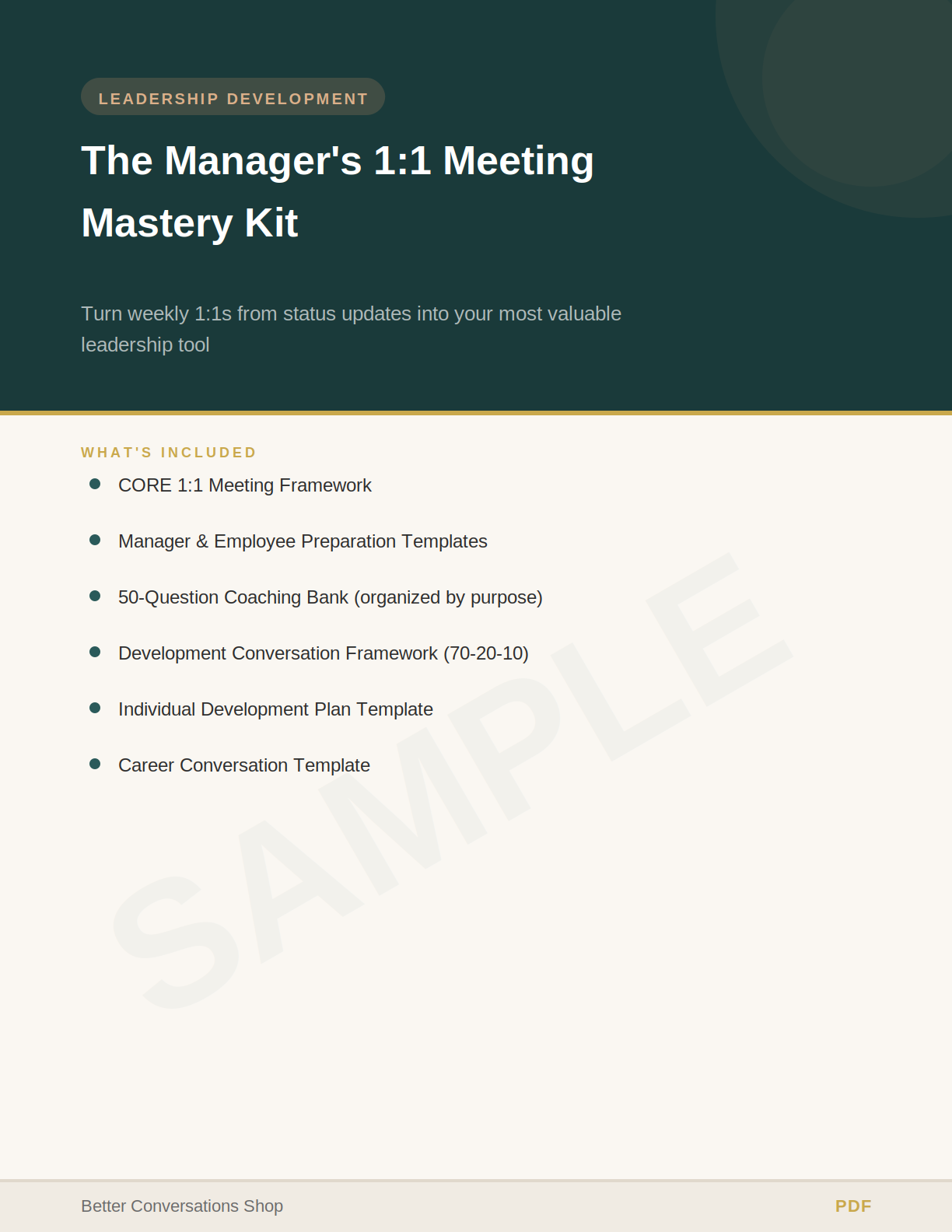
The Manager’s 1:1 Meeting Mastery Kit →
- Check-in (5 min): How is the person, not the project?
- Employee items (15 min): Their priorities, blockers, and questions
- Manager items (10 min): Feedback, alignment, decisions
- Development (5 min): One growth topic per meeting
- Action items (5 min): Who does what, by when
Keep notes in the same doc every time. Review last week’s action items before you start. Accountability lives in that follow-up, not in the conversation itself.
Skipping the follow-up is the fastest way to kill a 1:1 practice. Employees stop preparing when nothing they raise ever comes back.
One-on-One Meeting Questions for Managers That Go Beyond Status Updates

Good one-on-one meeting questions for managers pull out thinking, not task status. Status updates belong in a written standup.
Try questions like:
- What is taking more energy than it should right now?
- Where do you feel stuck, and what would help?
- What do you want to be known for in a year?
- What feedback would make your work easier to do?
- Is there anything I am doing that gets in your way?
Open-ended questions do the heavy lifting. They give the employee voice and surface the challenges a status report never shows.
What separates a routine 1:1 from one that changes a career? The willingness to ask about goals, expectations, and well-being, not just deliverables.
How to Give Feedback in a One-on-One Meeting Without Triggering Defensiveness
Feedback lands when it is specific, timely, and tied to a behavior rather than a personality. Learn how to give feedback in a one-on-one meeting and you remove most of the friction.
Use a simple three-step frame:
- Observation: “In Tuesday’s review, the client asked three times about the timeline.”
- Impact: “They left unsure we could deliver.”
- Change: “Next time, can you bring a dated plan to that meeting?”
Ask for their read before you finish. “How did that land?” turns a monologue into a conversation.
Constructive feedback should outnumber corrective feedback. Recognition that names the specific behavior builds the trust you need when a harder message arrives.
Deliver corrective feedback within 48 hours. Waiting for the next scheduled 1:1 lets the moment go stale and the memory blur.
Handle Difficult Conversations and Measure Whether Your 1:1 Meetings Work
Sensitive topics, from performance concerns to burnout, need structure. So does the question every leader eventually asks: are these meetings actually doing anything? Treat them as two separate disciplines.
Handling difficult conversations in a 1:1
Name the issue plainly, share what you observed, and make space for their side. Avoid softening so much that the message disappears. A workable sequence:
- Signal the topic early. “I want to spend ten minutes on something specific.” Surprises in a 1:1 erode the safety the rest of the meeting depends on.
- State the observation, not the label. “The last three handoffs arrived after the deadline” beats “you’re unreliable.”
- Pause and ask for their read. “What’s your view of what’s happening?” The answer often changes the conversation.
- Agree on one concrete change and a check-in date. Vague commitments evaporate.
For underperformance, separate the person from the pattern and be explicit about consequences without threatening. For burnout, lead with workload and sustainability before performance. For conflict between team members, hear each side in separate 1:1s before any joint conversation, and never adjudicate in the room.
Do not use a scheduled 1:1 as the first venue for a serious performance warning. The employee deserves a dedicated conversation, not a slot between agenda items. Use the 1:1 to follow up, not to ambush.
Measuring whether your 1:1 meetings work
Most leaders measure attendance or meeting count. Neither tells you whether the meeting is producing leadership impact. Track a small set of behavioral indicators instead:
- Follow-up completion. What share of action items from the last meeting closed before the next one? A low rate means the meeting is generating talk, not work.
- Agenda ownership. Do employees bring their own items, or does the manager fill the doc every week? Ownership is the clearest sign the meeting belongs to them.
- Blocker latency. How long does a raised blocker take to get resolved or escalated? Shrinking latency is the strongest evidence the 1:1 is doing real work.
- Priority clarity. Ask directly, once a quarter: “Can you state your top three priorities and how they connect to the team’s goals?” Fuzzy answers are a leading indicator of misalignment.
- Engagement signal. Do employees raise problems before they become crises, and do they mention growth and development unprompted?
Avoid simplistic targets such as “100% of 1:1s held” or “five action items per meeting.” They reward activity over outcomes and push managers toward performative meetings. A better pattern is to review the indicators quarterly alongside the employee, not about them.
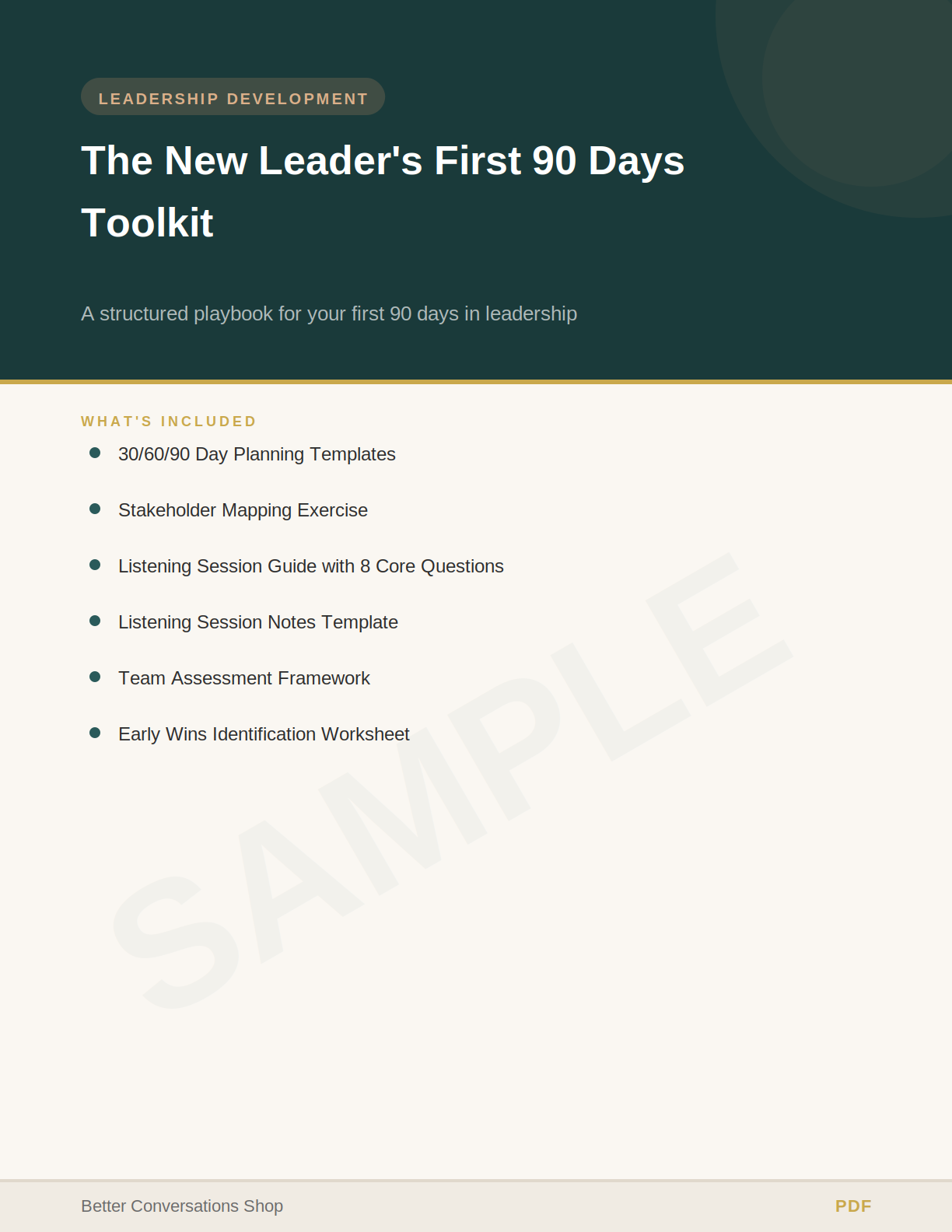
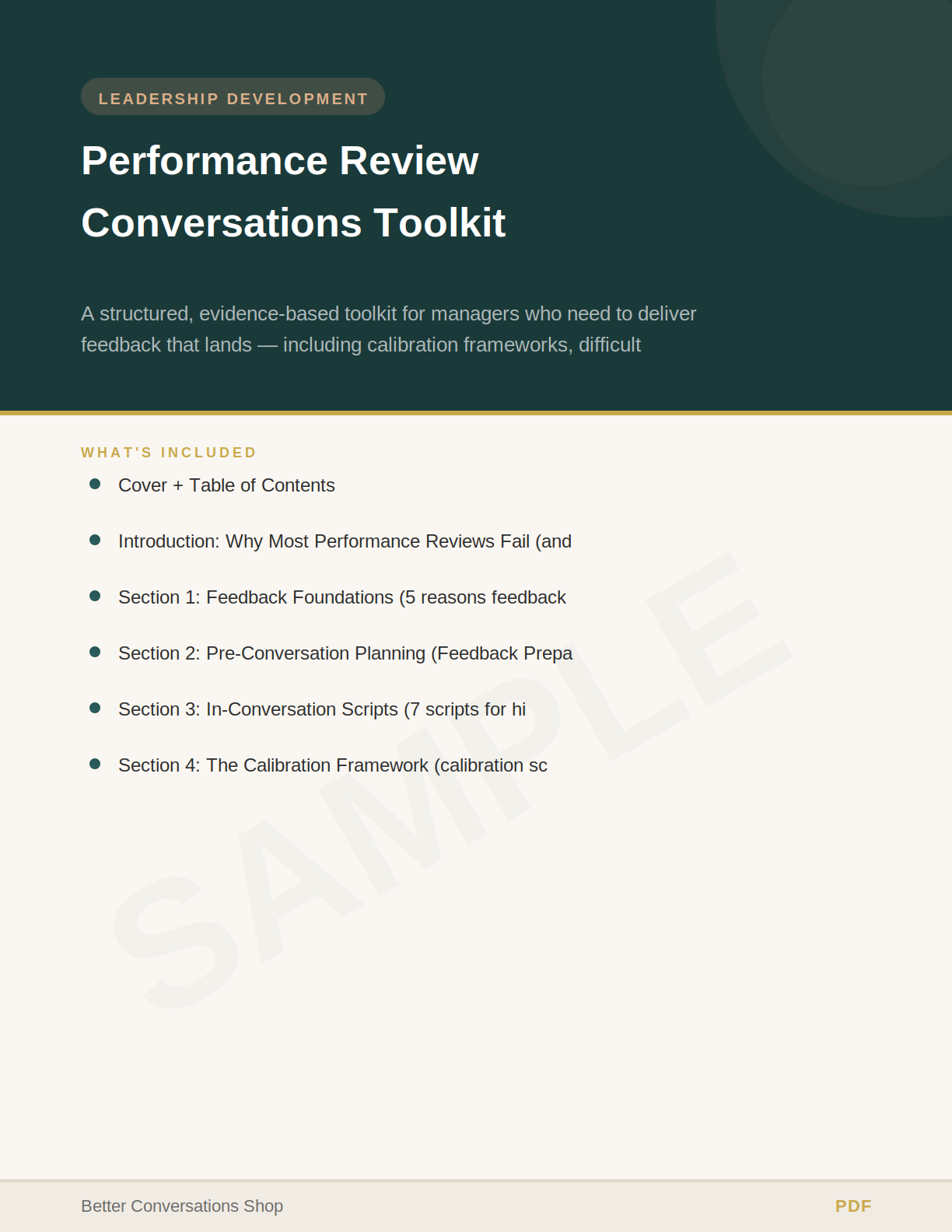
A complete meeting toolkit helps here. The Method Lab’s Manager’s 1:1 Meeting Mastery Kit gives you a proven CORE framework, a 50-question coaching bank, and accountability tracking tools. For harder moments, the Performance Review Conversations Toolkit provides scripts for high-stakes feedback. New leaders can pair both with the First 90 Days Toolkit to build the habit from day one.
Frequently Asked Questions
Should the employee or the manager set the 1:1 meeting agenda?
The employee should own most of it. Send the agenda 24 hours ahead with space for them to add items first, then add your own priorities underneath. When the manager fills the whole agenda, 1:1 meetings collapse into status updates and the employee stops preparing. A workable split is roughly 60% employee topics, 30% development and feedback, and 10% your items. The manager’s job is to hold the structure, not to fill the time.
How long should a 1:1 meeting last?
Thirty minutes works for a weekly check-in with a direct report who is on track. Forty-five to sixty minutes suits monthly development conversations, new hires in their first 90 days, or anyone navigating a difficult project. The length matters less than the consistency. A protected 30 minutes every week beats a 90-minute session that gets rescheduled twice a month. If a meeting routinely runs long, the agenda is probably carrying too many status items that belong in writing.
How often should managers have one-on-one meetings with employees?
Weekly is the default for direct reports, and it is the cadence most teams settle on because it catches problems before they compound. Biweekly can work for stable, experienced team members with high autonomy. Switch to weekly, or temporarily twice weekly, for new hires, anyone on a performance improvement plan, or a team member going through a reorganization. Whatever cadence you choose, put it on the calendar as a recurring event and treat cancellations as the exception.
How do you make 1:1 meetings more productive?
Three changes do most of the work. First, move status updates out of the meeting into a shared document so the live time goes to priorities, blockers, and development. Second, keep a running notes doc with action items and review it at the start of the next meeting, which turns follow-up into accountability rather than a reminder. Third, end every meeting with one clear commitment from each side. Managers who track commitments consistently report that employees bring bigger issues to the conversation instead of waiting for a review cycle.

