Table of Contents
- Why Scaling Coaching Programs Requires a Different Approach
- Transitioning from 1-on-1 to Group Coaching Models
- Building a Group Coaching Program Structure That Works
- Hiring and Training Coaching Staff as You Grow
- Implementing Coaching Business Automation Tools
- Setting Coaching Program Pricing Strategies That Scale
- Maintaining Quality and Measuring Impact at Scale
- Conclusion
Last Updated: August 5, 2026
Why Scaling Coaching Programs Requires a Different Approach
Scaling coaching programs for small teams isn’t simply doing more of what already works. The fundamental challenge is that individual coaching economics don’t scale: your time remains finite, revenue per hour plateaus, and impact reaches only those you personally meet with.
Scaling becomes strategic when you shift from selling time to selling outcomes, build systems that don’t depend entirely on your delivery, and measure results achieved rather than hours billed. Teams that make these shifts grow sustainably; those that skip them plateau or burn out.
What makes this different from scaling other service businesses is that you can’t automate coaching conversations or replace human connection. What you can do is architect your program so connection happens at scale through group models, peer learning, digital resources, and strategic delegation.
Transitioning from 1-on-1 to Group Coaching Models
The shift from individual to group coaching is a fundamental redesign of how coaching creates value. Group coaching works because it introduces peer learning, accountability, and diverse perspectives that individual sessions often lack.
A typical group coaching program includes 4-8 participants meeting regularly with a trained facilitator who guides conversation and ensures focus on outcomes. The real work happens between participants: they observe how others navigate similar challenges, offer perspective, and hold each other accountable.
The economics shift immediately. Where individual coaching might generate $150-300 per hour per client, a group of six people paying $200 monthly each generates $1,200 in monthly revenue from one facilitator’s time investment. Scale that to two or three concurrent groups, and you’ve fundamentally changed your business model.
The common mistake is treating group coaching like individual sessions scaled up. You can’t facilitate a group the same way you coach one person. Pacing, questions, and the role of silence all differ. A coach who tries to give everyone equal one-on-one attention creates a frustrating experience where people feel they’re waiting for their turn.
The fix requires rethinking facilitation. You’re orchestrating a conversation where participants learn from each other, not delivering wisdom to passive recipients. This requires explicit discussion guides, clear participation norms, and structured time for peer feedback.
Building a Group Coaching Program Structure That Works
A group coaching program requires clear architecture: enrollment criteria, session format, content framework, and success metrics.
Start with enrollment. The tightest groups have participants facing similar challenges or at similar career stages. A group of mid-level managers navigating their first leadership role creates natural alignment. Define your target participant profile before launch.
Session format matters enormously. Most effective group coaching follows a consistent structure: opening framing (5-10 minutes), individual reflections or case presentations (15-20 minutes), peer discussion and feedback (20-30 minutes), facilitator synthesis and next steps (5-10 minutes). This ensures everyone participates and the group stays focused on outcomes.
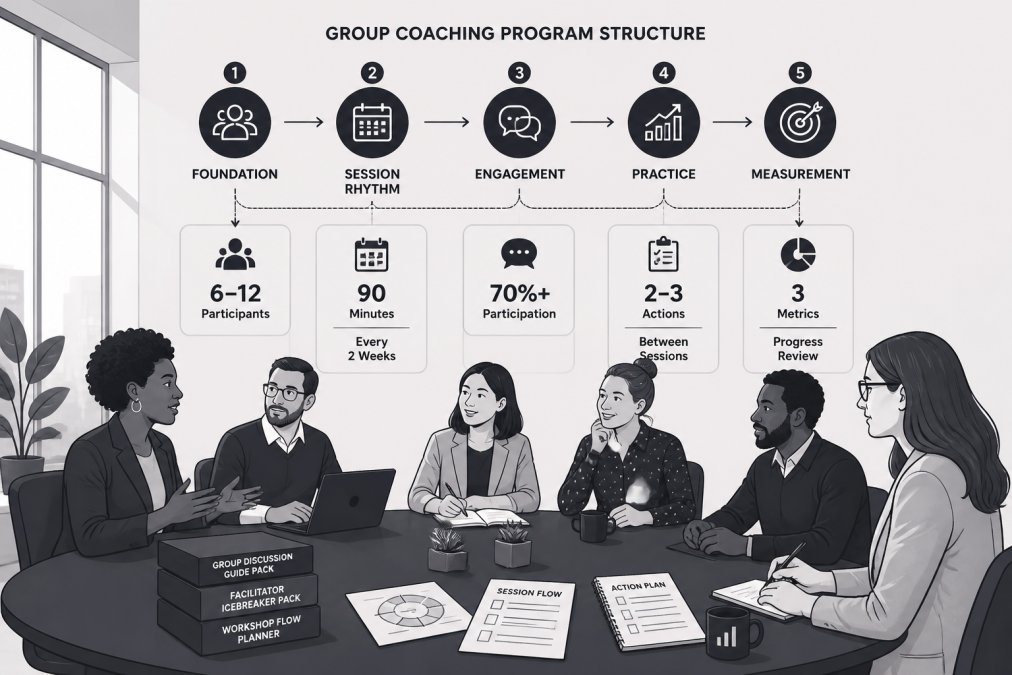
Content framework prevents sessions from becoming purely reactive. Effective programs have a curriculum: a sequence of topics or skills that participants move through over the program duration. This might be a 12-week leadership development curriculum or a 6-month executive presence program. The curriculum provides structure while allowing flexibility for real issues that arise.
Documentation of your coaching methodology becomes critical. What are your core principles? What questions do you ask? What does progress look like? Written methodology keeps facilitation consistent across multiple groups, becomes training material for future coaches, and demonstrates value to prospects.
Hiring and Training Coaching Staff as You Grow
Once you move from running one group to running three or four, you’ve hit the limit of solo delivery. Hiring becomes necessary, but hiring without proper training derails your program faster than staying small.
The first hire is usually a coordinator or assistant who handles scheduling, email, and participant communication. This buys you 5-10 hours per week. The second hire is typically another coach or facilitator, where training becomes critical.
A great one-on-one coach doesn’t automatically become a great group facilitator. The skills differ. Someone excellent at deep individual work might struggle with group pacing or avoid conflict rather than facilitating through it.

Structured onboarding is non-negotiable: shadowing your groups, co-facilitating with feedback, facilitating solo while you observe, and regular debrief conversations. The timeline is typically 8-12 weeks before a new facilitator runs a group independently.
What to look for: coaching certification is helpful but not sufficient. Intellectual curiosity, comfort with ambiguity, and ability to listen deeply matter more. Technical knowledge can be trained; the capacity to be present with someone’s struggle is harder to teach.
Compensation structures shift as you scale. Early on, you might pay facilitators per group. As you scale, moving to salary for core team members creates stability and incentivizes focus on program quality rather than volume.
Implementing Coaching Business Automation Tools
Scaling without automation leads to burnout. You’re managing rosters, scheduling, tracking progress, sending reminders, and collecting feedback manually. Automation eliminates busywork so you can focus on facilitation.
Start with scheduling automation. Tools that sync your calendar, send meeting links automatically, and handle rescheduling save hours per month. If you run four groups of six people, that’s 24 individual communication touchpoints per week. Automation cuts that to near-zero manual work.
Next, implement participant tracking. A simple spreadsheet works initially, but as you scale, dedicated tools become essential. Track attendance, key insights, individual progress toward goals, and completion status. This data helps you tailor facilitation, provides evidence of impact for marketing, and flags participants needing additional support.
Feedback collection should be automated. Post-session surveys take 90 seconds to complete but require manual sending, collection, and compilation. Automated surveys send immediately after each session, compile results automatically, and flag patterns. You see within days whether participants found the session valuable.
The key is choosing tools that integrate. A calendar tool that doesn’t talk to your email system creates duplicate work. Look for platforms that share data across functions or use tools with strong integration ecosystems.
Setting Coaching Program Pricing Strategies That Scale
Pricing is where many coaches leave money on the table when scaling. They carry forward hourly rates from individual coaching into group programs, which underprices the value delivered.
Group coaching creates value through structured curriculum, peer learning, accountability, and documented progress. These aren’t worth less than individual coaching; they’re often worth more because they produce outcomes faster.
A clearer model: charge per outcome, not per hour. If your group coaching program reliably produces a specific result, price based on that outcome. A 12-week executive presence program for six participants might charge $3,000 per participant ($18,000 total revenue). That’s $150-250 per participant per week, accessible to more people while generating substantial revenue from your time investment.
Membership or subscription models work well for ongoing peer coaching circles. Rather than charging per program, participants pay monthly ($200-400) for ongoing access. This creates predictable recurring revenue, stronger accountability, and deeper relationships.
Hybrid models combine group coaching with optional individual sessions. Participants attend group sessions included in their membership, with optional one-on-one coaching available at an additional fee. This captures participants wanting both experiences without increasing your core time commitment.
Maintaining Quality and Measuring Impact at Scale
The most common casualty of scaling is quality. You add more groups and facilitators, and the experience that built your reputation starts feeling diluted.
Quality control starts with clear standards. What does a well-facilitated session look like? What are the non-negotiables? Write these down. Use them to train facilitators. Audit against them regularly.
Facilitator observation and feedback is essential. Sit in on sessions regularly. Debrief with facilitators afterward. This ensures quality consistency, provides coaching to your facilitators, and keeps you connected to the actual participant experience.
Measuring impact is where most coaching programs fail. You collect feedback about how people felt, but don’t measure whether coaching changed behavior or produced results.
Define what success looks like for your program. For leadership development, success might be: participants report increased confidence in difficult conversations, their teams report better communication, and managers see measurable performance improvement. Measure these outcomes.
Track three types of data: participant perception (did they find it valuable?), behavioral change (did they apply what they learned?), and business impact (did it affect performance, advancement, or team results?). Most coaches stop at perception. Successful scaling teams measure all three.
|
Measurement Type |
What to Track |
Timing |
Why It Matters |
|---|---|---|---|
|
Perception |
Session satisfaction, relevance, facilitator quality |
After each session |
Ensures engagement and experience quality |
|
Behavioral Change |
Application of skills, practice of new approaches |
30-60 days post-program |
Confirms learning transferred to real work |
|
Business Impact |
Performance metrics, promotion, team results |
90+ days post-program |
Demonstrates ROI and justifies investment |
This data becomes your strongest marketing tool. When you can say “80% of participants reported increased confidence, 65% applied new skills within 30 days, and their managers saw measurable improvement,” you’ve moved from claiming value to proving it.
Scaling coaching programs for small teams succeeds when you shift from selling time to selling outcomes, build systems that don’t depend entirely on your delivery, and measure what actually matters. Start with clear program architecture, train facilitators properly, and measure real outcomes. That foundation makes everything else possible.
Frequently Asked Questions
How do you transition from 1-on-1 coaching to group coaching models?
Start by identifying which aspects of your 1-on-1 coaching methodology translate to group settings. Segment your client base by similar challenges or goals, then pilot a small group session with 4-6 clients. Use your existing coaching framework but adapt facilitation techniques for group dynamics. Focus on peer-to-peer learning opportunities that don't exist in 1-on-1 work. Document what works and refine before scaling to larger groups. This approach preserves your coaching impact while building scalability into your program delivery.
What are the best tools for managing a small coaching team?
Effective tools should address scheduling, client communication, progress tracking, and team collaboration. For automation, look for platforms that integrate calendar management with client check-ins to reduce administrative overhead. The Method Lab's Coaching Outcomes & Impact Measurement Kit helps teams standardize how they track client progress and demonstrate ROI. When selecting tools, prioritize those that reduce manual data entry and enable your team to focus on facilitation and client relationships rather than administrative tasks.
How do you maintain quality control when scaling coaching programs?
Document your coaching methodology thoroughly before scaling. Create standard operating procedures for session facilitation, client onboarding, and progress measurement. Implement peer review processes where coaches observe and provide feedback on each other's sessions. Use consistent frameworks across your team—The Method Lab's resources help establish this consistency. Regular check-ins on learning outcomes and client satisfaction metrics reveal quality gaps early. Train new coaches on your specific approach before they lead sessions independently, and maintain ongoing professional development to keep standards high.
How much does it cost to implement coaching software for small teams?
Costs vary widely based on features and team size. Basic scheduling and CRM tools start at $50-150 per month for small teams. More comprehensive platforms with automation, reporting, and client portals range from $200-500+ monthly. However, the ROI comes from time savings—most small teams recover software costs within 2-3 months through reduced administrative work. Consider tools that integrate multiple functions rather than buying separate solutions. The Method Lab's automation-focused resources complement software by helping you build efficient workflows that maximize what your tools can do.