Table of Contents
- Quick Comparison: Tools for Difficult Team Dynamics
- How We Evaluated These Team Dynamics Tools
- 1. Team Dynamics Assessment & Reset Pack: Start With a Team Dynamics Assessment
- 2. Conflict Mapping & Resolution Worksheets: Team Conflict Resolution Strategies on Paper
- 3. The Difficult Conversations Toolkit: How to Lead Difficult Conversations Without Derailing
- 4. The Manager’s 1:1 Meeting Mastery Kit: Rebuilding Trust One Conversation at a Time
- 5. Remote Facilitation Playbook: Handling Difficult Team Dynamics Across Distributed Teams
- 6. Group Discussion Guide Pack and Workshop Flow Planner: Team Communication Exercises That Stick
- Frequently Asked Questions
Last Updated: October 20, 2026
Quick Comparison: Tools for Difficult Team Dynamics
Managing difficult team dynamics is the work of naming what is actually happening, then giving people a structured way to talk about it. At The Method Lab, we build client-ready PDFs for exactly that job. Below is our comparison of eight tools, matched to the problems they solve best.
| Tool | Price | Best For | Format |
|---|---|---|---|
| Team Dynamics Assessment & Reset Pack | $26.99 | Diagnosing team health across 8 dimensions | PDF pack |
| Conflict Mapping & Resolution Worksheets | $25.99 | Untangling disputes before intervening | PDF worksheets |
| The Difficult Conversations Toolkit | $28.99 | High-stakes one-on-one talks | PDF toolkit |
| The Manager’s 1:1 Meeting Mastery Kit | $23.99 | Rebuilding trust through regular 1:1s | PDF kit |
| Remote Facilitation Playbook | $23.99 | Distributed and hybrid teams | PDF playbook |
| Group Discussion Guide Pack | $16.99 | Structured team communication exercises | 20 PDF guides |
| Workshop Flow Planner | $20.99 | Designing sessions that hold attention | PDF planner |
| Performance Review Conversations Toolkit | $28.99 | Feedback and formal review cycles | PDF toolkit with scripts |
How We Evaluated These Team Dynamics Tools
Most roundups of team dynamics tools rank products by feature count or price. That tells you nothing about whether a resource will survive a real conflict. We scored every tool against five criteria that map to the failure points managers actually report: diagnosis, preparation, delivery, follow-through, and escalation readiness.
1. Diagnostic power. Does the tool help you name the problem before you intervene? The Team Dynamics Assessment & Reset Pack and the Conflict Mapping & Resolution Worksheets scored highest because both force a mapping step before any conversation.
2. Preparation depth. Does the tool give you something to do before the meeting, not just during it? We looked for pre-conversation planners, stakeholder maps, and question banks. The Difficult Conversations Toolkit and the Manager’s 1:1 Meeting Mastery Kit both front-load preparation, which is where most managers report the most anxiety.
3. In-room usability. Can a manager without facilitation certification run the tool under pressure? We tested for clear instructions, recovery scripts for when a conversation turns defensive, and contingency guidance for sessions that run long. The Workshop Flow Planner’s contingency sections and the Difficult Conversations Toolkit’s mid-conversation reset guide were the strongest examples.
4. Follow-through and measurement. Does the tool leave you with a way to track whether anything changed? We looked for action plans, accountability logs, and reassessment prompts.
5. Escalation boundaries. Does the tool tell you when it is not enough? A worksheet cannot resolve harassment, a formal grievance, or a dispute that requires mediation. Resources that named their own limits scored higher than those that implied they could handle anything.
We also applied three disqualifiers. A tool was excluded if it required a certified facilitator to run, if it produced only theory with no usable output, or if it overpromised by claiming to fix trust and conflict with the same template.
Use these five criteria as your own buying checklist. If a product page cannot tell you how the tool handles diagnosis, preparation, in-room recovery, follow-through, and escalation, assume it handles none of them well.
1. Team Dynamics Assessment & Reset Pack: Start With a Team Dynamics Assessment
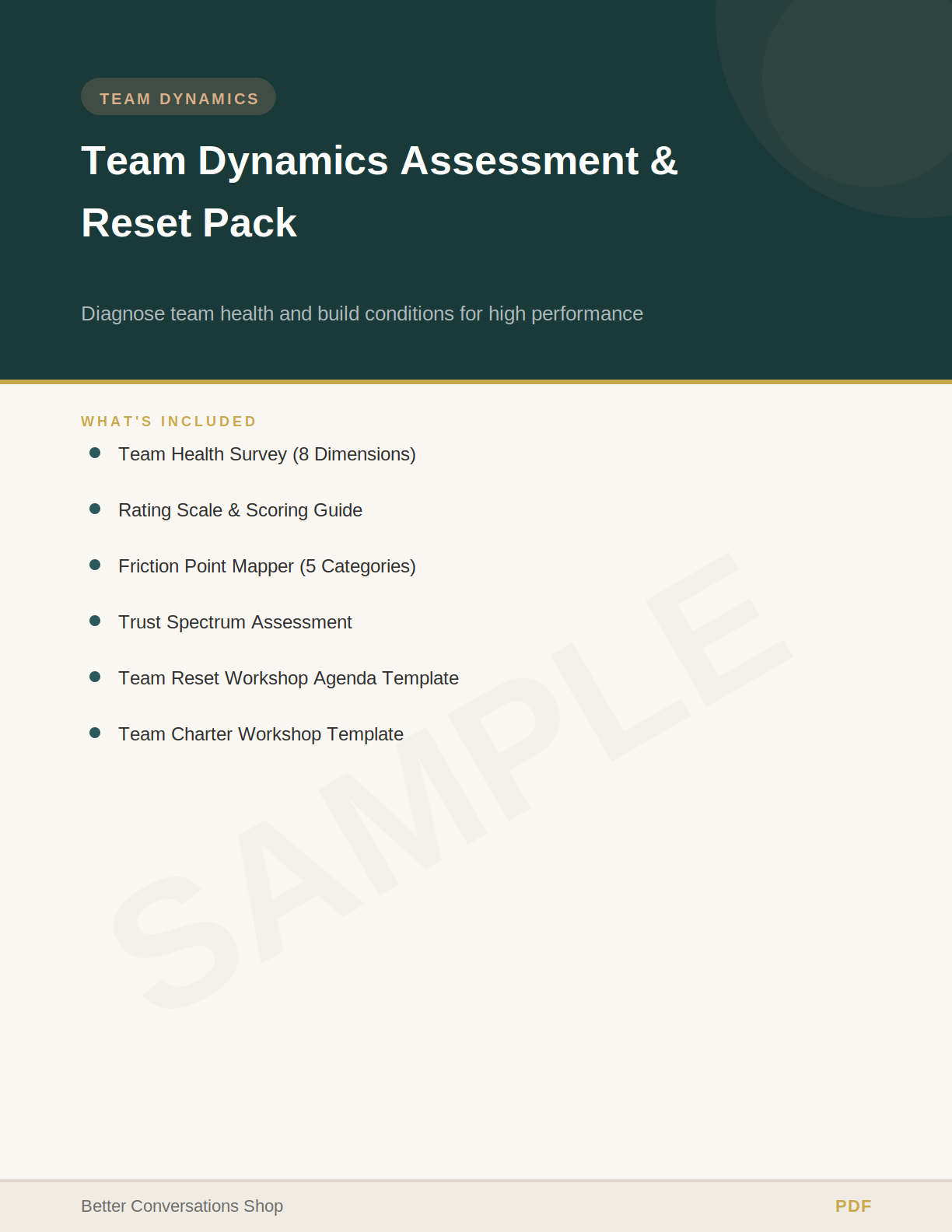
Start here if you cannot yet name the problem. This pack runs a team dynamics assessment across eight dimensions, maps friction points, and gives you a reset workshop structure plus a 90-day action plan.
The sequencing is the real value. Most leaders jump straight to a fix, which is why so many interventions fade within a quarter. Assessment first, agreement second, tracking third.
Pros and Cons
Pros: Validated survey tools, a clear workshop path, and a 90-day tracking plan that keeps momentum after the offsite ends.
Cons: It assumes you can get the whole team in one room or call. It is diagnostic, not a script for a single hard conversation.
2. Conflict Mapping & Resolution Worksheets: Team Conflict Resolution Strategies on Paper
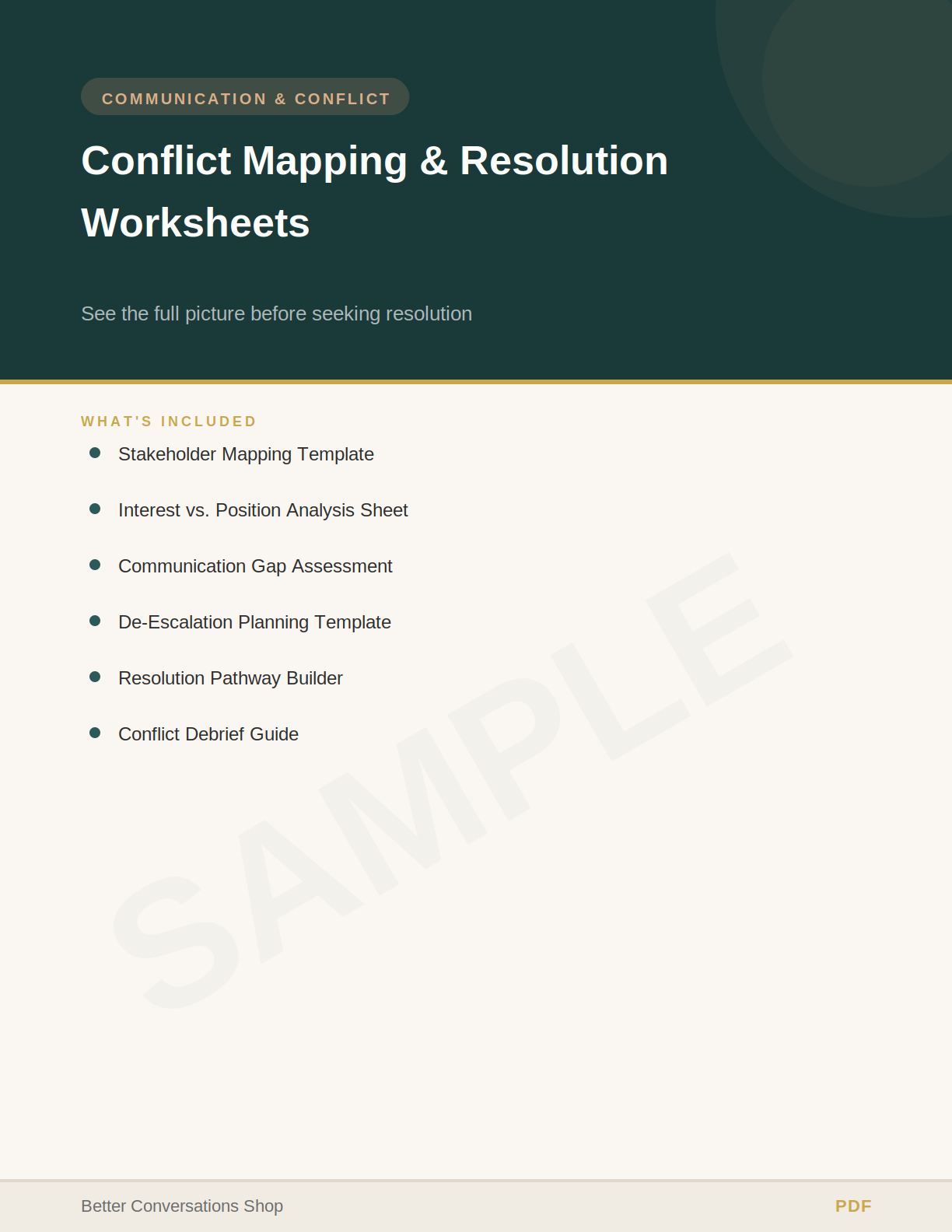
Team conflict resolution strategies fail when people argue about solutions before anyone agrees on the problem. These worksheets force the map first: stakeholder mapping, interest-position analysis, and a resolution pathway builder.
The distinction between positions and interests is the most useful idea in the pack. Two colleagues both want the project led by their function. That is a position. The interests underneath, recognition and workload control, are where a workable agreement lives.
Pros and Cons
Pros: Grounded in mediation practice, works for two-person disputes and group tensions, and gives HR a shared document to review.
Cons: It is preparation, not delivery. You still need the conversation skills to use the map well.
3. The Difficult Conversations Toolkit: How to Lead Difficult Conversations Without Derailing
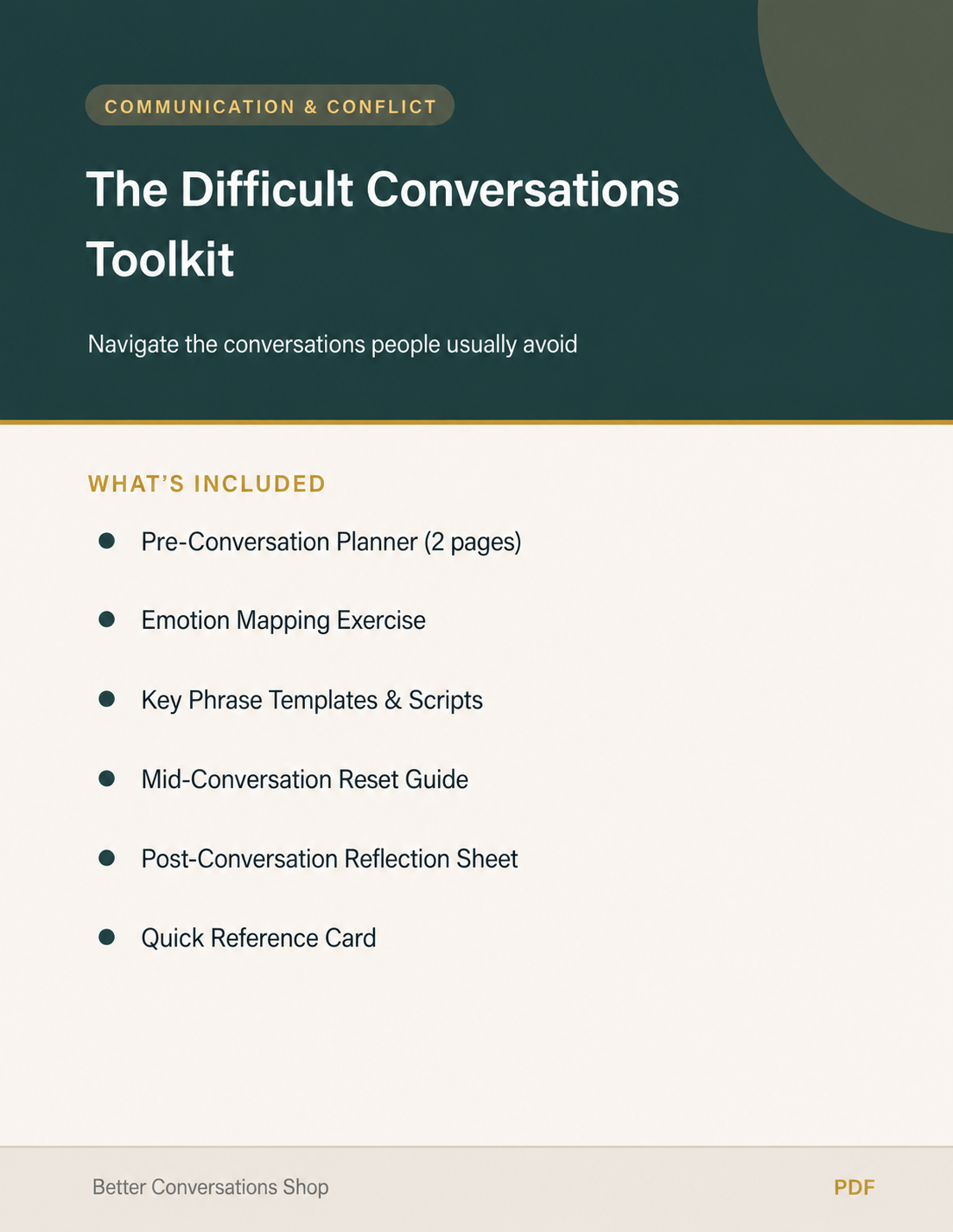
Knowing how to lead difficult conversations is a skill most managers learn by failing publicly. This toolkit front-loads the preparation: a pre-conversation planner, emotion mapping, key phrase templates, and a mid-conversation reset guide for when it goes sideways.
The reset guide earns its place. Anyone can open a hard conversation well. Fewer people can recover one that has turned defensive, and that recovery is where trust is either built or broken.
Pros and Cons
Pros: Reduces pre-conversation anxiety, provides language for the worst moments, and includes a post-conversation reflection sheet.
Cons: Templates can feel stiff at first. Expect to adapt the phrase library to your own voice before it sounds natural.
Team Dynamics Assessment & Reset Pack →
Do not read the phrase templates aloud verbatim. Scripted language in an emotional conversation reads as insincere and can escalate defensiveness. Use the structure, then say it in your own words.
4. The Manager’s 1:1 Meeting Mastery Kit: Rebuilding Trust One Conversation at a Time
Trust rarely breaks in one dramatic moment. It erodes through a hundred status-update 1:1s where nobody asked a real question. This kit rebuilds the habit with a CORE framework, a 50-question coaching bank, and accountability tracking.
For a new leader in the first 90 days, this is the highest-return item on the list. Weekly employee-led 1:1s surface friction before it becomes conflict, which means you spend less time mediating later.
Pros and Cons
Pros: Immediately usable question bank, development conversation guides, and tracking tools that make follow-through visible.
Cons: It depends on consistency. Skipping weeks undermines the whole point, and the kit cannot enforce your calendar.
5. Remote Facilitation Playbook: Handling Difficult Team Dynamics Across Distributed Teams
Hybrid teams lose the signals that make in-person facilitation work: body language, side conversations, the informal debrief afterward. This playbook replaces them with session architecture, a virtual check-in system, and five complete workshop templates.
The async section is the part competitors miss. Distributed conflict often plays out in chat threads over days, not in a meeting. Structured async decision workflows give you a way to close those loops instead of letting them fester.
Pros and Cons
Pros: Covers synchronous and async formats, includes templates for common sessions, and addresses dominant and quiet participants directly.
Cons: Requires a baseline of tooling comfort. If your team still struggles with breakout rooms, start with the fundamentals first.
6. Group Discussion Guide Pack and Workshop Flow Planner: Team Communication Exercises That Stick
Team communication exercises usually fail for one reason: they are fun in the moment and forgotten by Friday. This pair fixes that by separating the container from the content. The Guide Pack supplies twenty themed discussion guides with layered questions that move a group from small talk to genuine insight. The Flow Planner supplies the energy arc, sequencing, and timing to hold attention across a full session.
Use them together. The Planner designs the container; the Guides fill it with questions that actually go somewhere. A 60-minute session built on this pair typically runs: a 5-minute check-in, a 10-minute framing statement, a 25-minute structured discussion using one guide, a 15-minute synthesis, and a 5-minute close with named owners for follow-up actions.
What a layered question set looks like. A guide on workload tension might open with “When in the last month did you feel most and least resourced?” move to “What is one thing we keep doing that costs more than it returns?” and close with “What would we need to stop, start, and continue to make next month different?” The layering matters because it lets a quiet team warm up before anyone is asked to name a conflict directly.
Where the Planner earns its price. The contingency sections handle the three failure modes that derail most team sessions: a dominant participant who fills every silence, a session that runs long because one topic opens three more, and a group that stays polite and never reaches the real issue. The Planner gives you a redirect script for each, plus a timing buffer so you are not cutting the synthesis short.
Measuring whether the exercise worked. Do not rely on how the room felt. Track three indicators over the following 30 days: whether the same issue resurfaces in 1:1s, whether follow-up actions have named owners and dates, and whether participation in the next session is broader or narrower than the last.
Pros and Cons
Pros: Twenty ready-made guides save hours of prep, layered questions adapt to group readiness, and the Planner’s contingency sections handle sessions that run long or turn dominated by one voice.
Cons: Two purchases instead of one. The Guide Pack alone will not fix poor session design, and the Planner alone gives you structure without substance. Neither resource is a substitute for a diagnostic assessment when the underlying problem is unclear.
Do not run a discussion guide on an active two-person dispute. A group exercise in front of peers can harden positions rather than soften them. Use the Conflict Mapping worksheets first, resolve the dispute privately, then bring the team together.
Frequently Asked Questions
How do you manage difficult team dynamics when the tension has been building for months?
Start with a structured team dynamics assessment rather than a conversation. A validated survey gives you an honest picture of where the friction sits across dimensions like role clarity, trust, and communication before anyone has to defend themselves in a room. From there, map the specific conflicts on paper, then run a reset session with agreed norms. Skipping the assessment step is the most common reason resets fail: you end up solving the loudest complaint instead of the actual pattern.
Which tools help managers resolve conflict between team members?
Conflict mapping worksheets do the heavy lifting. They separate positions from underlying interests, identify where communication broke down, and let you plan de-escalation before you walk into the room. Pair that with a difficult conversations toolkit for the one-on-one follow-up. The combination matters: mapping tells you what is really happening, and the conversation framework tells you what to say. Most managers try to do both from memory and default to smoothing things over.
What are the five signs of a dysfunctional team?
Watch for these patterns: decisions get remade in side conversations, people route around a specific colleague rather than raise issues directly, meetings stay polite but nothing gets resolved, the same conflict reappears under a different topic, and quiet team members stop contributing in group settings. A team dynamics assessment surfaces these faster than observation alone because it asks every member the same questions, which makes the pattern visible instead of anecdotal.
How can a manager improve communication and trust on a remote or hybrid team?
Remote teams lose the hallway conversation, so trust has to be built deliberately. Use a remote facilitation playbook to design sessions that read participation signals you cannot see on video, and run structured team communication exercises with layered questions instead of open-ended check-ins. The 1:1 meeting kit matters more remotely, not less: employee-led conversations with real development questions replace the informal contact a shared office used to provide.
What should a leader do when team conflict keeps recurring?
Recurring conflict usually means the underlying structure is unchanged: unclear roles, mismatched expectations, or a performance issue nobody has addressed. Run a team dynamics assessment to check role clarity and expectations, then use conflict resolution strategies that target interests rather than incidents. If the same person is at the center of every dispute, move to a formal performance conversation with documented evidence. Repeated mediation without structural change just resets the clock.