Table of Contents
- Why Trust Fades in Hybrid Work (and What Actually Rebuilds It)
- Trust-Building Strategies That Start With Clear Expectations
- Hybrid Team Communication Best Practices for Everyday Contact
- Hybrid Team Meeting Best Practices That Earn Back the Time
- Hybrid Work Team-Building Activities That Don’t Feel Forced
- Employee Trust Survey Questions Worth Asking Every Quarter
- Common Mistakes That Undermine Trust-Building Strategies
- Frequently Asked Questions
Last Updated: October 19, 2026
Why Trust Fades in Hybrid Work (and What Actually Rebuilds It)
Trust in hybrid teams rarely collapses in a single dramatic moment. It erodes quietly, through missed context, uneven information, and the slow suspicion that the people working from home are doing less. The problem is almost never laziness or bad intent. It is the absence of shared visibility.
Trust in a hybrid work environment is the confidence each person has that colleagues are competent, honest, and acting in the team’s interest, even when nobody is watching in person. That confidence used to be built by accident, through hallway conversations and overheard phone calls. Now it has to be built on purpose.
The good news: deliberate trust-building strategies work faster than most managers expect. Below, we’ll show you exactly how to run them, starting with the single most overlooked lever, clear expectations.
Hybrid trust does not come from more video calls. It comes from fewer surprises: people knowing what “good” looks like, what is expected, and what happens next.
Trust-Building Strategies That Start With Clear Expectations
The fastest way to rebuild trust is to remove ambiguity. Most hybrid conflict traces back to people quietly guessing at standards and guessing wrong. Our advice: make the guesswork unnecessary.
Three moves do most of the work:
- Define outcomes in writing, not in meetings
- Agree on response-time norms for each channel
- State who decides what, so nobody has to test it
When expectations are explicit, a late reply stops reading as neglect. It reads as normal. That single shift prevents a surprising amount of resentment.
Write Down What “Good” Looks Like
Vague briefs are trust killers. “Can you pull something together on this?” leaves the door open for disappointment on both sides. A short written standard closes it.
For each recurring deliverable, capture four things:
- The outcome: what must be true when it’s done
- The format: document, deck, or a two-line message
- The deadline: date and time, with time zone
- The reviewer: who signs off
Keep it to one page. Review it after the first cycle and adjust. This is one of the simplest trust-building strategies available, and the most consistently underused.
Ask each team member to write their own one-page “how I work best” note: preferred channels, focus hours, and how they like feedback. Share them in a shared folder. It takes twenty minutes and removes months of small misunderstandings.
Hybrid Team Communication Best Practices for Everyday Contact
Everyday communication is where hybrid trust lives or dies. Teams that get this right follow one principle: match the channel to the stakes.

Here is a simple channel guide we recommend to the teams we work with:
| Situation | Best channel | Why it works |
|---|---|---|
| Quick status update | Team chat | Fast, low friction, searchable |
| Decision that affects others | Written doc + comment thread | Creates a record people can revisit |
| Sensitive or emotional topic | Video call | Tone and expression matter here |
| Complex problem-solving | Live session with notes shared after | Real-time thinking, written follow-up |
| Praise or recognition | Public channel | Visibility builds confidence |
Two habits matter more than any tool. First, default to written summaries after verbal decisions, so remote colleagues are not left reconstructing context. Second, respond within agreed windows rather than instantly. Constant availability is not a trust signal; predictability is.
A common mistake is treating chat as the primary record. It moves fast and buries decisions. Keep a single source of truth for anything that matters.
Hybrid Team Meeting Best Practices That Earn Back the Time
Meetings are where hybrid teams either build trust or quietly drain it. The test is simple: does this meeting need to be live?
Before scheduling, ask three questions:
- Does this need real-time discussion, or would a written update do?
- Who actually needs to decide something here?
- What should be true by the end of the hour?
If the answers are thin, cancel the meeting and send a note. Teams trust leaders who protect their time.
For meetings that survive, run them the same way every time:
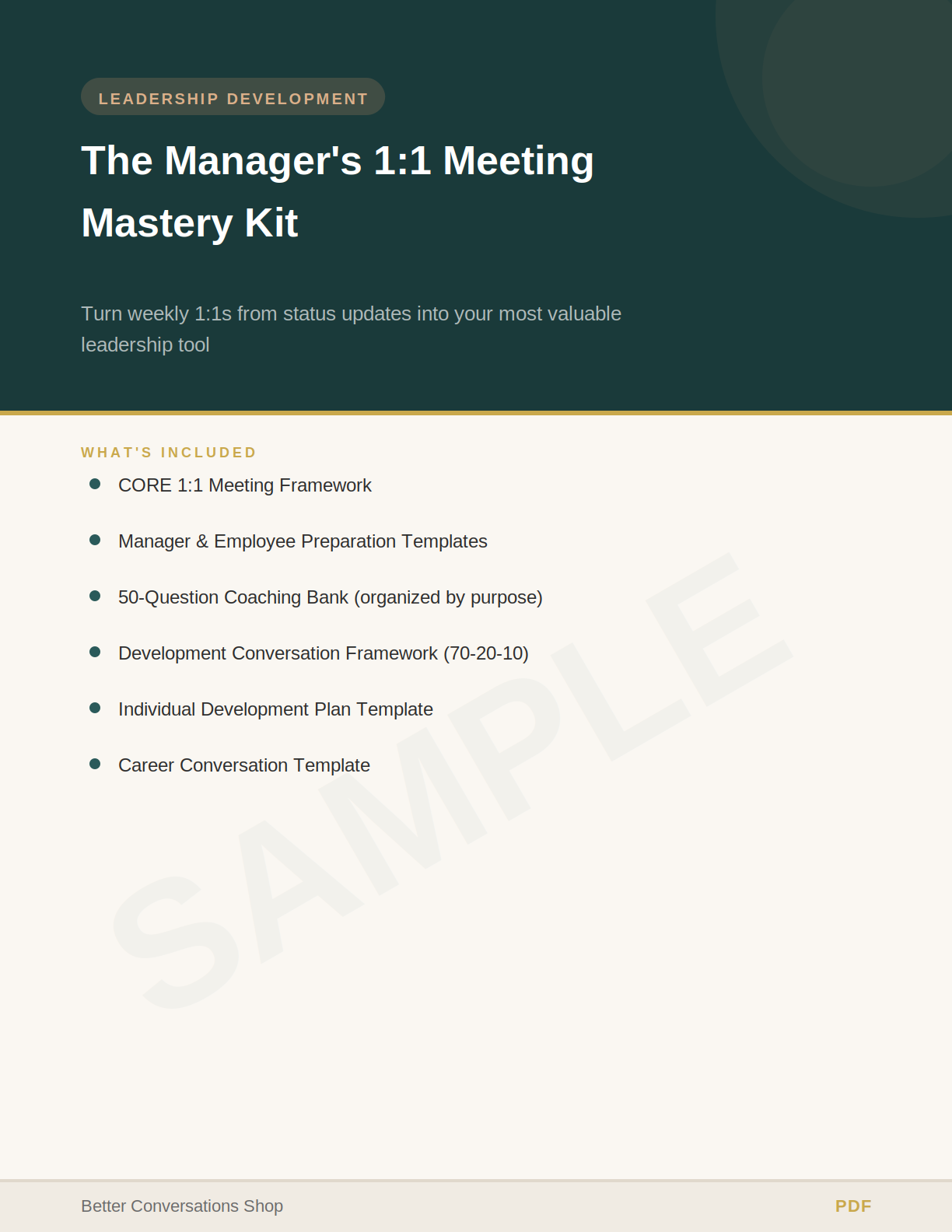
The Manager’s 1:1 Meeting Mastery Kit →
- Send an agenda at least a day ahead, with the decision to be made
- Open with a two-minute check-in, one sentence per person
- Give remote participants the first word on each topic
- Close with owners, dates, and a written recap
That last step is not admin. It is the trust mechanism. People trust what they can point to.
The most common hybrid meeting mistake is letting in-room participants dominate while remote colleagues go quiet. Over time, remote team members stop contributing and start assuming decisions are made without them. Rotate who speaks first, and call on remote voices by name.
Hybrid Work Team-Building Activities That Don’t Feel Forced
Forced fun backfires. Hybrid work team-building activities work when they are short, optional, and connected to real work rather than to trust falls on camera.
Try these instead:
- Show-and-tell demos: each person walks through something they built or solved, ten minutes each
- Working sessions: pick one real problem and solve it together for an hour
- Peer shout-outs: a standing five-minute slot where people recognize a colleague’s specific contribution
- Shared learning blocks: one person teaches a small skill, everyone tries it live
Notice the pattern: every activity produces something useful. That is what separates team-building that builds trust from team-building people quietly resent.
Keep sessions under an hour and never make attendance mandatory for social events. Optional participation tells you something useful about your culture, and respecting the “no” builds more trust than the event itself.
Employee Trust Survey Questions Worth Asking Every Quarter
You cannot fix what you do not measure. A short quarterly pulse, five to seven questions, gives you an early warning system before small frustrations turn into resignations.
Ask questions that surface behavior, not feelings alone:
- Do you know what is expected of you this week?
- When you make a mistake, do you feel safe raising it?
- Do you get the information you need to do your job well?
- Are decisions explained clearly enough for you to understand them?
- Do you trust your manager to follow through on commitments?
- Do you feel your work is visible to the people who need to see it?
- What is one thing we could change to make working here easier?
Use a simple five-point scale and add one open-text box. Then do the part most teams skip: share the results and say what you will change. A survey nobody acts on actively damages trust.
Teams of five to fifty people who want a lightweight quarterly check-in rather than a long annual engagement survey.
Common Mistakes That Undermine Trust-Building Strategies
Even well-intentioned efforts fail in predictable ways. Here are the mistakes we see most often, and what to do instead.
| Mistake | What it does to trust | What to do instead |
|---|---|---|
| Treating in-office presence as commitment | Makes remote work feel suspect | Measure outcomes, not attendance |
| Adding process without removing any | Signals distrust and slows everyone down | Pair every new rule with one you retire |
| Skipping written recaps | Leaves remote colleagues guessing | Send a short recap after every decision |
| Running surveys and never reporting back | Teaches people their input is ignored | Share results and name the changes |
| Managers going quiet under pressure | Reads as avoidance or favoritism | State when you are busy and when you will reply |
One more mistake deserves its own line: assuming trust problems are personality problems. Usually they are design problems. Fix the information flow and most of the friction disappears.
If your team struggles with the harder conversations that trust depends on, structured tools help. Our Difficult Conversations Toolkit gives you a preparation planner, phrase templates, and a reset guide for when emotions run high. For managers who want to make one-on-one time count, the Manager’s 1:1 Meeting Mastery Kit turns a routine check-in into a real development conversation.
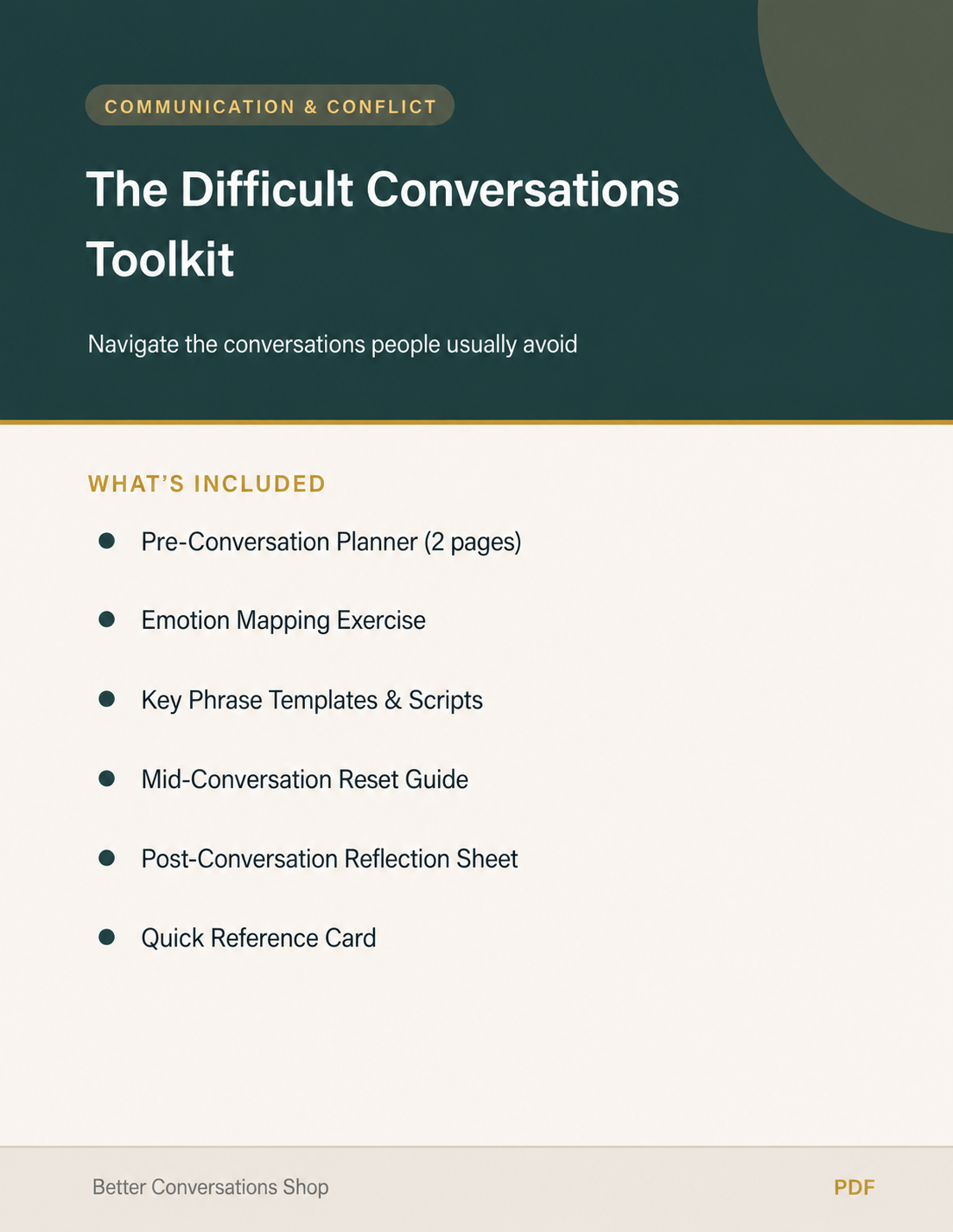
When a difficult conversation is coming, write your opening two sentences before you start. The first sentence names the issue. The second names your intent. That small preparation keeps the conversation from drifting into blame.
Frequently Asked Questions
How do you build trust in a hybrid work environment?
Start with consistency rather than grand gestures. Managers who hold the same meeting rhythm every week, follow through on small commitments, and give feedback in the same channel they promised build trust faster than any team event. Pair that with clear written expectations so people know what good work looks like without being watched. Trust-building strategies work when they are repetitive and predictable, because hybrid teams read reliability as respect.
How can managers prevent proximity bias in hybrid teams?
Proximity bias shows up when the people in the office get the interesting projects and the quick hallway feedback. Counter it with a simple rule: rotate who leads meetings, assign stretch work from a written list rather than from memory, and review who spoke last in your team channel. Ask in your employee trust survey questions whether people feel they have equal access to you. If the answer is no, fix the access before you fix the perception.
What hybrid team meeting best practices help remote employees feel included?
Assume everyone is remote, even the people in the room. Every participant joins on their own laptop, the agenda goes out 24 hours ahead, and the first five minutes are a real check-in rather than a status update. End each meeting by naming who owns what and by when. Hybrid team meeting best practices are less about technology and more about making sure no decision happens in a side conversation after the call ends.
How do you measure trust on a hybrid team?
Use a short quarterly pulse with employee trust survey questions, then watch behavior alongside the scores. Useful items include whether people feel safe raising a problem, whether they believe commitments will be met, and whether they think decisions are explained fairly. Pair the survey with signals like how quickly people respond to each other, how often work gets re-done, and whether anyone has gone quiet. A rising score with falling participation means you have a measurement problem, not a trust win.
Hybrid work will keep testing your team’s trust, and no single tool fixes it. What works is a system: written expectations, predictable communication, meetings that respect time, and a habit of asking people what they need. The Method Lab builds practical, client-ready frameworks for exactly these moments, from one-on-one conversation guides to team reset workshops. Get your free toolkit and give your next conversation a structure that holds up under pressure.