
Table of Contents
- Why a Team Leadership Development Framework Beats Ad-Hoc Training
- Build Your Leadership Competency Framework: Shared and Role-Specific Skills
- Applying the 70-20-10 Rule for Leadership Development to Team Learning
- Leadership Development Plan Examples You Can Adapt for Your Team
- The First 90 Days Leadership Playbook: Onboarding New Leaders Into the Framework
- Measuring Team-Level Outcomes and Calculating Program ROI
- Implementation Timeline, Ownership, and Common Failure Modes
- Conclusion: Turning Your Leadership Development Framework Into Daily Practice
- Frequently Asked Questions
Last Updated: October 15, 2026
Why a Team Leadership Development Framework Beats Ad-Hoc Training
Most organizations treat leadership growth as disconnected events: a workshop here, a conference when budget allows, producing scattered insight and little lasting behavior change.
Ad-hoc training fails because it has no shared language. When every manager is developed differently, teams can’t calibrate expectations, give consistent feedback, or plan succession.
Teams with a framework can answer three questions instantly: what skills matter here, who has them, and what’s the plan to close the gap.
A framework isn’t paperwork. It’s the shared vocabulary that makes feedback, promotion, and development decisions consistent across your whole team.
Build Your Leadership Competency Framework: Shared and Role-Specific Skills
Start with the shared tier: communication, feedback delivery, decision-making, and accountability. These apply whether someone leads engineers or manages a client portfolio.

Then layer role-specific competencies. A first-time manager needs coaching and delegation. A senior director needs strategic influence and stakeholder engagement.
| Competency Type | Applies To | Example Skills | How It’s Developed |
|---|---|---|---|
| Shared | Every leader | Feedback, communication, accountability | Workshops, coaching, peer practice |
| Role-specific | By function or level | Delegation, strategic influence, technical translation | Mentoring, stretch assignments, targeted training |
| Transitional | New leaders | Listening, stakeholder mapping, early wins | Structured 90-day onboarding |
The common mistake is building a framework so broad it describes everyone and guides no one. Keep the shared tier to four or five competencies.
Running a Team Skills Audit and Spotting Capability Gaps
A skills audit compares each leader’s capabilities against the competency framework, revealing where the team is strong and where gaps threaten performance.
Use three inputs: self-assessment, manager assessment, and observable evidence. Self-assessment alone is unreliable because confidence and competence rarely match (pubmed.ncbi.nlm.nih.gov).
Score each competency on a 1-to-5 scale, then look for patterns, not individual scores.
A skills audit works best when it’s low-stakes.
Applying the 70-20-10 Rule for Leadership Development to Team Learning
The 70-20-10 rule for leadership development allocates learning across three channels: roughly 70 percent on-the-job experience, 20 percent relationships like coaching and mentoring, and 10 percent formal training (The 70-20-10 Model for Learning and Development).
Most teams invert it, spending the bulk of their budget on workshops and almost nothing on the experiences where leaders actually grow. Flip that.
- 70 percent, experience: Stretch assignments, leading a real project, owning a difficult stakeholder relationship
- 20 percent, relationships: Coaching, mentoring, peer observation, structured feedback loops
- 10 percent, formal learning: Courses, certifications, workshops, reading
Design each development goal with all three channels attached.
What 70-20-10 Looks Like at the Team Level, Not the Individual Level
Most guides stop here. The 70-20-10 split is usually described for one person; applied to a team, the ratios become a portfolio decision: across all your leaders, how is the team’s total development time and budget actually distributed?
Tally every development activity your team runs in a quarter and sort it into the three buckets. A common pattern looks like this:
| Channel | Typical ad-hoc team | Rebalanced team |
|---|---|---|
| Experience (70%) | Untracked, incidental | Named stretch assignments tied to a competency |
| Relationships (20%) | Occasional, informal | Paired mentor or peer coach per leader, with a cadence |
| Formal (10%) | Most of the budget | Short modules attached to a live assignment |
The rebalanced column is not more expensive: same people, roughly the same budget, reorganized so the experience and relationship channels are intentional rather than accidental.
Three Team-Level Mechanics That Make the Ratios Real
1. Assign the 70 percent, do not hope for it. On-the-job growth only counts if the assignment targets a specific competency.
2. Make the 20 percent reciprocal. Peer coaching works best when it runs both directions.
3. Cap the 10 percent and attach it. Formal training is the easiest channel to over-buy because it’s the easiest to schedule and invoice.
Attach a real assignment to every formal training session. A workshop without a follow-up task attached to live work is entertainment, not development.
Where the Model Breaks Down
The 70-20-10 split fails in two predictable ways. First, it assumes the experience channel is available to everyone; leaders in narrow roles may have almost no 70 percent to draw on, and forcing the ratio can push people into assignments they aren’t ready for.
Treat the ratios as a diagnostic, not a rule. If your development is 90 percent formal, you have a rebalancing problem.
Leadership Development Plan Examples You Can Adapt for Your Team
A leadership development plan names specific goals, the competencies they target, the learning activities, a timeline, and how progress will be measured. Generic plans fail because they skip the measurement column and the timeline.
Here’s a template you can copy and adapt:
Leadership Development Plan
- Leader: [Name] | Role: [Title] | Plan period: [Start to end date]
- Target competency: [One from your framework]
- Current level: [1-5 score from the skills audit]
Keep each plan to one or two competencies. A plan with six goals is a wish list; one clear goal with a real assignment attached gets done.
Worked Example: A 90-Day Plan for a First-Time Manager
Days 1-30, listen and map. The new manager meets every team member individually, maps stakeholders, and completes a self-assessment against the shared competencies.
Days 31-60, set direction and test. They deliver one early win, then begin weekly one-to-ones with a consistent structure.
Days 61-90, build the rhythm. They establish a repeatable operating cadence, give their first structured feedback conversation, and complete a midpoint review.
Performance Review Conversations Toolkit →
First-time managers and anyone stepping into a leadership role with an existing team. The 90-day structure works whether the transition is internal or external.
The First 90 Days Leadership Playbook: Onboarding New Leaders Into the Framework
A first 90 days leadership playbook is the onboarding sequence that brings a new leader into your framework from day one, so development starts with structure instead of waiting for the first review cycle.
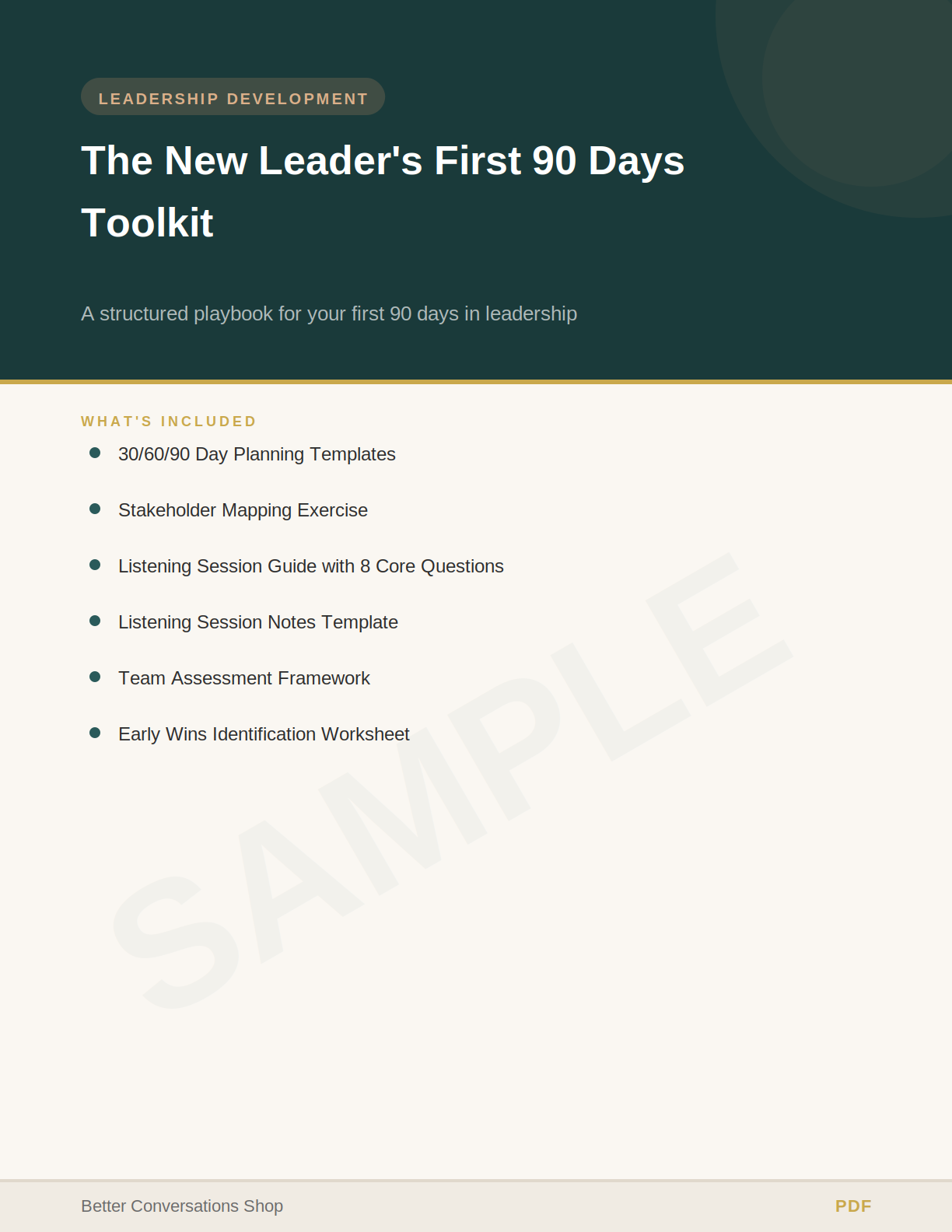
Build the playbook around four phases, each with a deliverable: listening produces a stakeholder map, mapping produces a competency baseline, direction-setting produces one or two early wins, and rhythm-building produces the leader’s ongoing operating cadence.
Assign a mentor before day one. The mentor’s job isn’t to teach the job; it’s to translate your framework into this team’s reality.
Skipping the listening phase to “show initiative” is the most common new-leader mistake. Early changes made before you understand the team erode trust you’ll spend months rebuilding.
Measuring Team-Level Outcomes and Calculating Program ROI
Team-level measurement tracks whether the framework changed behavior across the group, not just whether individuals completed training, because attendance is not an outcome. Most guides go quiet here: they say “measure results” without explaining how to establish a baseline, separate your program’s effect from everything else moving at once, or put a defensible number in front of a sponsor.
Start With a Baseline, or You Have Nothing to Compare
You cannot claim improvement without a starting point. Before launch, capture three numbers and date them:
- Capability baseline: the average competency score from your team skills audit, by competency.
- Behavior baseline: a short 360-style pulse asking each leader’s manager, peers, and direct reports to rate a handful of observable behaviors.
- Outcome baseline: the team metrics you expect the framework to move, such as voluntary turnover, internal promotion rate, and engagement scores.
Write the baseline down and share it with your sponsor. A baseline captured after launch is a guess, not a baseline.
Three Layers of Measurement
Track three layers, and be clear about what each can and cannot prove.
| Layer | What it measures | Example metric | What it proves |
|---|---|---|---|
| Participation | Whether people engaged | Completion rate, mentor-pair cadence | Activity, not results |
| Behavior change | Whether leaders act differently | Pre/post 360-style ratings on target behaviors | The framework is working at the individual level |
| Team outcomes | Whether the team improved | Retention, internal promotion rate, engagement | Direction of travel, with attribution caveats |
Participation is easiest to collect and least meaningful on its own. Behavior change tells you the framework is landing. Team outcomes are what sponsors care about, and the hardest to attribute.
Calculating ROI Without Overclaiming
To calculate ROI, put a dollar figure on the targeted outcome, then compare it against total program cost.
Step 1: Value the outcome. If your goal is reducing manager-driven turnover, estimate the departures you expect to prevent and multiply by your average replacement cost, which typically includes recruiting, onboarding, and lost productivity during the vacancy.
Step 2: Total the cost. Add facilitation, materials, tools or platforms, and the opportunity cost of participants’ time.
A Simple Attribution Approach
Perfect attribution isn’t possible, but you can get close enough to be credible. Use two techniques together:
- A comparison group. If only part of the team went through the framework in the first cycle, compare the two groups on the same metrics. Not a controlled experiment, but far stronger than a single before-and-after.
- A timeline overlay. Plot the outcome metric against program milestones. If turnover starts falling before launch or keeps falling after the program ends, something else is at work.
Neither technique proves causation alone. Together they give a defensible story: the metric moved, it moved in the group that went through the program, and it moved on a timeline that lines up with the rollout.
Do not report a single ROI number with no caveat. A sponsor who later discovers the number was inflated will discount every future report, including the accurate ones.
Report the Trend, Not the Trophy
The most useful measurement habit is cadence. Report at 90 days, 180 days, and annually, using the same three layers each time. A trend line that holds across three reports is more persuasive than any single impressive figure, and it gives you early data to fix what isn’t working while people still care.
Implementation Timeline, Ownership, and Common Failure Modes
Rollout fails when no one owns it. Name a single accountable person, usually an HR or learning lead, plus a senior sponsor with budget authority. Without both, the framework stalls after the launch meeting.
A realistic timeline runs 90 to 120 days:
| Phase | Timeline | Owner | Key Deliverable |
|---|---|---|---|
| Design | Weeks 1-3 | HR or L&D lead | Competency framework draft |
| Audit | Weeks 3-5 | HR lead and managers | Skills audit results |
| Plan | Weeks 5-7 | Managers with HR support | Individual development plans |
| Launch | Weeks 7-9 | Senior sponsor | Kickoff and mentor assignments |
| Review | Weeks 12-16 | Program owner | First measurement report |
Four failure modes show up repeatedly: no executive sponsor, so the program has no air cover; frameworks built without manager input, which produces immediate buy-in problems; no measurement plan, so you can’t prove value at renewal; and treating it as a one-time launch instead of an annual cycle.
Run the first review at 90 days, not 12 months. Early data lets you fix what isn’t working while people still care about the program.
Conclusion: Turning Your Leadership Development Framework Into Daily Practice
The hardest part of any framework is daily practice, not design. Competencies only matter if they show up in one-to-ones, feedback conversations, and promotion decisions. That’s where structure either earns its keep or becomes another document nobody opens.
The Method Lab builds the practical tools that make this real: the Performance Review Conversations Toolkit for feedback that changes behavior, The Manager’s 1:1 Meeting Mastery Kit for consistent development conversations, and The New Leader’s First 90 Days Toolkit for onboarding new leaders into your framework from day one.
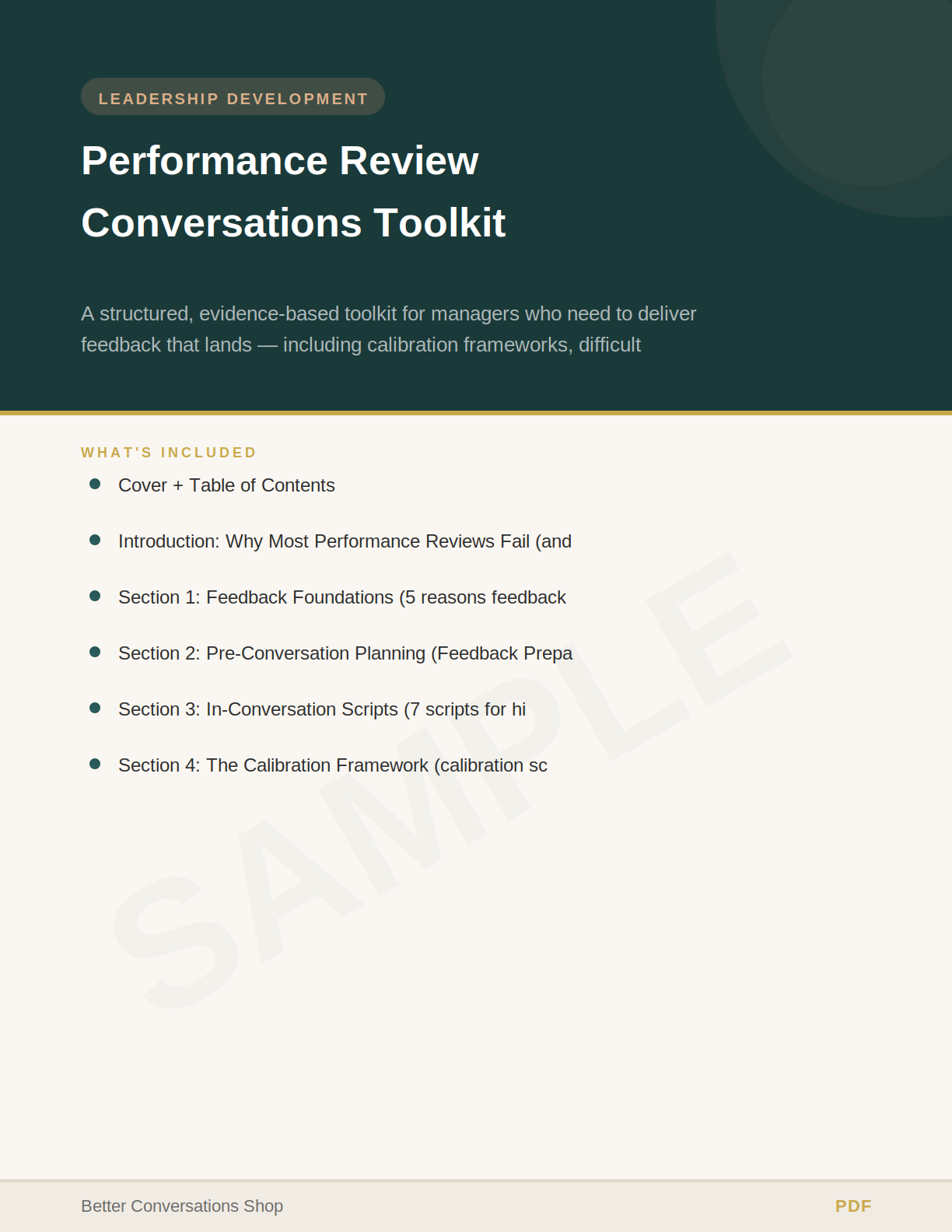
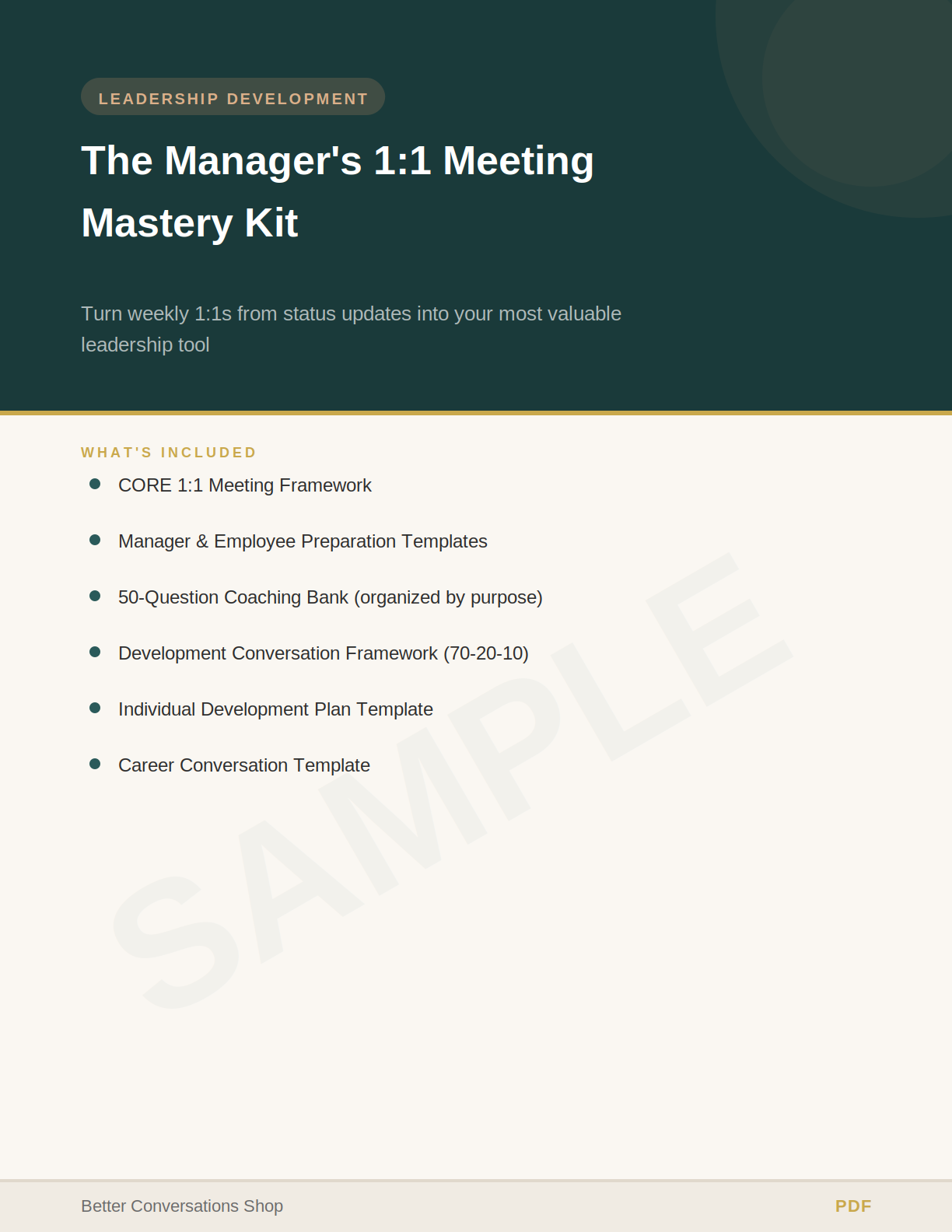
Get started with The Method Lab and turn your framework into something your team actually uses.
Frequently Asked Questions
What should a leadership development framework include?
A workable leadership development framework covers five parts: a competency model with shared and role-specific skills, a skills assessment process, development goals tied to business strategy, a mix of learning formats (the 70-20-10 rule is a common starting point), and a measurement plan. The Team Dynamics Assessment & Reset Pack helps you diagnose where your team stands before you design anything, so the framework targets real gaps instead of generic training topics.
How do you create a leadership development plan for a team?
Start with a team skills audit to surface capability gaps, then define shared competencies every leader needs plus role-specific ones. Set development goals per person, choose training formats that fit how your team actually works, and assign a manager or mentor for support. Review progress quarterly. The New Leader’s First 90 Days Toolkit gives new managers a structured path through this process from day one.
What is the 70-20-10 rule for leadership development?
The 70-20-10 rule splits learning into three channels: roughly 70% from on-the-job experience, 20% from coaching and mentoring, and 10% from formal training. For teams, that means most development happens through stretch assignments and real projects, not workshops. Use it as a planning guide rather than a strict formula, and make sure your leadership development plan examples reflect all three channels.
How do you measure the success of leadership development?
Measure at the team level, not just the individual. Track behavioral change through manager and peer feedback, monitor engagement scores, and tie outcomes to business metrics like retention or project delivery. The Coaching Outcomes & Impact Measurement Kit provides a baseline-to-post-engagement system with an ROI calculation you can present to sponsors. Without a baseline, you cannot prove progress.
How can teams apply a leadership framework in the first 90 days?
Use the first 90 days for structured listening, stakeholder mapping, and quick wins. A first 90 days leadership playbook walks a new leader through deep listening, direction-setting, and building a leadership operating rhythm. Pair it with weekly 1:1s using the Manager’s 1:1 Meeting Mastery Kit so development conversations happen consistently, not just at review time.
How long should a leadership development program last?
Most teams see meaningful results in six to twelve months, but the framework itself should be ongoing. Run a formal cohort or curriculum for six months, then shift to continuous development through coaching, stretch assignments, and quarterly reviews. Programs that end abruptly lose momentum; those with a built-in review cycle keep producing capability growth.
What are examples of leadership development activities for new managers?
Practical activities include leading a cross-functional project, shadowing a senior leader, running weekly 1:1s with a coaching question bank, facilitating a team retrospective, and working through feedback scenarios. The Performance Review Conversations Toolkit includes scripts for seven high-stakes feedback situations, which new managers can practice before real review cycles.
How do you identify leadership skills gaps across a team?
Combine a skills audit with 360-degree feedback and performance data. Ask each leader to self-assess against your competency framework, then compare with manager observations and team input. Look for patterns: if multiple leaders struggle with difficult conversations, that is a team-level gap, not an individual one. The Team Dynamics Assessment & Reset Pack surveys team health across eight dimensions to surface friction points.