Table of Contents
- Why Coaching Tools Matter for New Corporate Leaders
- 1. The New Leader’s First 90 Days Toolkit: Build Credibility From Day One
- 2. The Manager’s 1:1 Meeting Mastery Kit: Transform Your Most Powerful Leadership Moment
- 3. The Difficult Conversations Toolkit: Navigate High-Stakes Moments With Structure
- 4. Performance Review Conversations Toolkit: Feedback That Actually Changes Behavior
- 5. Executive Presence & Leadership Brand Guide: Develop Executive Presence Coaching Tools
- 6. Team Dynamics Assessment & Reset Pack: Build High-Performing Teams From the Start
- 7. Coaching Outcomes & Impact Measurement Kit: Prove Your Coaching ROI
- Frequently Asked Questions
Last Updated: August 24, 2026
Why Coaching Tools Matter for New Corporate Leaders
The first 90 days of a leadership role determine whether a new manager builds credibility or spends the next two years recovering from early missteps (peer-reviewed research). Most new corporate leaders enter their roles without a structured playbook, relying instead on intuition or advice from colleagues who may not understand their specific context.

Structured coaching tools make the difference. They reduce anxiety in high-stakes conversations, provide clarity when emotions run high, and give you language for difficult moments. The challenge isn’t that new leaders lack intelligence or work ethic, it’s that they lack a system. Without one, every conversation becomes an improvisation. With one, every conversation becomes an opportunity to build trust and move your team forward.
At The Method Lab, we provide structured coaching tools to guide thinking, prepare for difficult moments, and track what’s working. This guide covers seven essential coaching tools for new corporate leaders that will help you move from reactive management to intentional leadership.
1. The New Leader’s First 90 Days Toolkit: Build Credibility From Day One
Your first 90 days set the trajectory for everything that follows. Leaders who establish credibility early outperform those who spend months finding their footing.
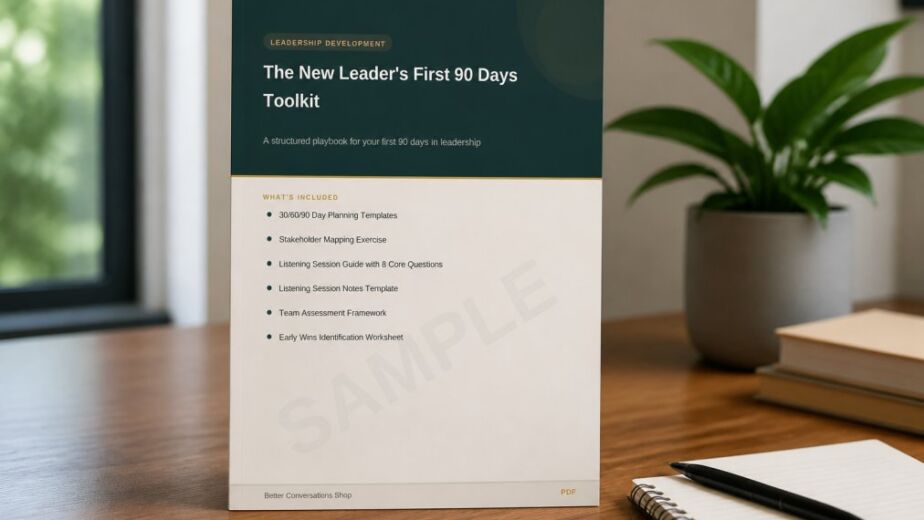
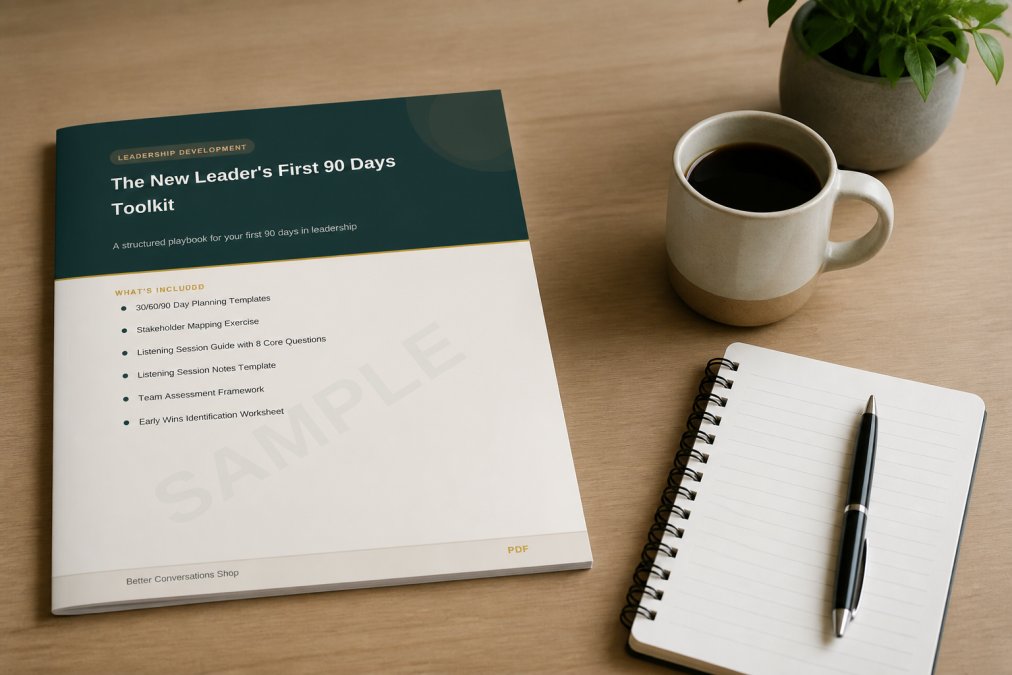
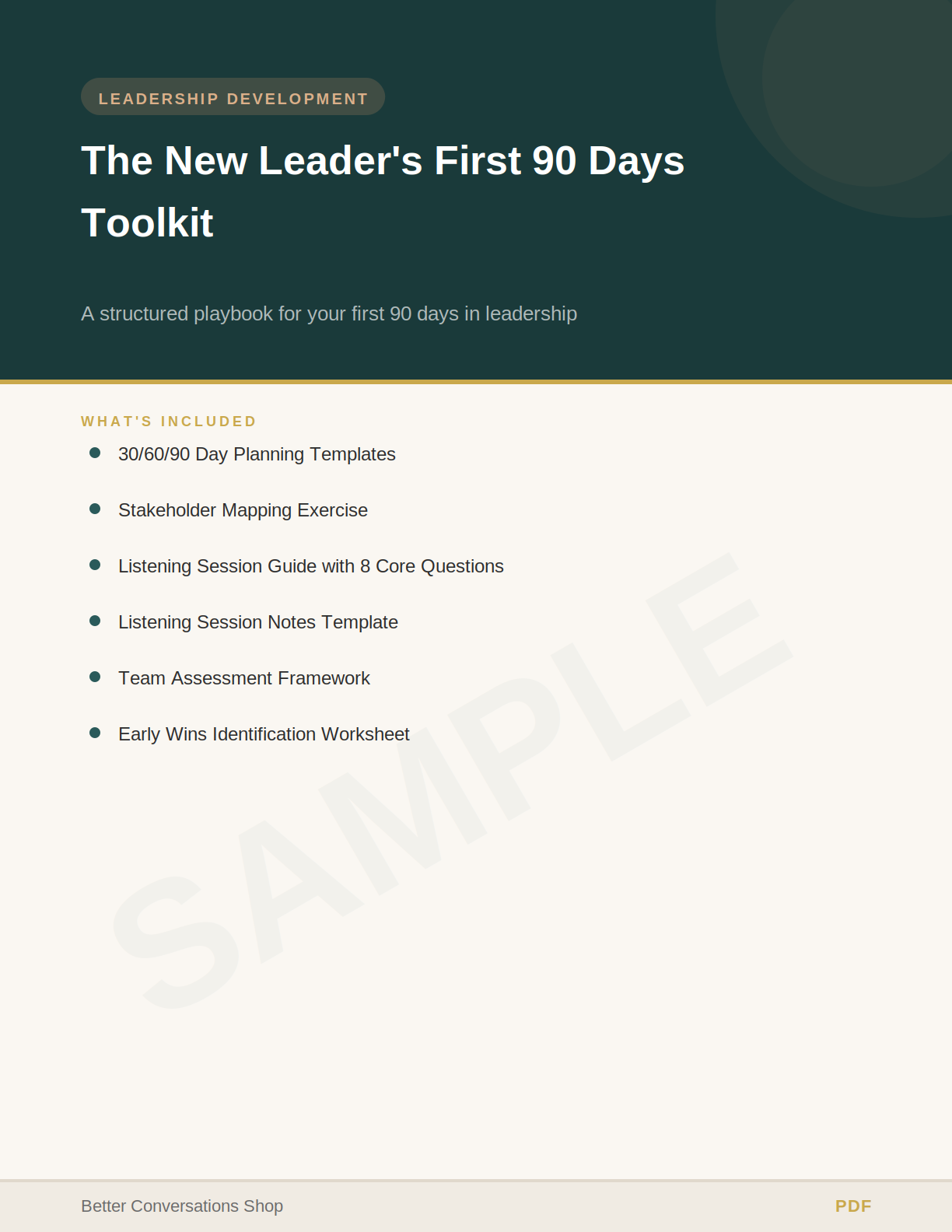
The New Leader’s First 90 Days Toolkit ($29.99) walks you through every phase of your transition: deep listening and stakeholder mapping, direction-setting without dictating, identifying and delivering early wins, and building your leadership operating rhythm.
What’s Inside
The toolkit breaks your first 90 days into three phases. The listening phase (Days 1-30) focuses on understanding your team’s strengths, constraints, and unspoken frustrations. You’ll map stakeholders, identify power dynamics, and build a picture of what’s actually working before you change anything.
The direction-setting phase (Days 31-60) is where you establish your leadership point of view. The toolkit shows you how to set direction without dictating and create buy-in by involving your team in the thinking, not just announcing decisions.
The momentum phase (Days 61-90) focuses on early wins and establishing your operating rhythm. Which small projects can you complete and celebrate? How will you structure recurring meetings and decision-making processes? The toolkit includes templates for all of it.
How to Use It
Start before your first day by understanding organizational context and key players. On your first day, listen rather than lead. Schedule 1:1s with each direct report and key stakeholders using the listening guide.
By week two, synthesize what you’ve heard using the toolkit’s synthesis worksheet. Identify patterns: What’s working well? Where are friction points? What’s been tried before and why didn’t it stick?
By day 45, communicate your leadership vision and begin executing early wins. By day 90, you’ll have established the rhythms and relationships that define your tenure.
2. The Manager’s 1:1 Meeting Mastery Kit: Transform Your Most Powerful Leadership Moment
Most managers run 1:1 meetings as status updates. One-on-one meetings are the single highest-use leadership behavior available to you, yet they’re often the least structured (shrm.org).

The Manager’s 1:1 Meeting Mastery Kit ($23.99) includes a proven CORE framework, a 50-question coaching bank, development conversation guides, and accountability tracking tools. It transforms 1:1 time from a status check into a development conversation that builds trust and moves your team forward.
The CORE Framework Explained
CORE stands for Connection, Ownership, Reflection, and Execution.
Connection (first 5 minutes) builds the relationship by understanding the person, their priorities, what energizes them, and what’s draining them. This foundation makes the rest of the conversation land.
Ownership (next 10-15 minutes) is where your direct report leads. They set the agenda and talk about what’s on their mind and where they’re stuck. Your job is to listen and ask clarifying questions.
Reflection (next 10 minutes) is where you add perspective. You might reflect back what you heard, offer a different angle, or ask questions that help them see their situation differently. This is where coaching happens.
Execution (final 5 minutes) clarifies commitment. What’s the one thing they’re committing to before your next 1:1? What do they need from you? The toolkit includes a commitment tracker that ensures follow-up.
Coaching Questions for New Managers: The 50-Question Bank
The toolkit includes 50 coaching questions organized by category: understanding their work, developing capabilities, building self-awareness, and managing difficult situations. Examples include: “What’s one thing you did well this week that you want to do more of?” “Where are you feeling stuck?” “What would success look like for you in this role in 12 months?” These questions help direct reports think more clearly about their work and development.
3. The Difficult Conversations Toolkit: Navigate High-Stakes Moments With Structure
Every manager faces moments where the conversation feels too important or emotionally charged to wing. Without structure, these conversations often go sideways and nothing changes.
The Difficult Conversations Toolkit ($28.99) gives you a comprehensive preparation framework for high-stakes moments. It includes a pre-conversation planner that walks you through your objectives, evidence, expected emotional state, and desired outcomes. An emotion mapping exercise helps you anticipate where the conversation might get heated and plan how you’ll reset it. Key phrase templates give you language for tense moments.
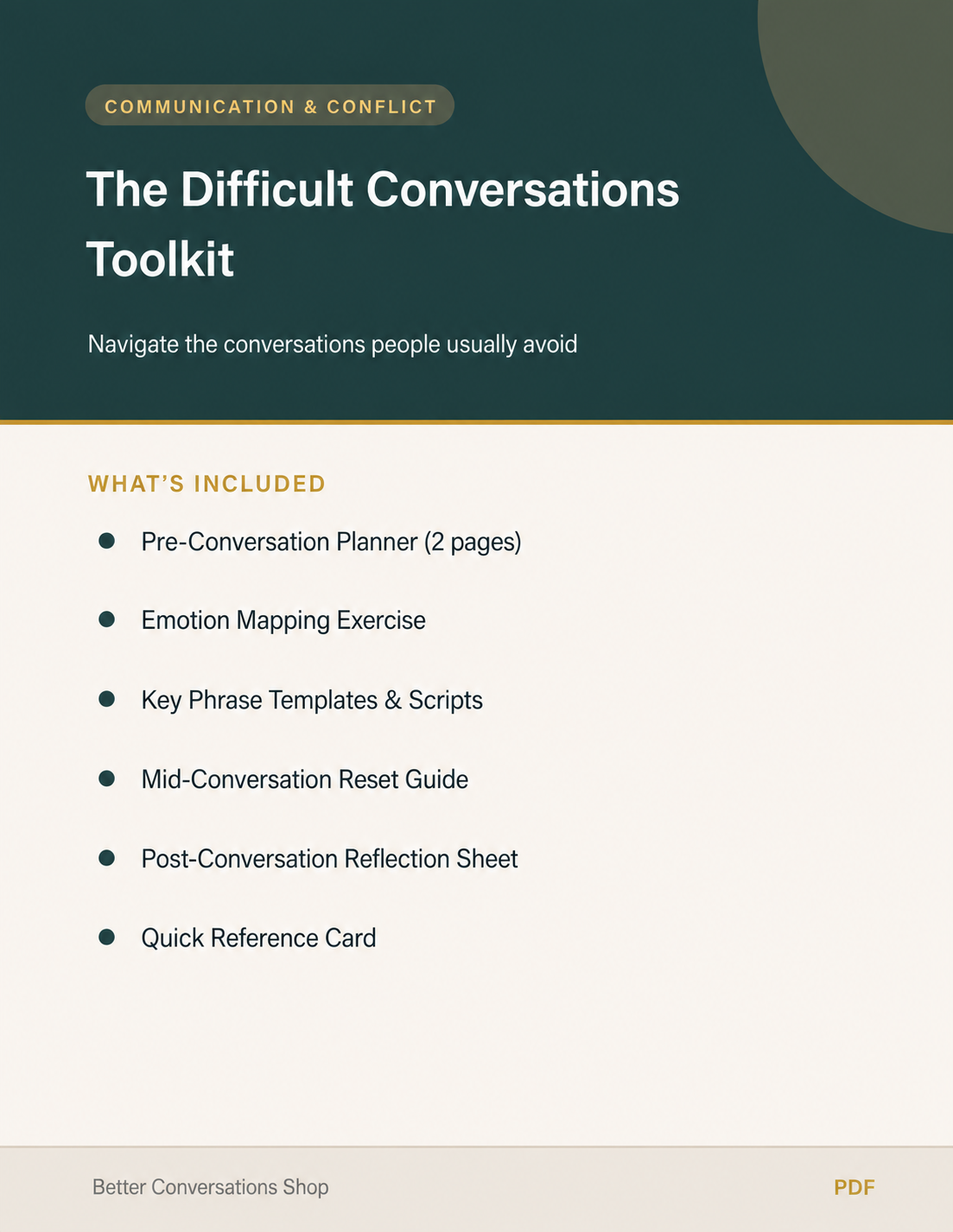
The pre-conversation planner ensures you walk in with clarity about what you’re trying to achieve, what evidence you’re bringing, and how you’ll handle it if the conversation goes off the rails. The emotion mapping exercise helps you prepare for the emotional dimension by anticipating where your direct report might feel attacked or shut down. The key phrase templates provide anchors when emotions run high: “I want to be direct about something I’ve noticed…” “I care about your success, and that’s why I’m bringing this up now.”
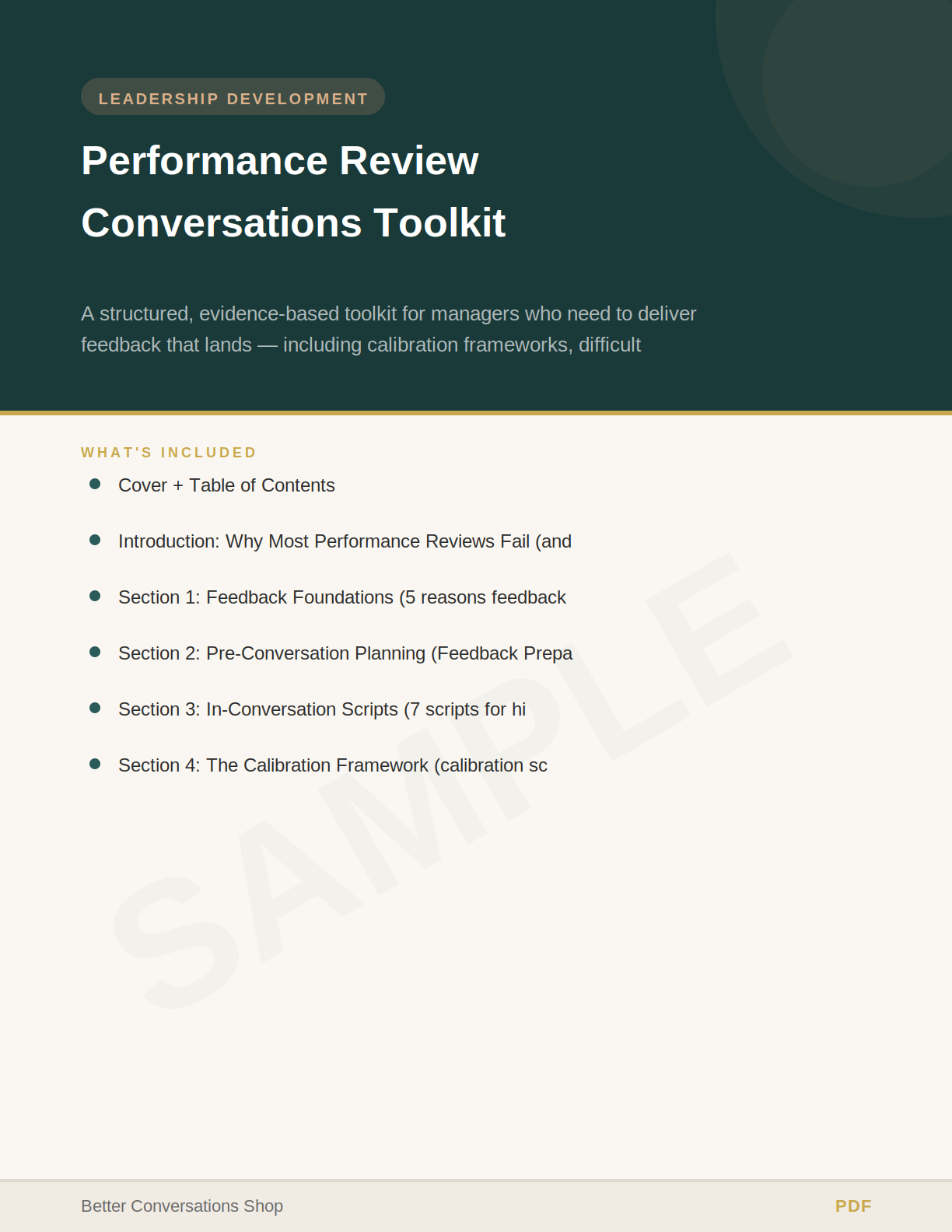
4. Performance Review Conversations Toolkit: Feedback That Actually Changes Behavior
The difference between a performance review that changes behavior and one that just checks a box comes down to the conversation. Most managers deliver feedback in a way that makes employees defensive or checked out.
The toolkit uses the Observation-Impact-Change model. You observe a specific behavior or outcome, describe the impact it had, and discuss what needs to change. Most managers skip steps and jump to judgment instead of starting with observation.
The Feedback Preparation Canvas walks you through every step: What specifically did you observe? What was the impact? How will you describe this in a way that helps them understand rather than defend? What change are you asking for? The toolkit includes ready-to-use scripts for seven high-stakes feedback scenarios and a calibration framework that aligns feedback across your management team so employees receive consistent, fair evaluation.
5. Executive Presence & Leadership Brand Guide: Develop Executive Presence Coaching Tools
Executive presence is often described as “you know it when you see it,” which is unhelpful if you’re trying to develop it (ccl.org). The Executive Presence & Leadership Brand Guide ($33.99) breaks it down into learnable components: gravitas, communication, and appearance.
Gravitas is about how you show up, whether you command attention, whether people trust your judgment, whether you seem grounded or scattered. Communication is about clarity and structure, can you explain complex ideas that land? Can you adjust your style based on audience? Appearance supports or undermines your message through polish and intentionality.
The guide includes a 90-day development plan grounded in micro-habits that compound over time. You’re not transforming overnight. You’re making small, consistent changes: speaking more deliberately in meetings, asking strategic questions before offering opinions, or dressing one notch more formally. These micro-habits, practiced consistently, build executive presence.
6. Team Dynamics Assessment & Reset Pack: Build High-Performing Teams From the Start
Teams don’t fail because people are bad at their jobs. They fail because the conditions for performance were never created. The Team Dynamics Assessment & Reset Pack ($26.99) gives you a structured toolkit for assessing team health, mapping friction points, and running a reset that produces lasting change.
The assessment tool measures psychological safety, clarity of purpose, role clarity, accountability, communication quality, decision-making effectiveness, conflict resolution, and trust. The friction mapping exercise helps you understand why the team is struggling in specific areas. The reset workshop framework walks you through a facilitated session where the team addresses issues together and agrees on new norms and commitments. The toolkit includes templates for team agreements that people actually honor.
7. Coaching Outcomes & Impact Measurement Kit: Prove Your Coaching ROI
Many coaches struggle to demonstrate the value of their work. The Coaching Outcomes & Impact Measurement Kit ($28.99) provides a complete measurement system that demonstrates coaching ROI in a way that leads to renewals, referrals, and organizational buy-in.
The system starts with a pre-coaching baseline: What’s the current state? What are the client’s goals? What would success look like? During coaching, you track goal clarity and commitment. After coaching, you capture behavioral change evidence and what results the client achieved. The ROI calculation translates outcomes into business terms, improved retention, team productivity, or accelerated promotion timelines, creating a compelling case for coaching’s value.
The coaching tools for new corporate leaders outlined above aren’t optional nice-to-haves. They’re essential infrastructure for anyone managing people or coaching leaders through high-stakes transitions. The difference between managers who build trust and momentum in their first 90 days and those who struggle for months comes down to preparation, structure, and the ability to navigate difficult conversations with confidence.
The Method Lab has designed each toolkit to be immediately usable. You’re not buying theory. You’re buying frameworks, templates, and conversation guides you can deploy in your next meeting. Start with the toolkit that addresses your most pressing challenge, whether that’s your first 90 days, your 1:1 meetings, or a difficult conversation you need to navigate. Each one will give you the structure and confidence to move from reactive management to intentional leadership.
Get Your Free Toolkit from The Method Lab and start building the foundation for leadership excellence today. Download the resources that will help you establish credibility, navigate difficult moments with structure, and demonstrate the impact of your coaching work.
Frequently Asked Questions
Q: What are the most effective coaching frameworks for first-time leaders?
A: The most effective frameworks combine structured listening with clear goal-setting. The CORE framework (used in 1:1 meetings) focuses on Connection, Ownership, Reflection, and Execution. The Observation-Impact-Change model helps with feedback delivery. The 70/30 rule—where the coach speaks 30% and the coachee speaks 70%—ensures active learning. New leaders who use these frameworks can build self-awareness faster and create psychological safety with their teams, leading to higher engagement and faster skill development.
Q: How can new corporate leaders use coaching questions for new managers to improve team performance?
A: Coaching questions shift conversations from directive (telling) to developmental (discovering). Instead of ‘Here’s how to solve this,’ ask ‘What have you tried so far?’ or ‘What would success look like?’ A 50-question coaching bank gives new managers ready-to-use prompts for career conversations, skill gaps, and accountability moments. Teams respond better to questions that invite their thinking because it builds ownership. Start with open-ended questions in 1:1s, track what you learn, and adjust your leadership approach based on their responses.
Q: What is the difference between managing and coaching for new supervisors?
A: Managing is about task completion and performance standards. Coaching is about developing capability and self-awareness. A new manager might say, ‘This report is due Friday’—that’s managing. A coach says, ‘Walk me through your process for this report. Where do you see gaps?’ That’s coaching. The best new leaders do both: set clear expectations (managing) while building their team’s ability to exceed them (coaching). Coaching tools help new supervisors ask better questions, listen more deeply, and move from command-and-control to collaborative problem-solving.
Q: How do you apply the 70/30 rule in leadership coaching?
A: The 70/30 rule means the person being coached should speak 70% of the time and the coach 30%. New leaders often reverse this, talking too much and telling too much. To apply it: ask an open question (‘What’s your biggest challenge this quarter?’), then listen without interrupting. When they pause, resist the urge to fill the silence—ask a follow-up question instead. This builds their thinking, deepens their self-awareness, and makes them more invested in solutions they generate themselves. Use coaching tools with built-in listening prompts to break the habit of over-talking.
Q: Can coaching tools work for remote and hybrid teams?
A: Yes, coaching tools work exceptionally well for remote and hybrid teams when adapted for digital channels. 1:1 frameworks translate directly to video calls—in fact, structured agendas become even more important when you can’t read body language as easily. Difficult conversation toolkits help with asynchronous communication and written feedback. The key is intentionality: remote leaders must be more deliberate about creating psychological safety, scheduling focused 1:1 time (no multitasking), and following up in writing. Many new leaders find remote coaching actually forces better structure because there’s less room for casual check-ins.