
Table of Contents
- Why Coaching Resources Matter for New Managers
- 7 Essential Coaching Resources and Tools for Managers and Leaders
- Coaching Questions for Managers: Building Your Question Bank
- Manager Coaching Conversation Template: A Step-by-Step Structure
- Coaching Frameworks for Managers: How to Choose and Apply
- Your First 90 Days: A Resource Implementation Plan
- Measuring Coaching Effectiveness: Demonstrating Real Value
- Frequently Asked Questions
Last Updated: October 13, 2026
Why Coaching Resources Matter for New Managers
New managers face a critical window: the first 90 days determine whether you establish credibility or spend the next year rebuilding trust.
The gap isn’t intelligence or experience, it’s tools. Essential coaching resources for new team managers bridge the gap between knowing you should coach and actually running conversations that land.
This guide covers seven essential coaching resources and tools for managers and leaders, plus how to implement them in your first 90 days.
7 Essential Coaching Resources and Tools for Managers and Leaders
1. The Manager’s 1:1 Meeting Mastery Kit
One-to-one conversations are the highest-use leadership behavior available to you, yet most managers run them as status updates employees see as a chore.
The Manager’s 1:1 Meeting Mastery Kit transforms that time with a proven CORE framework, a 50-question coaching bank, development conversation guides, and accountability tracking tools, so you never run out of meaningful questions to ask.
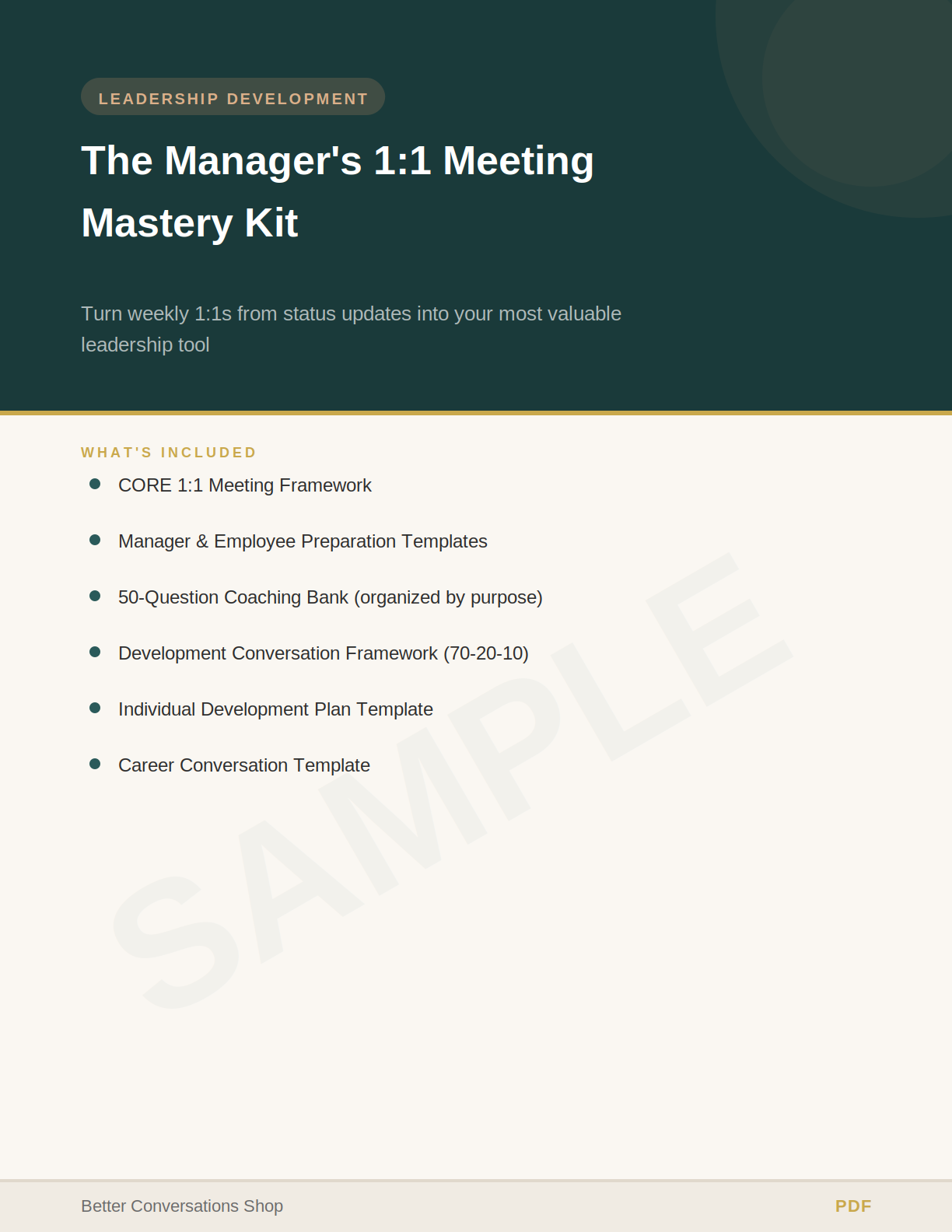
The kit costs $23.99 as a one-time purchase and works for teams of any size.
The 50-question bank is organized by conversation type: career development, obstacle removal, skill building, and accountability. Sort by the type of conversation you need, not by guessing what to ask.
Best for: New managers building their 1:1 practice from scratch, or experienced managers who want to elevate conversation quality.
2. The New Leader’s First 90 Days Toolkit
Your first 90 days set the trajectory for your entire tenure, yet most new leaders skip the listening phase and jump straight to direction-setting.
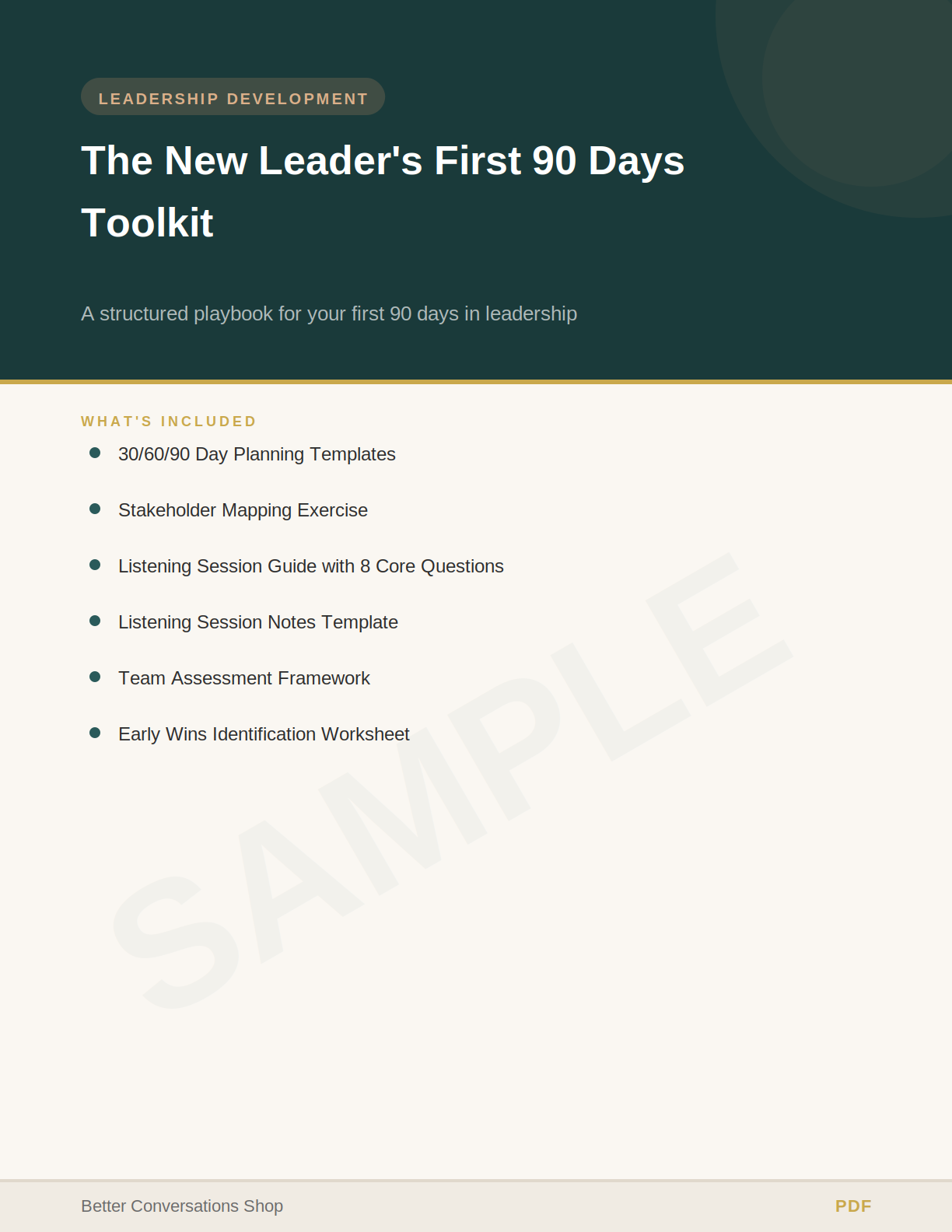
The New Leader’s First 90 Days Toolkit walks you through every phase: deep listening and stakeholder mapping, direction-setting without dictating, identifying early wins, and building your leadership operating rhythm.
At $29.99, it includes stakeholder mapping worksheets, frameworks for direction-setting that earns buy-in, and a 90-day action plan template.
The first 90 days aren’t about proving yourself. They’re about building credibility through structured listening, then earning the right to set direction.
Best for: Leaders preparing for a new role, coaches supporting organizational transitions, and onboarding programs for newly hired leaders.
3. Performance Review Conversations Toolkit
The difference between a performance review that changes behavior and one that just checks a box is the conversation itself.
The Performance Review Conversations Toolkit gives you everything needed to run feedback conversations employees act on: the Observation-Impact-Change model, a Feedback Preparation Canvas worksheet, and ready-to-use scripts for seven high-stakes scenarios including performance decline, under-delivery against a new role, behavioral issues, team dynamics failures, and upward feedback to senior leaders.
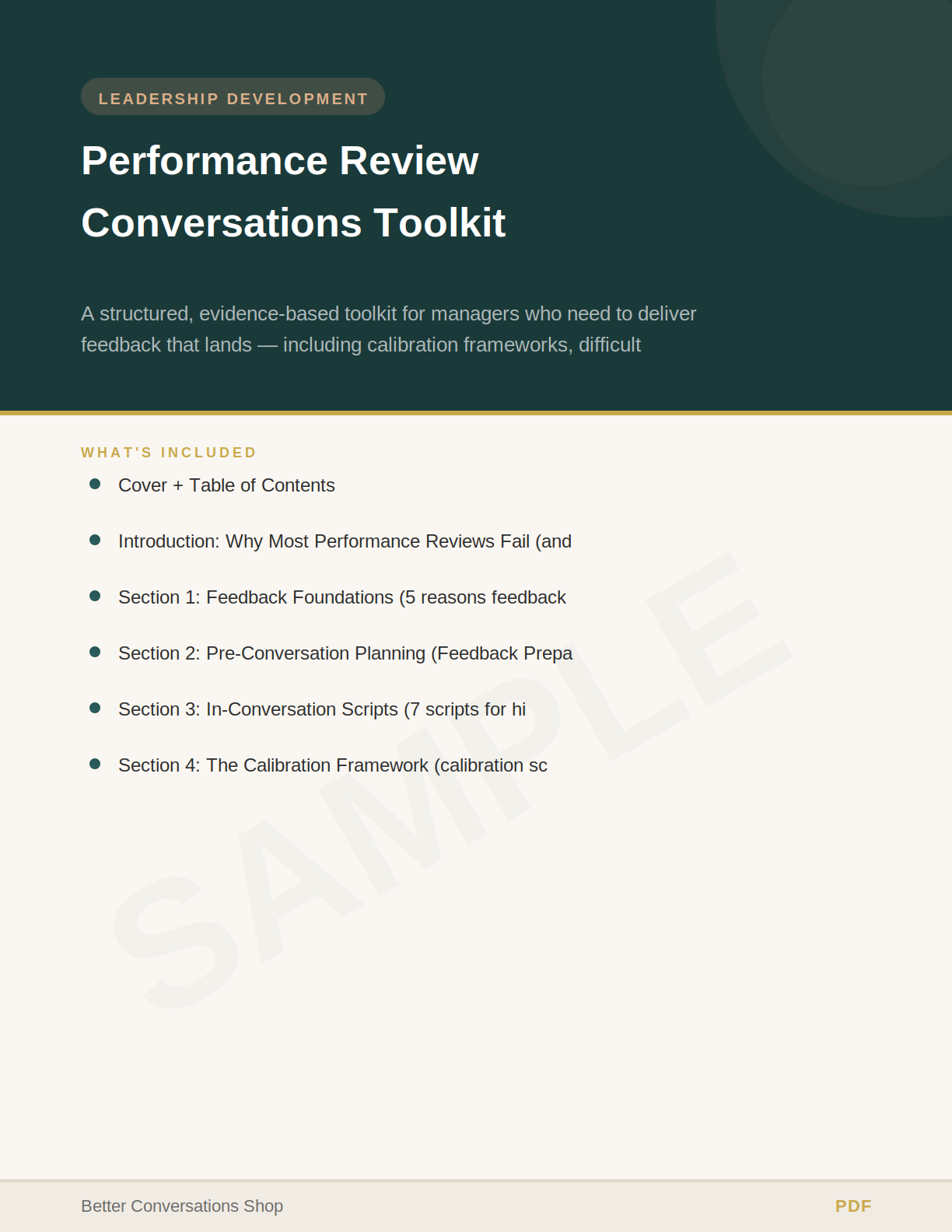
It also covers calibration across your management team so employees receive consistent, fair evaluation. At $28.99, it includes printable templates for pre-conversation planning, in-conversation scripts, post-review action planning, and the calibration scorecard.
Best for: New managers running their first formal review cycle, HR business partners supporting leadership teams, and coaches working with leaders on feedback delivery.
4. Team Dynamics Assessment & Reset Pack
Teams don’t fail because people are bad at their jobs. They fail because the conditions for performance were never created, friction, misalignment, and unclear roles compound until the team is stuck.
The Team Dynamics Assessment & Reset Pack provides a structured toolkit for assessing team health across eight dimensions, mapping friction points, and running a reset workshop that produces lasting change, with validated survey tools, a team health diagnostic, and a 90-day action plan template.
For $26.99, you get an honest picture of team health before crisis hits. The survey results become the foundation for team agreements that people actually honor.
New managers inheriting teams with unclear roles or unresolved conflict, leadership teams preparing for an offsite, and coaches facilitating team reset workshops.
Best for: Team coaching engagements, leadership offsites, and manager-led team health conversations.
5. The Difficult Conversations Toolkit
High-stakes conversations trigger anxiety. Performance reviews with defensive employees, partnership disagreements, team dynamics issues, these conversations matter too much to wing.
The Difficult Conversations Toolkit includes a pre-conversation planner, emotion mapping exercise, key phrase templates, a mid-conversation reset guide, and a post-conversation reflection sheet.
At $28.99, it’s designed for coaches, HR professionals, managers, and anyone navigating sensitive interpersonal dynamics.
Best for: Managers preparing for performance reviews with difficult employees, coaches facilitating workplace conflict resolution, and professionals navigating partnership disagreements.
6. Decision Making & Clarity Kit
New managers face decisions they’ve never faced before. Staffing choices, resource allocation, strategic direction, most people don’t need more information. They need structure.
The Decision Making & Clarity Kit is a science-backed workbook built on bounded rationality research, cognitive bias science, and goal-setting theory that takes you from stuck and circular to clear and committed in one focused session.
At $28.99, it’s invaluable for high-stakes decisions.
Most decision difficulty comes from skipping one step in the clarity framework: defining the real decision, clarifying objectives, generating alternatives, mapping consequences, acknowledging tradeoffs, or committing. Rushing through any step leads to second-guessing later.
Best for: New managers facing high-stakes decisions, career inflection points, and anyone who tends to overthink and under-decide.
7. Coaching Outcomes & Impact Measurement Kit
Coaching effectiveness matters, but most coaches lack tools to measure it, research shows 60% lack adequate evaluation systems.
The Coaching Outcomes & Impact Measurement Kit provides a complete measurement system from pre-coaching baseline through post-engagement impact survey and ROI calculation.
Best for: Executive coaches reporting outcomes to HR or sponsors, independent coaches building credibility, and coaching programs measuring organizational impact.
Coaching Questions for Managers: Building Your Question Bank
Powerful questions are the foundation of coaching conversations. Open-ended questions unlock thinking. Closed questions confirm understanding.
The Manager’s 1:1 Meeting Mastery Kit →
The best coaching questions are specific enough to focus thinking but open enough to allow multiple answers.
According to research on executive coaching effectiveness, the quality of questions asked by coaches directly correlates with client outcomes.
Here’s how to build your question bank:
- Career development: “What skills would make you more effective in your next role?” / “What’s holding you back from pursuing that opportunity?”
- Obstacle removal: “What’s the real barrier here?” / “What would need to be true for this to work?”
- Skill building: “How did you approach that situation?” / “What would you do differently next time?”
The Manager’s 1:1 Meeting Mastery Kit includes 50 questions organized by conversation type.
Manager Coaching Conversation Template: A Step-by-Step Structure
Structure removes anxiety from difficult conversations.

A coaching conversation has four phases: context-setting, exploration, commitment, and follow-up.
Phase 1: Context-Setting (2-3 minutes)
Name the purpose: “I want to talk about your progress on the project and where you see obstacles.” This removes ambiguity, the other person knows this isn’t a performance review or casual check-in.
Phase 2: Exploration (10-15 minutes)
Ask open-ended questions and listen.
Phase 3: Commitment (5-10 minutes)
Once you understand the situation, ask what they’re committing to.
Phase 4: Follow-Up (ongoing)
Track the commitment. In your next 1:1, ask how it went.
The Difficult Conversations Toolkit includes a step-by-step template you can print and reference during conversations.
Coaching Frameworks for Managers: How to Choose and Apply
Multiple coaching frameworks exist, GROW, CLEAR, OSKAR, and others each have strengths.
A good coaching framework should:
- Be simple enough to remember without notes
- Work across different conversation types
- Feel natural to your communication style
The CORE framework in The Manager’s 1:1 Meeting Mastery Kit is designed for managers running regular 1:1s, focusing on Context, Obstacles, Resources, and Expectations.
When choosing a framework, test it in three conversations. Does it feel forced or natural? Does the other person respond positively or defensively?
Most managers stick with one framework rather than switching between three. Consistency matters more than theoretical perfection.
Your First 90 Days: A Resource Implementation Plan
You don’t need all seven resources on day one. You need a sequence:
| Week | Resource | Focus | Outcome |
|---|---|---|---|
| 1-2 | New Leader’s First 90 Days Toolkit | Stakeholder mapping, listening | Understand your team and context |
| 3-4 | Team Dynamics Assessment & Reset Pack | Team health diagnostic | Identify friction points and priorities |
| 5-6 | Manager’s 1:1 Meeting Mastery Kit | Build 1:1 practice | Run first structured development conversations |
| 7-8 | Difficult Conversations Toolkit | Prepare for tough talks | Navigate early performance issues |
| 9-12 | Performance Review Conversations Toolkit | Prepare for calibration | Run first formal review cycle |
| Ongoing | Decision Making & Clarity Kit | High-stakes decisions | Make faster, more confident choices |
| Ongoing | Coaching Outcomes & Impact Measurement Kit | Track progress | Demonstrate coaching value |
This sequence builds from foundation (listening and team health) to execution (running conversations and tracking outcomes), building capability week by week rather than mastering everything at once.
By week 12, you’ll have established your leadership operating rhythm: structured 1:1s, addressed team dynamics, navigated difficult conversations, and completed your first review cycle.
Measuring Coaching Effectiveness: Demonstrating Real Value
Coaching feels valuable when people improve, but improvement is hard to measure without a system.
Start with a clear baseline: what’s true right now, the person’s goal clarity, commitment level, and current performance level.
Then track progress. After each session, ask: Did we move forward? What shifted? What’s the commitment for next time?
At the end, measure impact. Has goal clarity improved? Has the person taken new actions? Have business metrics moved?
According to ICF Global Coaching Study, coaches who track outcomes and communicate results to sponsors see higher renewal rates and more referrals.
The resources above aren’t generic templates. The Manager’s 1:1 Meeting Mastery Kit, The New Leader’s First 90 Days Toolkit, Performance Review Conversations Toolkit, Team Dynamics Assessment & Reset Pack, The Difficult Conversations Toolkit, Decision Making & Clarity Kit, and Coaching Outcomes & Impact Measurement Kit together form a complete system for new managers to build credibility, develop their teams, and demonstrate coaching’s value.
Frequently Asked Questions
What coaching skills do new team managers need most?
New managers need active listening, powerful questioning, constructive feedback delivery, and the ability to build trust. These skills form the foundation of effective coaching conversations. Active listening means fully focusing on what employees say without planning your response. Powerful questions help employees discover their own solutions rather than being told what to do. Constructive feedback delivered with empathy creates psychological safety, making employees more receptive to growth. Trust is built through consistency, follow-through on commitments, and genuine interest in your team members as people, not just performers.
How often should new managers hold coaching conversations with their teams?
Research shows that regular one-on-one meetings are the highest-leverage leadership behavior. Most effective managers hold weekly or bi-weekly one-on-ones with direct reports, typically 30-60 minutes depending on team size and needs. Beyond scheduled meetings, coaching happens in real-time during project work, after key events, and when performance issues arise. The frequency matters less than consistency and quality. A monthly meeting run with genuine coaching intent outperforms weekly status updates. New managers should establish a predictable rhythm early and protect that time.
What’s the difference between coaching and direct management?
Coaching draws out capability and solutions from your team member through questions and reflection. Direct management tells people what to do, when, and how. Coaching works best for developing capability, building confidence, and solving complex problems where the employee has valuable input. Direct management is appropriate for urgent situations, clear compliance requirements, or when an employee lacks the foundational knowledge to contribute meaningfully. Effective managers shift between both modes depending on the situation and the employee’s readiness. New managers often default to directing; learning when to coach builds your team’s capability and engagement.
How can I measure whether my coaching is actually working?
Track three types of evidence: behavioral change (what employees do differently), goal achievement (progress toward development or performance goals), and engagement (whether employees feel supported and valued). Start with a baseline before coaching begins, then measure at 30, 60, and 90 days. Ask employees directly: ‘What’s different about our conversations?’ and ‘How has this coaching affected your work?’ Document specific examples of improved performance, new skills applied, or problems solved. The Coaching Outcomes & Impact Measurement Kit provides a complete system for establishing baseline metrics and calculating coaching ROI, which is especially valuable if you need to report results to HR or organizational sponsors.
Should I use the same coaching approach with every team member?
No. Effective coaching adapts to each person’s experience level, learning style, and current readiness. A new employee in their first month needs more structure and direction than a high-performer with five years in role. Some people think best through written reflection; others need verbal conversation. Some need frequent check-ins; others prefer autonomy between meetings. Start by observing how each team member responds to questions, feedback, and responsibility. Ask them how they prefer to receive input and what kind of support helps them learn. This builds psychological safety and shows respect for individual differences, which strengthens trust and makes your coaching conversations more effective.