
Table of Contents
- Why Leadership Communication Skills Matter
- Active Listening Techniques for Managers
- How to Lead Difficult Conversations with Structure
- Delivering Constructive Feedback Examples That Drive Change
- Building Authenticity and Clarity in Your Message
- Leadership Communication Templates for Real Situations
- Communication in Remote and Hybrid Teams
- Measuring Communication Impact and Building Psychological Safety
- Frequently Asked Questions
Last Updated: August 22, 2026
Why Leadership Communication Skills Matter
Strong leadership communication skills separate managers who inspire action from those who struggle to move teams forward. The difference isn’t polish or charisma, it’s clarity, intent, and the ability to adapt your message to what your audience needs to hear.
When leaders fail to communicate effectively, the costs ripple across organizations. Teams misunderstand priorities. Conflict festers because difficult conversations never happen. Talented people leave because they don’t feel heard. Initiatives stall because stakeholders weren’t brought along.
The Method Lab works with leaders and coaches who understand that how you communicate directly determines your impact. This guide covers the core competencies that separate effective communicators: active listening, difficult conversation management, feedback delivery, authenticity, and psychological safety. You’ll find practical templates and techniques you can apply immediately.
Active Listening Techniques for Managers

Active listening is where most leadership communication fails. Managers hear words but don’t listen to meaning. They’re already formulating responses while the other person is still talking.
Real active listening requires you to stop trying to solve the problem immediately. Your job in the listening phase is to understand, not to fix.
Pause before responding. After someone finishes speaking, wait two full seconds before you answer. This signals that you processed what they said instead of having a canned response ready.
Reflect back what you heard. Use phrases like “What I’m hearing is…” or “It sounds like you’re concerned about…” This confirms you understood correctly and shows the speaker you were actually listening.
Ask clarifying questions instead of making assumptions. “Help me understand what you mean by that” is more powerful than “I think you mean…” Questions keep the conversation open and prevent you from projecting your own interpretation.
Notice what isn’t being said. Tone, hesitation, and body language often reveal what someone won’t say directly. If someone says “I’m fine with this decision” but their jaw is tight and their voice is flat, acknowledge it: “I notice some hesitation. What’s on your mind?”
Avoid the urge to problem-solve immediately. Many managers jump to solutions the moment they hear a problem. Instead, listen fully, then ask: “What have you already considered?” or “What would help you move forward here?”
Genuine active listening makes people feel seen. They’re more likely to share information, raise concerns early, and trust your leadership.
How to Lead Difficult Conversations with Structure
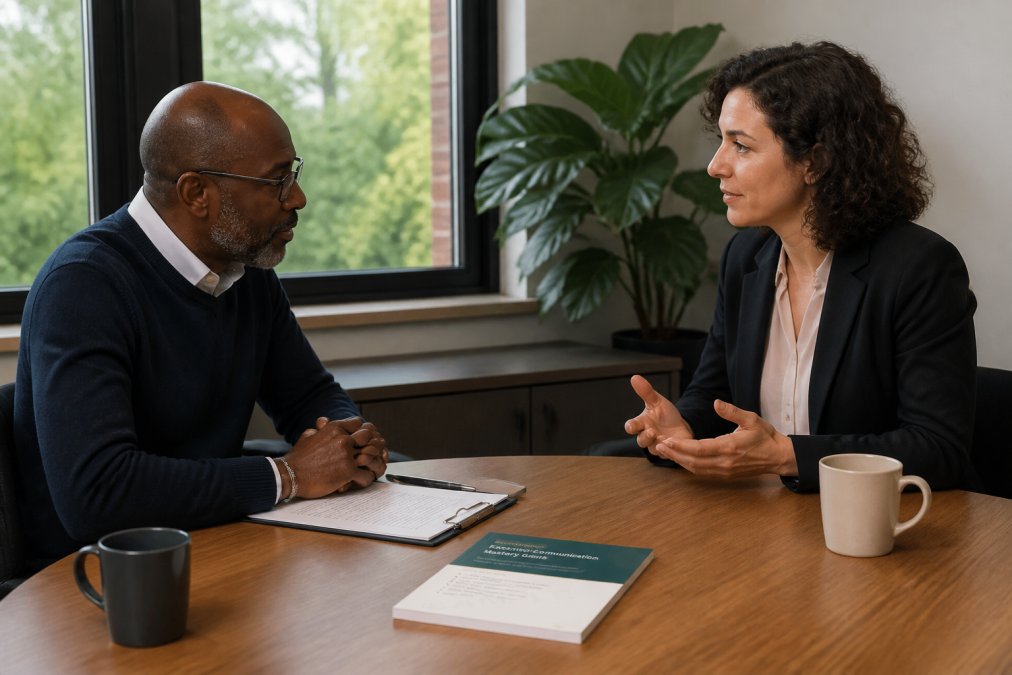
Difficult conversations test leadership communication skills most. Performance issues, missed deadlines, conflict between team members, and disagreements about decisions all require structure.
Most leaders avoid these conversations until they become crises. By then, trust is broken and resentment has built.
The structure that works is simple: prepare, open clearly, listen, address the issue directly, and close with next steps.
Preparation phase. Get clear on three things: What’s the specific issue? What outcome do you want? What’s your role in this situation? Write down the core issue in one sentence. If you can’t do that, you’re not ready yet.
Opening. State the purpose directly. “I want to talk about the missed deadline on the Johnson project” is infinitely better than “We need to have a conversation” or circling around the issue.
Listen first, even in a difficult conversation. Ask: “Help me understand what happened” or “What was going on from your end?” People are more likely to accept accountability when they feel understood first.
Address the issue directly. Use “I” statements paired with observable facts. “I noticed the deadline was missed, and that impacted the client timeline” is clearer than “You failed.”
Close with clarity. End with specific next steps. “Here’s what needs to happen…” and “Here’s how I’ll support you…” This transforms the conversation from criticism into a forward-looking plan.
The Method Lab’s Difficult Conversations Toolkit provides templates for preparing these conversations in advance, including emotion mapping and stakeholder analysis.
Delivering Constructive Feedback Examples That Drive Change
Feedback without structure feels like criticism. Criticism without context feels like punishment. Neither drives the behavior change you’re after.
Constructive feedback requires three elements: specificity, impact, and a path forward.
Observation: “In the client call yesterday, you presented the three options, but you didn’t pause to check if they understood the differences between them.”
Impact: “The client left uncertain which option was best for their situation, which means they’ll likely need a follow-up call to decide.”
Path forward: “Next time, after presenting options, ask something like ‘Which of these resonates most with where you are right now?’ That invites them to engage instead of just receiving information.”
This structure is specific enough that the person knows exactly what you’re referring to. It connects their behavior to a real outcome and gives them a concrete tool to try next time.
Deliver feedback as soon as possible after the behavior. Feedback loses power when weeks pass. Avoid feedback sandwiches (praise, criticism, praise), which signal you’re softening the blow and undermine the feedback itself.
The best feedback is specific enough that someone could replay the situation and know exactly what to do differently.
Building Authenticity and Clarity in Your Message
Authenticity and clarity work together. You can be clear and robotic. You can be authentic and confusing. The leaders people actually follow are both.
Authenticity means your message matches your actual values and experience. It means you’re not performing a version of leadership you think you should be. This doesn’t mean oversharing, it means your communication is grounded in who you actually are.
The trap most new leaders fall into is adopting corporate-speak. “We need to use our synergies to drive alignment on this initiative” is the opposite of authentic. Real authenticity sounds like: “Here’s what I see happening. Here’s why I think it matters. Here’s what I need from you.”
Clarity means your message is so straightforward that there’s no room for misinterpretation.
Unclear: “We should probably consider thinking about how we might want to approach the resource allocation in a way that could potentially align with our broader objectives.”
Clear: “We need to allocate resources to the three projects that directly support our Q4 goals.”
Building authenticity means speaking from your actual experience, acknowledging what you don’t know, being consistent between public and private communication, and following through on commitments.
Building clarity means one main idea per message, specific examples instead of abstract concepts, active voice, short sentences, and removing words that don’t add meaning.
The combination of authenticity and clarity builds trust faster than anything else.
Leadership Communication Templates for Real Situations
Templates remove the anxiety of starting from scratch so you can focus on making the message fit your specific situation.
One-on-one meeting opening (when you need to address performance):
“I want to check in on [specific project/behavior]. From my perspective, [what you observed]. I want to understand what’s happening from your side. Help me understand [specific question].”
Feedback delivery (when behavior needs to change):
“I noticed [specific behavior] in [specific situation]. The impact was [concrete result]. Going forward, I’d like to see [specific alternative behavior]. Here’s how I can support you in that.”
Difficult conversation opening (when you need to address a serious issue):
“I need to talk with you about [specific issue]. This is important, and I want to make sure we’re both clear on what happened and what needs to change. I’m not looking to punish, I’m looking to solve this and move forward. Let’s start with your perspective.”
Delegation with clarity:
“I need you to [specific task]. Here’s why it matters: [impact]. Here’s what success looks like: [specific outcomes]. Here’s what I need from you by [date]. What questions do you have?”
Feedback on something going well:
“I want to point out something that worked really well. In [specific situation], you [specific behavior]. That resulted in [concrete outcome]. Keep doing that.”
The Method Lab’s Manager’s 1:1 Meeting Mastery Kit includes expanded templates for these situations plus frameworks for handling variations that come up in real conversations.
Communication in Remote and Hybrid Teams
Remote and hybrid work changes leadership communication fundamentally. You lose the ambient information that comes from physical proximity. You can’t read the room or catch someone after a meeting to clarify something.
This means your communication has to be more intentional and more frequent.
Clarity becomes even more critical. In a physical office, you can course-correct misunderstandings in real time. Remote, misunderstandings compound. Write as if you won’t have a chance to clarify in person.
Asynchronous communication requires different structure. State the context, the ask, the deadline, and the rationale. Don’t make people ask follow-up questions to understand what you need.
One-on-ones become more important, not less. Use them for actual conversation, not status updates. Ask about how they’re doing. Listen for what’s not being said.
Over-communicate about changes and decisions. When you make a decision, explain the reasoning. When something changes, explain why. This prevents the rumor mill that fills information gaps.
Video calls matter more than you think. For anything emotionally loaded or complex, use video. The bandwidth lets you pick up on what’s actually happening beneath the words.
Document decisions and context. When you make a decision, document it. When you have an important conversation, summarize the key points and send it to relevant people. This prevents conflicts from different memories of conversations.
Remote communication requires more intentionality, more structure, and more clarity. Leaders who master it build stronger teams because communication has to be explicit instead of assumed.
Measuring Communication Impact and Building Psychological Safety
You can’t improve what you don’t measure. Most leaders have no idea whether their communication is actually working.
Psychological safety is the belief that you can take interpersonal risks, speak up, ask questions, admit mistakes, and disagree without fear of punishment or humiliation (peer-reviewed research). When psychological safety is high, teams communicate more openly (apa.org).
Are people bringing you problems before they become emergencies? If people flag issues early, you’re building the right environment.
Are people asking questions and pushing back? Silence usually means people don’t feel safe disagreeing. In a healthy environment, you hear questions and dissenting views.
Are people staying? High turnover is often a communication problem (shrm.org). People leave when they don’t feel heard or when feedback is unclear.
Do people understand the “why” behind decisions? Ask your team why a decision was made. If they can articulate the reasoning, communication is working.
Are conflicts being addressed or avoided? In low psychological safety environments, conflict goes underground. In high psychological safety environments, conflict is addressed openly.
Building psychological safety requires consistent behavior over time. You build it by responding non-defensively to concerns, admitting when you don’t know something, following through on commitments, asking for input and considering it, addressing issues directly, and being transparent about decisions.
Leadership communication skills are ultimately about creating an environment where people can do their best work. That requires clarity, authenticity, active listening, and psychological safety.
Improving your leadership communication skills is one of the highest-use investments you can make as a leader. The frameworks and templates in this guide work because they’re built on how people actually process information and build trust.
If you’re looking for structured tools to apply these principles with your team, The Method Lab offers resources specifically designed for coaches and leaders navigating high-stakes conversations. The Executive Communication Mastery Guide breaks down how to build executive presence through clarity and authenticity. The Difficult Conversations Toolkit provides preparation frameworks and emotion mapping exercises for conversations you’re dreading. Get your free toolkit and start applying these frameworks today.
Frequently Asked Questions
What are the core components of effective leadership communication skills?
Effective leadership communication rests on four pillars: clarity (your message is easy to understand), authenticity (you sound like yourself, not corporate-speak), active listening (you genuinely hear what others say), and consistency (your words and actions align). When these work together, you build trust and psychological safety—the foundation for team productivity and employee loyalty. Strong communication also requires adapting your message to your audience and maintaining transparency about decisions and reasoning.
How can leaders improve their active listening skills?
Active listening means fully focusing on the speaker rather than planning your response. Pause before replying, ask clarifying questions, and reflect back what you heard: ‘What I’m hearing is…’ Minimize distractions, maintain eye contact, and watch non-verbal cues—body language often reveals what words don’t. Resist the urge to interrupt or offer solutions immediately. This approach strengthens interpersonal skills and helps you understand the real intent behind what someone is saying, not just the surface message.
What is the best way to deliver constructive feedback to employees?
Use a structured approach: be specific about the behavior (not the person), explain the impact, and offer a clear path forward. Example: ‘In yesterday’s client call, you interrupted twice. That signals you’re not fully hearing their concerns, which damages trust. Next time, listen first, then ask clarifying questions.’ Timing matters—give feedback privately and soon after the event. Focus on growth, not blame. This method transforms feedback into a learning opportunity and preserves psychological safety, making employees more receptive to future guidance.
How do you maintain professional credibility during difficult conversations?
Credibility comes from preparation, honesty, and composure. Before a difficult conversation, clarify your intent and the outcome you want. During the talk, stay calm, acknowledge the other person’s perspective even if you disagree, and avoid defensive language. Use ‘I’ statements instead of accusations. Be transparent about constraints or decisions you can’t change. Follow through on commitments you make. Conflict resolution succeeds when both parties feel heard and respected—that builds lasting credibility far more than winning the argument.
What communication challenges do new leaders commonly face?
New leaders often struggle with authenticity, trying to adopt a formal ‘leadership voice’ that doesn’t feel natural. They also hesitate to have difficult conversations, fearing they’ll damage relationships. Remote environments add complexity—without in-person cues, messages are easier to misinterpret. Many new managers run 1:1 meetings as status updates rather than meaningful dialogues, missing the chance to build rapport and psychological safety. The fix: stay authentic, prepare for hard conversations with frameworks, and use structured tools designed for your specific situations.
How does emotional intelligence impact leadership communication?
Emotional intelligence—understanding your own emotions and reading others’—shapes how you communicate under pressure. Leaders with high emotional intelligence stay calm during conflict, notice when someone is frustrated even if they don’t say so, and adapt their tone accordingly. They recognize when they’re defensive and pause before reacting. This awareness helps you choose words that land better, build stronger teams, and navigate organizational change with resilience. It’s the difference between a conversation that damages trust and one that strengthens it.
Are leadership communication frameworks too rigid for real conversations?
No—the best frameworks provide a skeleton, not a script. They ensure you prepare, ask the right questions, and stay on track without sounding robotic. Authenticity comes from your genuine intent and voice, not from abandoning structure. Think of it like a musician learning scales: the structure frees you to play with confidence. Tools like pre-conversation planners and feedback templates help you organize your thoughts so you can focus on listening and responding authentically. Structure and sincerity work together, not against each other.