
Table of Contents
- Why Difficult Conversations Matter and the Cost of Avoiding Them
- Preparing for a Difficult Conversation: Your Pre-Conversation Framework
- Difficult Conversation Scripts for Managers: What to Say in High-Stakes Moments
- How to Handle an Employee Who Overreacts: Staying Grounded Under Pressure
- Examples of Difficult Conversations at Work: Real Scenarios and Responses
- Mastering Executive Poise: Active Listening and Nonverbal Communication
- Choosing the Right Time, Setting, and Approach
- After the Conversation: Follow-Up and Accountability
- Frequently Asked Questions
Last Updated: October 17, 2026
Why Difficult Conversations Matter and the Cost of Avoiding Them
Difficult conversations are where leadership is tested, not in strategy meetings, but when you address underperformance, misalignment, or conflict directly. Avoidance compounds the cost.
When managers delay, problems grow. An employee with no feedback on declining performance assumes it’s acceptable. Unaddressed dynamics create resentment, and unspoken disagreements erode trust.
The real damage is the pattern.
The alternative: address issues promptly, with clarity and composure.
Preparing for a Difficult Conversation: Your Pre-Conversation Framework
Preparation is where most managers fail. They think about the conversation on the walk to the meeting, without clarifying what they want to achieve, how the other person might react, or their own emotional state.
Preparation is the difference between a conversation that lands and one that spirals.
Map Your Emotional Triggers
Before you sit down, know what will push you off balance: defensiveness, blame-shifting, interruptions, or tears.
Identify your top three triggers and write down what you’ll do when one shows up, pause, breathe, ask a clarifying question. The goal is to notice emotion and stay intentional, not suppress it.
Also map the other person’s likely triggers. If they get defensive about work quality, don’t lead with “Your performance has declined.” If they’re sensitive to feeling singled out, acknowledge that others share similar gaps.
Clarify Your Purpose and Desired Outcome
Most managers go in with a vague sense of frustration, they want the person to “do better.” That’s a feeling, not a purpose.
Get specific. What needs to change? By when? What does success look like in three months?
Then ask what you want them to understand, not just do: “I want them to understand that this impacts the team’s ability to deliver to clients on time.”
That clarity changes how you show up. You’re not venting. You’re solving a specific problem.
Difficult Conversation Scripts for Managers: What to Say in High-Stakes Moments
Knowing what to say in the moment keeps a conversation professional instead of personal. Scripts aren’t robotic, they’re structure to anchor to when emotions rise.
Opening Your Conversation With Clarity
How you open sets the tone. A vague opening creates confusion; a clear one creates focus.
Start with the purpose, not the problem.
“I want to talk with you about your project delivery timeline. I’ve noticed a pattern, and I want to understand what’s happening and find a path forward together.”
Notice what’s happening here:
- You name the topic specifically (not “your work”, “your project delivery timeline”)
- You own your observation (“I’ve noticed”) instead of stating it as fact
- You signal openness (“I want to understand”) instead of judgment
This signals a serious conversation about a specific issue that’s safe to engage with.
Avoid these openings:
- “We need to talk about your performance.” (Too broad, too heavy)
- “I’m frustrated with you.” (Personal, not specific)
- “This isn’t working.” (Vague, creates defensiveness)
Delivering Specific, Fact-Based Examples
This is where most difficult conversations collapse.
Flip to facts. Specific, observable facts.
Instead of: “You’re not meeting deadlines.”
Say: “The client presentation materials were due Friday. They arrived Monday.
Instead of: “You’re not engaging with the team.”
Say: “In the last three team meetings, you haven’t contributed to the discussion.
Prepare 2-3 specific examples before the conversation. Write them down. Use dates, numbers, observable behaviors.
How to Handle an Employee Who Overreacts: Staying Grounded Under Pressure
Some conversations go sideways, the other person raises their voice, cries, or shuts down. This is where your difficult conversations executive poise either holds or collapses.
Recognize the Signs Early
Overreaction has tells: voice changes, breathing shifts, tightened body language, more interruptions, repeated points, personal attacks. These signal they’ve moved into a reactive state and can’t hear you yet.
Your job isn’t to fix their reaction, it’s to pause the conversation and create space for them to regulate.
The Mid-Conversation Reset
When someone overreacts, stop. Pushing creates more defensiveness.
Say one of these:
- “I can see this is hitting hard. Let’s pause for a second.”
- “I notice we’re both getting heated. That’s not helping. Can we take a breath?”
- “This is clearly important to you. I want to make sure I’m hearing you. Help me understand what you’re most concerned about.”
Then pause. Actually pause. Don’t fill the silence. Let them respond.
If they’re still escalated:
- “I think we need to take a break. Let’s come back to this in 20 minutes.”
- “This conversation matters too much to have it when we’re both upset. Let’s reschedule for tomorrow.”
This isn’t weakness, it’s executive poise. You’re choosing clarity over speed and staying in control by knowing when to pause.
When you resume, acknowledge what happened. “I could see that landed hard.
The Difficult Conversations Toolkit →
Then go back to the facts. Stay specific. Stay calm. Your composure gives them permission to regulate.
Examples of Difficult Conversations at Work: Real Scenarios and Responses
Difficult conversations take different shapes. Here’s how to handle three common scenarios.
Performance Feedback on Underperformance
The situation: An employee’s work quality has declined over the past two months. Deliverables have errors. Deadlines are being missed. This is someone who used to perform well.
What to do:
- Open with specificity: “I want to talk about your recent project work. I’ve noticed a shift in quality and timeline, and I want to understand what’s happening.”
- Give fact-based examples: “The client review flagged three errors in the proposal. The timeline for the analysis was pushed twice. I’m seeing a pattern that’s different from how you usually work.”
- Ask before assuming: “What’s going on? Is there something I should know about?”
- Listen. There might be a reason: they’re overwhelmed, dealing with something personal, unclear on expectations, or missing the tools they need.
- Co-create the fix: “Here’s what needs to happen. Deliverables need to be error-free before they go to clients. Timelines need to be met. What support do you need from me to make that happen?”
- Set a follow-up: “Let’s check in next Friday to see how this is working.”
Addressing Behavioral Issues or Team Dynamics
The situation: An employee is undermining team decisions in meetings, going around you to senior leadership, and creating tension with peers.
What to do:
- Be direct about the behavior: “I’ve noticed you’re raising concerns about team decisions with [senior leader] after we’ve already aligned as a team. I’ve also heard from team members that they feel dismissed in meetings when you push back on their ideas.”
- Name the impact: “This is creating confusion about what we’ve actually decided, and it’s affecting team trust.”
- Clarify expectations: “Here’s what I need: If you disagree with a decision, bring it up in the meeting. We can debate it. But once we decide, we move forward as one team. If you have concerns after that, you come to me first, not to [senior leader].”
- Understand their perspective: “Help me understand what’s driving this. Are you uncomfortable with how we’re making decisions? Do you feel like your input isn’t being heard?”
- Reset the agreement: “Going forward, here’s what I expect. And here’s what you can expect from me in return.”
Upward Conversations: Disagreeing With Leadership
The situation: You disagree with a decision your leader has made. You need to speak up without damaging the relationship or your credibility.
What to do:
- Request a private conversation: “I’d like to talk with you about the decision to [X]. I have some concerns I want to raise.”
- Lead with respect: “I know you’ve thought a lot about this. I respect that. I have a different perspective I’d like to share.”
- Name the stakes: “I’m raising this because I think it matters for [outcome]. I want to make sure we’re seeing the full picture.”
- Present your case with data: “Here’s what I’m seeing. [Specific facts, numbers, examples.] Based on that, I’m concerned that [specific risk].”
- Invite their thinking: “What am I missing? How are you thinking about [the risk I raised]?”
- Know when to accept: If they hear you and still decide differently, accept it. “I hear you. I still have concerns, but I understand your decision. Here’s how I’ll support it.”
Mastering Executive Poise: Active Listening and Nonverbal Communication
Executive poise isn’t about being calm all the time, it’s about staying intentional when pressure rises. Two things determine that: whether you’re actually listening, and whether your body and tone match your words.
Listen Without Interrupting
Most managers think they listen, but they’re just waiting for their turn to talk. Real listening means understanding the other person’s actual concern, not planning your rebuttal.
Here’s what real listening sounds like:
- You ask a question and then actually wait for the answer
- You don’t interrupt, even when you disagree
- You ask follow-up questions to understand their perspective: “Say more about that.” “What do you mean by that?” “Help me understand why that matters to you.”
When you listen like this, the other person feels heard and becomes more open to hearing you.
One practical tip: Take notes during difficult conversations. It signals you’re taking what they say seriously and keeps you from interrupting, you’re focused on capturing their words, not formulating your response.
Control Your Body Language and Tone
Your body language communicates before your words do.
Here’s what executive poise looks like physically:
- Shoulders relaxed, not hunched
- Hands visible, not crossed or hidden
- Leaning slightly forward (shows engagement, not dominance)
Your tone matters just as much.
Practice this: Record yourself in a difficult conversation (with permission). Listen to your tone. Does it match what you’re trying to communicate?
Once you notice the pattern, you can interrupt it. Slow down. Lower your voice slightly. Pause between sentences. These small shifts change how your message lands.
Choosing the Right Time, Setting, and Approach
When and where you have a difficult conversation matters as much as what you say.
Timing: Have it when you’re both calm and have time.
Approach: Give context beforehand: “I’d like to talk with you about how your recent projects are going.
For upward conversations, the same rules apply: request a private meeting, give context, don’t ambush your leader in a group setting.
After the Conversation: Follow-Up and Accountability
The conversation isn’t the end, it’s the beginning.
Within 24 hours, send a follow-up documenting what you discussed and agreed to.
“Thanks for talking with me yesterday. Here’s what I heard: [summary].
This creates accountability without feeling punitive. Everyone knows what was agreed to.
Then actually check in.
Follow-up is where most managers fail.
Difficult conversations are where leaders build or lose credibility.
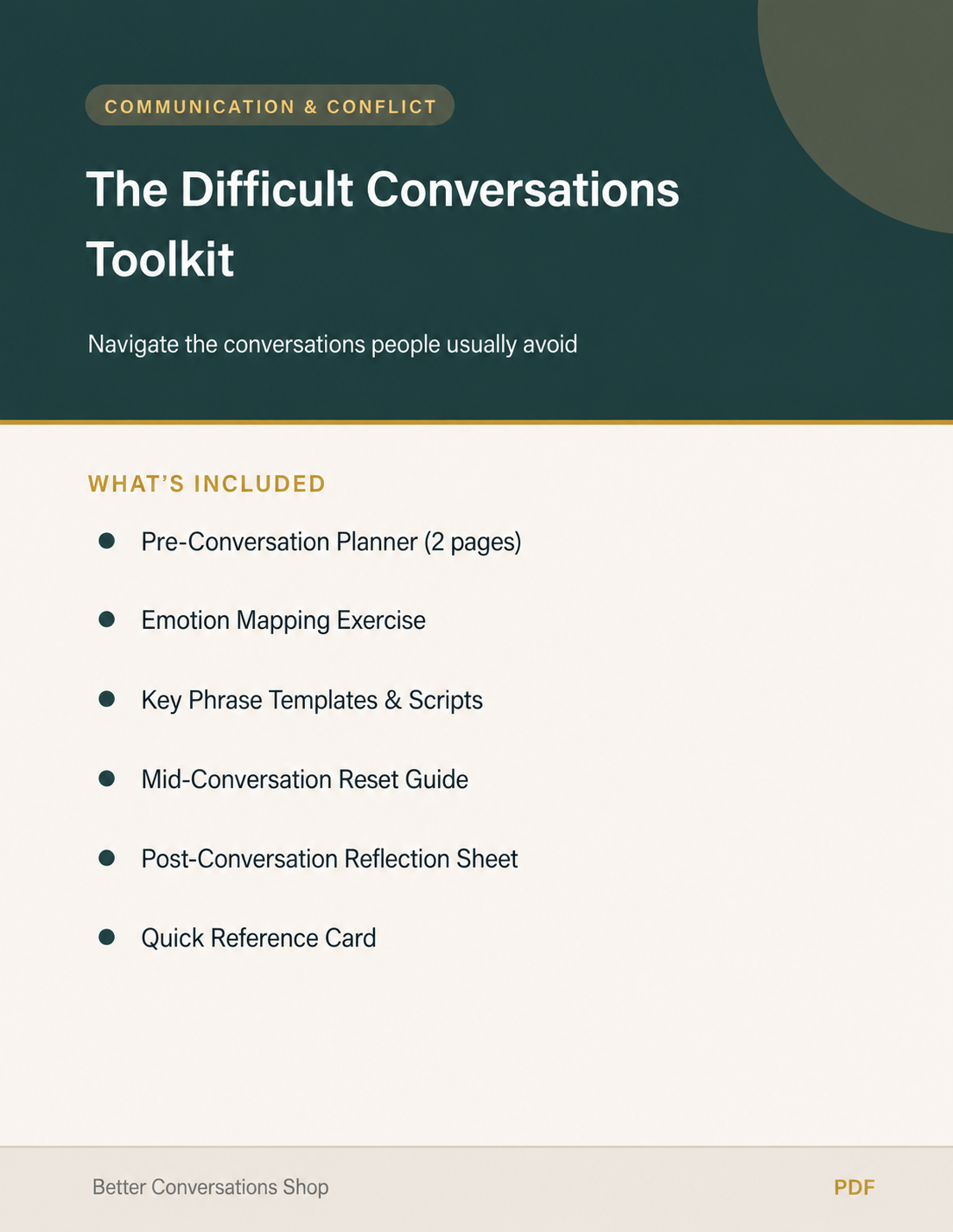
The Method Lab’s Difficult Conversations Toolkit gives you the pre-conversation framework, emotion mapping exercises, and mid-conversation scripts you need to stay grounded.
| Conversation Type | Key Focus | Success Indicator |
|---|---|---|
| Performance feedback | Specific examples, clear expectations | Employee understands what needs to change |
| Behavioral issues | Impact on team, clear boundaries | Behavior shifts within two weeks |
| Upward conversations | Respect + data, acceptance of decision | Relationship stays intact, decision moves forward |
| Emotional escalation | Pause and reset, stay grounded | Conversation resumes with clarity |
Frequently Asked Questions
How do you prepare for a difficult conversation with an employee?
Start by clarifying your specific purpose and desired outcome. Use the Difficult Conversations Toolkit to map your emotional triggers, gather fact-based examples, and script your opening. Identify the employee’s likely emotional response and plan a calm, private setting. Document the issue with specifics: dates, behaviors, and impact. Practice your key phrases aloud. This preparation reduces anxiety and ensures you communicate with clarity and professionalism when the conversation happens.
What should you do if an employee overreacts during a difficult conversation?
Stay physically calm and lower your voice slightly. Pause the conversation if emotions escalate beyond productive dialogue. Acknowledge their reaction without matching it: ‘I see this is difficult. Let’s take a moment.’ Use the mid-conversation reset technique: breathe, remind yourself of your purpose, and refocus on facts rather than emotion. Ask open-ended questions to understand their perspective. If they remain unable to engage, reschedule the conversation for when both parties can discuss the issue constructively and with respect.
What are effective scripts for delivering difficult feedback to a manager?
Start with specific facts: ‘In last week’s meeting, when you made that decision without consulting the team…’ Then describe the impact: ‘It created confusion and delayed our timeline.’ Finally, state the change you need: ‘Going forward, I’d like us to align on major decisions before implementation.’ Keep your tone professional and collaborative. Avoid accusatory language. End with a question to invite their perspective: ‘How do you see this, and what support do you need?’ This approach builds trust and accountability.
How can you stay calm and composed during a high-stakes conversation?
Executive poise comes from preparation and emotional regulation. Before the conversation, practice grounding techniques: deep breathing, visualization of a successful outcome, or brief physical movement. During the conversation, focus on your breathing and body language. Maintain steady eye contact, keep your shoulders relaxed, and speak at a measured pace. If you feel tension rising, pause and take a sip of water. Remember your purpose, this is about achieving clarity and accountability, not winning an argument. After the conversation, reflect on what went well and what you’d adjust next time.
The difference between a manager people respect and one they resent often comes down to how they handle one difficult conversation. Prepare with intention. Speak with clarity. Listen without defending. Follow up without hesitation. That’s executive poise. That’s leadership.