
Table of Contents
- What Executive Presence Actually Is
- Building Executive Presence Communication Skills
- Executive Presence in Meetings: Practical Strategies
- How to Sound Confident at Work
- Executive Presence Coaching Techniques for Leaders
- Measuring Your Progress: Self-Assessment and Development Plan
- Common Mistakes That Undermine Executive Presence
- Frequently Asked Questions
Last Updated: October 17, 2026
What Executive Presence Actually Is
Executive presence is the ability to command attention and trust in professional settings, not charisma or polish, but clarity, composure, and the confidence to influence decisions.
Executive presence has three core components:
- Gravitas, the weight and credibility you bring to conversations
- Communication, how clearly and strategically you frame your message
- Appearance, the visual signals that reinforce your authority
Most people focus only on appearance. That’s backwards. A polished look without clear thinking reads as hollow; solid thinking delivered with confidence moves people.
Building Executive Presence Communication Skills
Your communication is the primary vehicle for executive presence. Without it, gravitas and appearance mean nothing.
Verbal Communication: Clarity and Authority
Clarity is non-negotiable.
Reverse that. State your point first. Then provide the reasoning.
Here’s the pattern:
- First sentence: Your core message or recommendation
- Next 2-3 sentences: The reasoning or data that supports it
- Final sentence: The action or decision you’re asking for
Weak: “We’ve been tracking customer churn across three regions. Retention is down in the Northeast, which correlates with competitive activity.
Strong: “We need to invest in a Northeast retention program immediately. Churn is up 18% year-over-year, driven by competitive pressure.
Use concrete language. Replace vague phrases with specifics.
- Instead of: “We should probably look at improving our processes”
- Say: “We need to reduce approval time from 14 days to 5 days by implementing automated workflows”
Specificity signals authority. Vagueness signals uncertainty.
Nonverbal Communication: Body Language and Physical Signals
Your posture, eye contact, and hand movement either reinforce your message or undermine it.
Start with posture: stand or sit upright, shoulders back, chest open. Hunched shoulders and crossed arms signal defensiveness; open posture signals confidence and receptivity.
Eye contact is your second tool: rotate your gaze among attendees in a meeting, and hold steady eye contact while listening one-on-one.
Executive Presence in Meetings: Practical Strategies
Meetings are where executive presence gets tested, with limited time and competing voices. The signals differ across in-person rooms, video calls, and hybrid setups.

Before the Meeting: Prepare the Moment, Not the Script
Don’t wing it, but don’t over-script. Write three things on an index card:
- Your core point in one sentence
- The two or three pieces of evidence that support it
- The specific decision or action you’re asking for, with an owner and a date
This takes five minutes and anchors you when the conversation drifts. If presenting, rehearse the opening 90 seconds and likely Q&A, not the full deck. The opening sets the frame; the Q&A is where presence is won or lost.
In the Room: Speak Early, Ask Strategic Questions
Speak early. The first voice often sets the frame; waiting until the end means reacting instead of leading.
Listen actively. Presence isn’t about talking the most.
Don’t over-explain. State your point, answer questions, stop. More talking erodes credibility; if you’ve made your case in three sentences, resist adding a fourth.
On Video Calls: Presence Through a Small Rectangle
Video changes the signals: your face is the frame, and small habits read much larger than in person.
- Camera at eye level. A stack of books under the laptop fixes the downward angle. Eye-level framing reads as peer-to-peer, not subordinate.
- Look at the camera on your key point. Make eye contact with the lens during your most important sentence; save grid-scanning for listening.
- Mute discipline and hand-raising. In large calls, use the hand-raise feature rather than interrupting. It signals composure and respect for the format.
On video, silence feels longer than it does in person. A two-second pause that reads as thoughtful in a conference room can feel like a frozen connection on a call. If you need to think, say so: “Let me think about that for a second.” Naming the pause prevents others from filling it for you.
In Hybrid Meetings: Claim the Room and the Screen
Hybrid is the hardest format because remote attendees are easily forgotten and in-room attendees can dominate. If you’re remote, speak early and name yourself before making a point (“This is [name], one thing I’d add…”). If you’re in the room, explicitly direct questions to remote participants (“Before we move on, let’s hear from the remote group”).
Handling Pushback and Difficult Q&A
High-stakes moments, a challenge to your recommendation, a hostile question, a request to defend a number, are where presence is most visible. Use a simple three-step response pattern:
- Acknowledge the question without conceding the point. “That’s the right question to ask.” or “I understand the concern about cost.”
- Pause for two to three seconds. This signals composure and gives you time to choose your words.
- Answer with a structure. “Here’s what the data shows, here’s what it doesn’t show, and here’s what I recommend we do next.”
If you don’t know the answer, say so directly: “I don’t have that number in front of me. I’ll send it to you by end of day tomorrow.” Then do it. Follow-through on a small commitment is one of the fastest ways to build credibility in a room.
After the Meeting: Close the Loop
Presence doesn’t end when the call drops. Send a short recap within an hour: the decision made, the owner, and the date. A three-line email that names the next step does more for your reputation than a polished presentation that ends without a clear outcome. If you committed to follow up on a question, do it before the next meeting, and reference it when you do.
Meeting presence is a set of small, repeatable moves: prepare one card, speak early, ask one strategic question, pause before answering a challenge, and close the loop in writing. None of these require a personality change, just discipline.
How to Sound Confident at Work
Confidence is audible. Your pace, volume, and tone either build credibility or destroy it.
Vocal Presence and Tone
Speak slowly. Most nervous speakers accelerate; slow speech signals control and gives listeners time to process.
Volume matters too. Speak loud enough to be heard without straining: if people lean in, you’re too quiet; if they flinch, you’re too loud.
Tone is texture. A flat, monotone voice puts people to sleep.
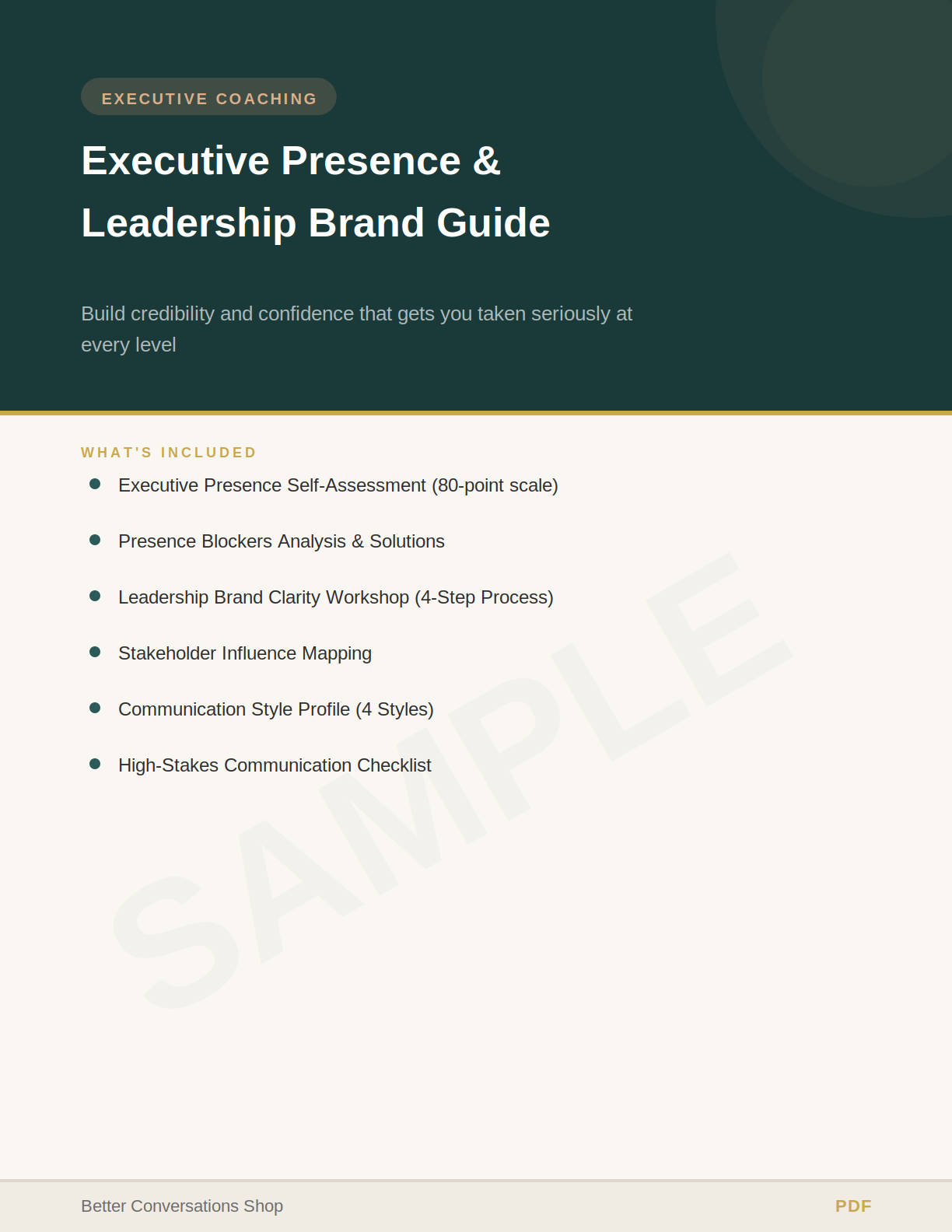
Executive Presence & Leadership Brand Guide →
One specific mistake: ending statements with rising inflection, like a question.
Composure Under Pressure
Composure is what separates good leaders from great ones. When you’re challenged, criticized, or surprised, how you respond defines your executive presence.
When someone challenges your idea or asks a difficult question, take a breath and count to two silently.
If you don’t know the answer, say so: “That’s a great question.
Executive Presence Coaching Techniques for Leaders
If you’re coaching others or developing your own presence, use these techniques.
Video yourself. Record a meeting or presentation.
Get feedback from trusted peers. Ask three people you respect: “When I present in meetings, what’s my biggest strength?
Practice the specific moment. Don’t practice your entire presentation.
Measure changes in real time. After you make a change, slower pace, better eye contact, clearer opening statement, notice what happens.
Measuring Your Progress: Self-Assessment and Development Plan
Most advice on improving executive presence stops at “be more confident.” That’s not measurable. To actually improve, you need a baseline, a rubric, feedback prompts, and a practice plan you can run in 30 or 60 days. Here’s a structured approach you can start this week.
Step 1: Build Your Baseline Rubric
Rate yourself 1-5 on each observable behavior below. A 1 means “rarely,” a 3 means “inconsistently,” and a 5 means “consistently, even under pressure.” Ask a trusted peer to rate you independently on the same rubric, the gap between your self-rating and their rating is often the most useful data you’ll get.
| Observable behavior | 1 (Rarely) | 3 (Inconsistent) | 5 (Consistent under pressure) |
|---|---|---|---|
| States the recommendation in the first sentence | Buries the point in context | Sometimes leads with the point | Always leads with a clear ask |
| Speaking pace in formal settings | Rushes or trails off | Variable | Steady 120-140 words per minute |
| Eye contact in meetings | Looks at notes or screen | Alternates | Rotates gaze across attendees |
| Pause before responding to challenge | Answers immediately | Sometimes pauses | Consistent 2-3 second pause |
| Uses filler words (um, uh, like) | Frequent | Occasional | Rare, even when thinking |
| Closes with a specific next step | Ends vaguely | Sometimes | Always names owner and date |
| Adjusts message to audience | Same message for everyone | Some adaptation | Tailors framing to stakeholder priorities |
Score yourself honestly. Most leaders find two or three behaviors drag down the rest. Those are your starting points.
Step 2: Gather Structured Feedback
Self-rating is unreliable. Use these three prompts with three people who see you in different settings, a peer, a direct report, and a manager or cross-functional partner:
- “In the last month, when did I lose the room? What was happening right before?”
- “When I make a recommendation, what’s the first thing you notice, the clarity of the ask, the evidence, or my delivery?”
- “If I could change one communication habit in the next 30 days, what would make the biggest difference to you?”
Write down their exact words. Patterns across three people are signal; a single comment is noise. Avoid defending or explaining, just listen and take notes.
If you want a more formal read, a lightweight 360-degree input process works: send the three prompts above to 5-8 colleagues via a short form, anonymize the responses, and look for themes that appear in at least three replies. You don’t need a paid platform to do this, a simple form and a spreadsheet will surface the patterns.
Step 3: Run a 30-Day Practice Plan
Pick one behavior from the rubric. One. Trying to fix everything at once produces no measurable change.
Days 1-10: Notice and name. Before each meeting, write the one behavior you’re practicing on a sticky note.
Days 11-20: Practice in low-stakes settings. Rehearse the behavior in internal team meetings, one-on-ones, and routine updates.
Step 4: Measure What Actually Changed
Behavioral change shows up in how others respond, not in how you feel. Track these leading indicators weekly:
- How often people ask follow-up questions that build on your point (versus restating it)
- How often your recommendation appears in the meeting recap or next-step list
- How often colleagues seek your input before a decision is made
A simple weekly log, one line per meeting, is enough. After 30 days, review it against your baseline rubric. If the behavior moved from a 2 to a 3, that’s real progress. If it didn’t move, the practice wasn’t specific enough; narrow the behavior and run another 30-day cycle.
Step 5: Extend to 60 and 90 Days
Once one behavior is consistent, add a second. A realistic cadence is one new behavior every 30 days. At 90 days you’ll have three behaviors operating under pressure, enough to change how people experience you in meetings. Re-run the peer feedback prompts at day 90 and compare the language people use to describe you against your day-one notes.
The point of measurement isn’t a score. It’s a feedback loop: baseline, practice, observe, adjust. Leaders who improve fastest are the ones who treat presence like a skill with reps, not a trait they either have or don’t.
Common Mistakes That Undermine Executive Presence
Mistake 1: Over-preparing to the point of rigidity. You memorize your presentation word-for-word, then freeze when someone asks a question.
Mistake 3: Filling silence with filler words. Um. Uh. Like. You. Know. These are confidence killers.
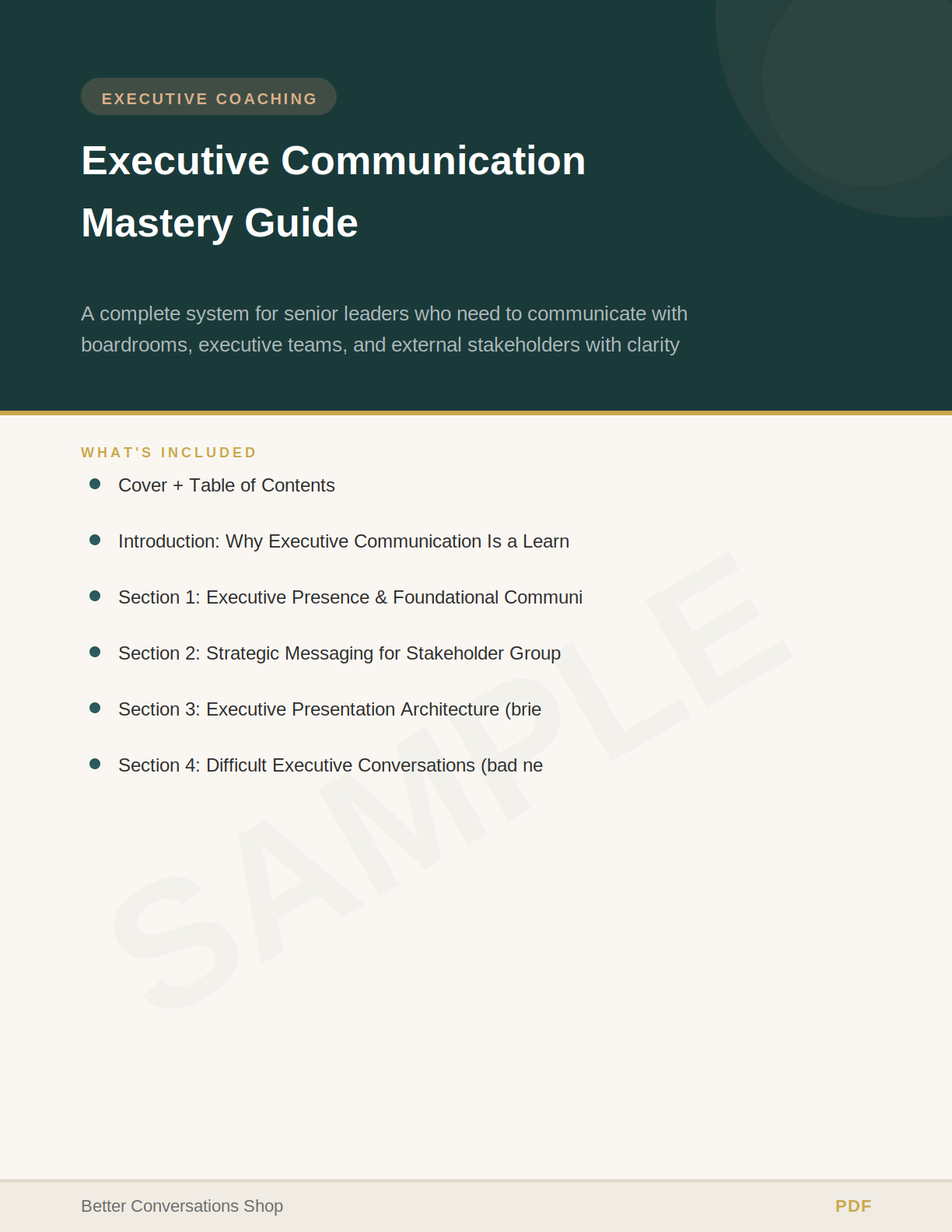
The Method Lab’s Executive Communication Mastery Guide ($33.99) provides a complete system for the communication situations that define your career: board presentations, executive committee updates, difficult stakeholder conversations, and the everyday patterns that build or erode trust.
Get your free toolkit and start building the executive presence that moves decisions and builds trust.
Frequently Asked Questions
What does executive presence mean in professional communication?
Executive presence is the ability to communicate with clarity, credibility, and composure in high-stakes situations. It combines verbal communication (what you say and how you say it), nonverbal signals (posture, eye contact, gesture), emotional intelligence, and authentic authority. Executive presence is learnable, it’s not about charisma or personality type, but about observable communication behaviors that build trust and influence.
How can I improve my executive presence communication skills in challenging conversations?
Start by clarifying your message before the conversation: what outcome do you want, and what key points must land? Practice active listening to understand the other person’s perspective, which builds credibility. Use measured pacing and pauses instead of filler words. Structure difficult feedback using a problem-framing approach: state the situation objectively, explain the impact, and offer a clear path forward. Record yourself in practice conversations to identify verbal habits that undermine authority.
Can executive presence be learned, or is it something you’re born with?
Executive presence is entirely learnable. It’s built on communication skills, self-awareness, and intentional practice, not innate personality traits. The key is consistent practice of specific behaviors: eye contact, vocal control, message clarity, and composure under pressure. Small daily habits compound into noticeable shifts in how others perceive your authority and credibility.
How do I communicate with authority without sounding arrogant in executive presence in meetings?
Authority comes from clarity and preparation, not volume or dismissiveness. Speak with conviction about what you know, acknowledge what you don’t, and invite input from others. Use ‘we’ language when appropriate to build alignment. Maintain steady eye contact and open body language to signal confidence without defensiveness. Pause to let your points land rather than filling silence. Authentic authority includes admitting mistakes and adjusting course, this builds more respect than false certainty ever will.