

Table of Contents
- What Makes a Coaching Framework Right for High-Stakes Situations
- GROW Model: The Foundation for Goal-Driven Coaching
- CLEAR Model: Building Psychological Safety Under Pressure
- STEPPPA Model: Integrating Emotion and Cognitive Load in Crisis Coaching
- Coaching Framework Examples for Leaders: OSKAR and FUEL Models
- Best Practices for High-Stakes Leadership Coaching
- Coaching Tools for High-Stakes Decision Making
- How to Choose Your Framework: A Decision Matrix
Last Updated: August 12, 2026
What Makes a Coaching Framework Right for High-Stakes Situations
High-stakes coaching demands more than good listening skills. When leaders face critical decisions, organizational crises, or career-defining moments, the framework you choose determines whether the conversation builds resilience or compounds stress.
The best coaching frameworks for high stakes balance structure with psychological safety. Under pressure, cognitive load spikes and emotion clouds judgment. Standard approaches designed for routine performance reviews fall apart when stakes actually matter.
This guide examines frameworks that work when pressure is highest, addressing emotion alongside cognition, and provides decision-making tools to match your coaching scenario to the right framework.
GROW Model: The Foundation for Goal-Driven Coaching
The GROW Model remains the most widely taught coaching framework for a reason: it works when clarity and goal-setting are primary needs. Goal, Reality, Options, Will, each step moves the coachee from desired outcome through current state to actionable commitment.
GROW excels in performance coaching and problem-solving scenarios where emotional components are secondary. A leader deciding whether to take a promotion, a team member navigating a project pivot, or a manager handling a straightforward performance issue are ideal GROW territory. The framework’s linear structure creates momentum and prevents circular thinking.
However, GROW has a critical limitation in truly high-stakes moments: it assumes the coachee can think clearly about options. When someone is stressed or facing organizational upheaval, the “Options” step often produces only surface-level suggestions. The framework doesn’t address emotional barriers that block clear thinking.
When to use GROW:
- Performance coaching and goal-setting conversations
- Problem-solving where the path forward is relatively clear
- Coaching someone with available cognitive bandwidth
- Situations where accountability and action are primary needs
What GROW misses:
- Deep emotional processing before problem-solving
- Recognition of stress and cognitive overload
- Systemic or organizational context that shapes individual choices
Many coaches layer emotional awareness into the Reality or Options steps, or add a reflection phase before the Will step. Used as written, GROW is excellent for routine coaching. Modified for emotional complexity, it becomes more versatile.
CLEAR Model: Building Psychological Safety Under Pressure
The CLEAR Model, Contracting, Listening, Exploring, Action, Review, prioritizes psychological safety. Under pressure, people need to know it’s safe to be honest about doubts, fears, and uncertainties before they can think clearly about solutions.
CLEAR’s genius is in its sequencing. Contracting establishes what’s safe to discuss. Listening creates space for the full picture before problem-solving. Exploring digs into beliefs and assumptions, the often-invisible constraints that shape how someone sees their options. Only then does Action become possible.
This framework is built for complexity. A leader navigating difficult stakeholder relationships, someone dealing with organizational politics, or a manager facing conflict with their boss benefit from CLEAR’s attention to emotional and relational dimensions.
The tradeoff is pace. CLEAR takes longer than GROW. If your coachee needs immediate direction, CLEAR’s emphasis on deep listening can feel slow. The framework also requires high emotional intelligence from the coach.
When to use CLEAR:
- Coaching involving relational or interpersonal complexity
- Situations where trust has been damaged or is fragile
- High-stakes decisions where the coachee’s emotional state shapes the outcome
- Transformational coaching aimed at behavioral or mindset change
- Crisis situations where psychological safety must be established first
What CLEAR demands:
- Time for genuine listening and exploration
- Coach skill in creating and maintaining psychological safety
- Comfort with emotion and ambiguity before moving to action
STEPPPA Model: Integrating Emotion and Cognitive Load in Crisis Coaching
The STEPPPA Model stands apart because it explicitly names emotion as part of the problem-solving process. Subject, Target, Emotion, Perception, Plan, Pace/Action, this framework acknowledges that under high stakes, how someone feels shapes what they can see and do.
STEPPPA is built for moments that break other frameworks: an executive under extreme stress, a team member facing rapid organizational change, or a leader dealing with failure. The model creates space to name the emotional state (“I’m terrified,” “I feel betrayed”), then explores how that emotion shapes perception. By surfacing this connection, the coachee can distinguish between what’s actually true and what fear or stress is making them believe.
The framework also builds in pacing, recognizing that under stress, sustainable action matters more than execution speed.
When to use STEPPPA:
- High-pressure executive coaching with visible stress or emotional impact
- Crisis situations where cognitive load is extreme
- Coaching aimed at building resilience and stress management
- Situations where perception is distorted by emotion
- Change management coaching where psychological adjustment is the real work
Unique advantage:
- Explicitly addresses the cognitive load problem that breaks other frameworks under pressure
Coaching Framework Examples for Leaders: OSKAR and FUEL Models
Two additional frameworks deserve attention for high-stakes leadership coaching: OSKAR and FUEL. Both are solution-focused, which matters when time is limited and momentum is critical.
OSKAR Model (Outcome, Scaling, Know-how, Affirm & Action, Review) keeps attention on what’s working rather than what’s broken. In high-stakes moments, leaders often spiral into problem focus. OSKAR redirects: “What’s already working? How do we build on that?” This identifies existing strengths and resources so the coachee doesn’t have to invent solutions from scratch.
OSKAR works well for business coaching and performance discussions where the coachee has agency and existing wins. It’s less effective for someone in genuine crisis or facing circumstances beyond their control.
FUEL Model (Frame, Understand, Explore, Lay out a plan) is designed specifically for managers coaching their direct reports. It balances structure with conversational ease and is straightforward enough that managers can use it without extensive training. For organizations building internal coaching capability, FUEL is often the right entry point.
Quick comparison:
- OSKAR: Best when you need to surface existing strengths and build forward momentum
- FUEL: Best when you need a manager-friendly framework that works in routine conversations
- GROW: Best when goal-setting and clarity are primary needs
- CLEAR: Best when psychological safety and relational complexity are central
- STEPPPA: Best when emotion and cognitive load are the real obstacles
Best Practices for High-Stakes Leadership Coaching
Structure matters less than execution when stakes are high. The best frameworks fail in the hands of coaches who miss these foundational practices.

Create a pause before action. High-stakes moments trigger urgency. The best coaches create deliberate space between understanding the situation and committing to action. A 48-hour gap between the coaching conversation and the decision often produces better outcomes than immediate commitment.
Name the stakes explicitly. Don’t assume the coachee has clarity on why this moment matters. Naming what’s actually at stake, for the leader, team, and organization, creates shared understanding.
Build accountability into the framework. High-stakes moments demand follow-through. The best frameworks include explicit review and accountability mechanisms. GROW’s “Will” step, CLEAR’s “Review,” and STEPPPA’s “Pace/Action” aren’t optional, they’re what make coaching stick.
Adapt the framework to cognitive load. A leader in acute crisis has limited bandwidth. Simplify. Use GROW or FUEL rather than CLEAR if cognitive load is extreme. Match the framework’s complexity to what the coachee can actually process.
Use contracting to set expectations. Before beginning, clarify what you’re doing, how long it will take, and what success looks like. Clear contracting reduces uncertainty and builds psychological safety.
The Method Lab’s resources, including the Executive Communication Mastery Guide and The Difficult Conversations Toolkit, provide structured templates for these conversations.
Coaching Tools for High-Stakes Decision Making
Beyond frameworks, high-stakes coaching benefits from decision-making tools that structure thinking and reduce cognitive load.
A decision matrix helps when multiple options exist and the choice isn’t obvious. Map options against criteria (speed, risk, stakeholder impact, alignment with values) and score each. This makes judgment visible and systematic.
Scenario planning surfaces hidden assumptions. “If we choose this path, what happens in six months if the market shifts?” Forces the coachee to think beyond the immediate decision to consequences and contingencies.
Stakeholder mapping clarifies who’s affected and what they care about. A leader often sees a decision as purely personal or team-focused. Mapping stakeholder impact reveals complexity that changes the decision.
Rapid problem-solving frameworks like 5 Whys or First Principles thinking help when the coachee is stuck in circular thinking.
The Decision Making & Clarity Kit provides ready-made versions of these tools, eliminating the need to design them during a high-stakes conversation.
How to Choose Your Framework: A Decision Matrix
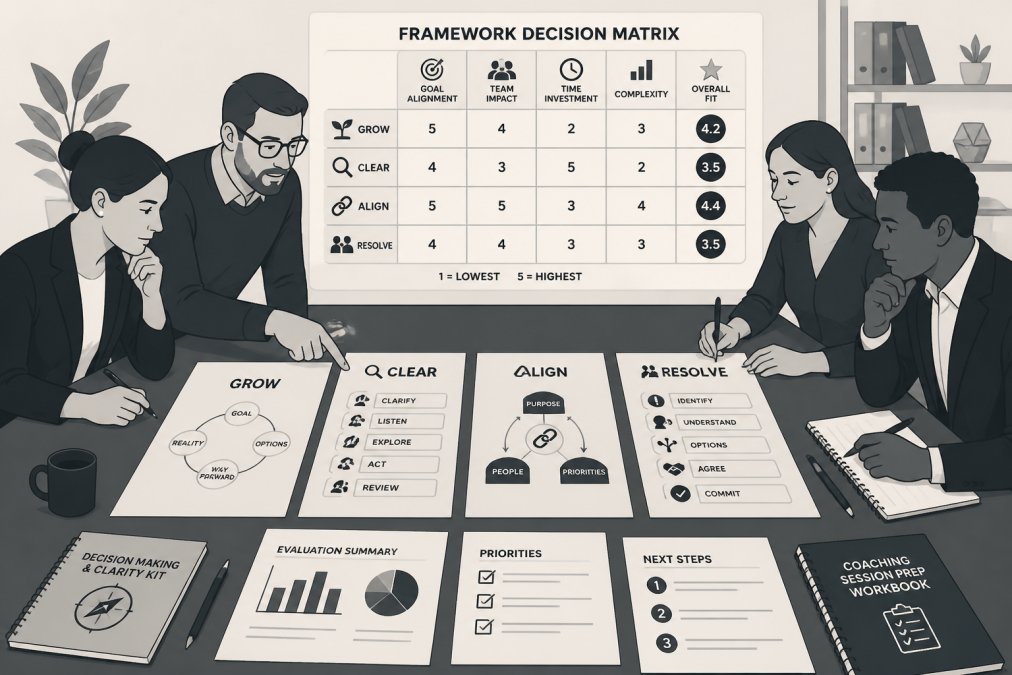
Choosing the right framework depends on three variables: the nature of the challenge, the coachee’s current state, and the time available.
|
Framework |
Best For |
Cognitive Load Required |
Time Investment |
Primary Strength |
|---|---|---|---|---|
|
GROW |
Goal-setting, performance, clarity |
Low to medium |
30-45 min |
Momentum and action |
|
CLEAR |
Relational complexity, trust-building |
Medium to high |
60+ min |
Psychological safety |
|
STEPPPA |
Stress, emotion, resilience |
Medium |
45-60 min |
Addressing emotional barriers |
|
OSKAR |
Building on strengths, momentum |
Low to medium |
30-45 min |
Solution-focus and scaling |
|
FUEL |
Manager coaching, 1:1s |
Low |
30 min |
Accessibility and simplicity |
If the challenge is primarily about goal clarity or decision-making: Use GROW or OSKAR. OSKAR if the coachee has wins to build from; GROW if you need a straightforward path forward.
If the challenge involves relational complexity or trust issues: Use CLEAR. The time investment pays dividends in deeper change.
If the coachee is visibly stressed or emotionally activated: Use STEPPPA. The framework addresses the real obstacle before problem-solving.
If you’re a manager coaching your direct report in a routine conversation: Use FUEL.
If you’re building organizational coaching capability: Start with FUEL or GROW, building to CLEAR and STEPPPA as coach skill develops.
The real skill is recognizing which framework fits the moment. A leader might need CLEAR one week and GROW the next, depending on what’s blocking them. The best coaches hold multiple frameworks and choose based on what they observe: cognitive load, emotional state, relational dynamics, and time available.
Choosing the right coaching framework is ultimately about meeting your client where they are. The Method Lab provides ready-made toolkits that bring these frameworks to life in actual conversations, from the Coaching Session Prep Workbook for planning your approach to the Coaching Outcomes & Impact Measurement Kit for demonstrating the value of your coaching. Get your free toolkit and start building credibility in your next high-stakes conversation.
Frequently Asked Questions
What is the best coaching framework for high-stakes decision-making?
The best framework depends on the context. STEPPPA excels when emotions and cognitive load are blocking clear thinking, as it explicitly names stress and explores perception shifts. OSKAR works well for rapid problem-solving where you need to surface existing strengths quickly. For decisions involving multiple stakeholders, CLEAR builds the psychological safety required for honest dialogue. Use the decision matrix in this article to match your specific scenario to the right coaching framework.
How do coaching frameworks differ in high-stakes versus routine coaching situations?
High-stakes coaching requires frameworks that address cognitive load and emotional blockers, not just linear goal-setting. Standard GROW works for performance discussions, but under pressure, leaders need models that slow down perception-checking (CLEAR, STEPPPA) or accelerate action with existing resources (OSKAR). The key difference: high-stakes frameworks build in reflective practice and accountability mechanisms to ensure decisions hold under stress. Most frameworks can adapt, but STEPPPA and CLEAR were specifically designed for complex, emotionally charged scenarios.
Can I use multiple coaching frameworks with the same client?
Yes, and experienced coaches often do. A leader might start with GROW to clarify goals, then shift to CLEAR if emotional resistance emerges, then use OSKAR to maintain momentum on action. The risk is confusing your client with too many models in one engagement. Best practice: choose your primary framework upfront, then shift deliberately when you hit a barrier the first model can't address. Document the shift so your client understands why you're changing approach. Tools like the Coaching Outcomes & Impact Measurement Kit help track which frameworks drive results for specific situations.
How do I know if a coaching framework is actually working in real client situations?
Measure three things: (1) Does the client move from stuck to clarity? (2) Do they commit to specific actions with deadlines? (3) Do they follow through and report measurable results at the next session? Many coaches lack measurement systems, which is why 60% struggle to prove coaching ROI. The Coaching Outcomes & Impact Measurement Kit provides a structured way to track progress against the framework you're using, so you can see which models deliver results for which types of challenges. Collect data across 5-10 engagements before deciding whether a framework works for your practice.
