
Table of Contents
- Why Structured Tools Matter for Managing Difficult Employees
- How to Lead Difficult Conversations With Confidence
- Scripts for Addressing Employee Behavior Issues
- Objective Documentation Strategies for Performance Issues
- Performance Improvement Plan Templates and Implementation
- Active Listening and Root Cause Analysis
- Building Psychological Safety While Maintaining Boundaries
- Conclusion
Last Updated: August 18, 2026
Why Structured Tools Matter for Managing Difficult Employees
Managing difficult employees with structured tools transforms what could be a chaotic, emotionally draining process into a clear, repeatable framework. Without structure, managers often react to behavior problems instead of addressing them strategically. They avoid conversations, document inconsistently, or escalate prematurely, each approach creating more friction, not less.
The real problem isn’t that difficult employees exist. It’s that most managers navigate these situations without a reliable playbook. They wing it, hoping the conversation goes well or that the problem resolves itself. Neither happens. Instead, tension builds, documentation becomes legally risky, and the employee either leaves or stays resentful.
Structured tools solve this by doing three things at once. First, they reduce the emotional weight of the conversation for the manager, you’re following a framework, not improvising. Second, they ensure consistency. Every employee with a similar issue receives fair, documented treatment. Third, they create accountability. Both manager and employee know what was discussed, what’s expected, and what happens next.
At The Method Lab, we’ve worked with managers across industries who initially resisted structured approaches, thinking they’d feel robotic or inauthentic. What they discovered was the opposite: structure actually freed them to be more human. When you know the framework, you can focus on listening instead of worrying about what to say next.
This guide walks you through the exact tools and conversations that work, from preparation through documentation to follow-up. You’ll see how to lead difficult conversations with confidence, use scripts that don’t sound scripted, and build documentation that protects both you and the employee.
How to Lead Difficult Conversations With Confidence
Leading a difficult conversation starts long before you sit down with the employee. Most managers skip preparation entirely, then wonder why the conversation derails. Preparation isn’t about controlling the outcome, it’s about controlling your own clarity, emotions, and response options.
Pre-Conversation Preparation
Preparation happens in three stages: clarifying your intent, mapping the emotional landscape, and deciding your opening move.
Start by getting clear on what you actually want to accomplish. Not what you want the employee to feel, but what specific behavioral change you need. “Be more professional” is too vague. “Attend meetings on time and contribute prepared comments” is actionable. Write it down. This becomes your north star when the conversation gets difficult.
Next, map the emotions you expect to encounter, both yours and theirs. What makes you anxious about this conversation? Will the employee get defensive? Cry? Blame others? Acknowledge these possibilities. This sounds like overthinking, but it’s actually the opposite. When you’ve already imagined a difficult moment, it hits less hard when it happens.

Finally, decide your opening sentence. Not a script, a real sentence that feels true to you. “I want to talk about what’s been happening with your project deadlines because I see potential in you and I want you to succeed” is better than “We need to discuss performance.” The second one sounds like a warning. The first one signals you’re invested in the outcome.
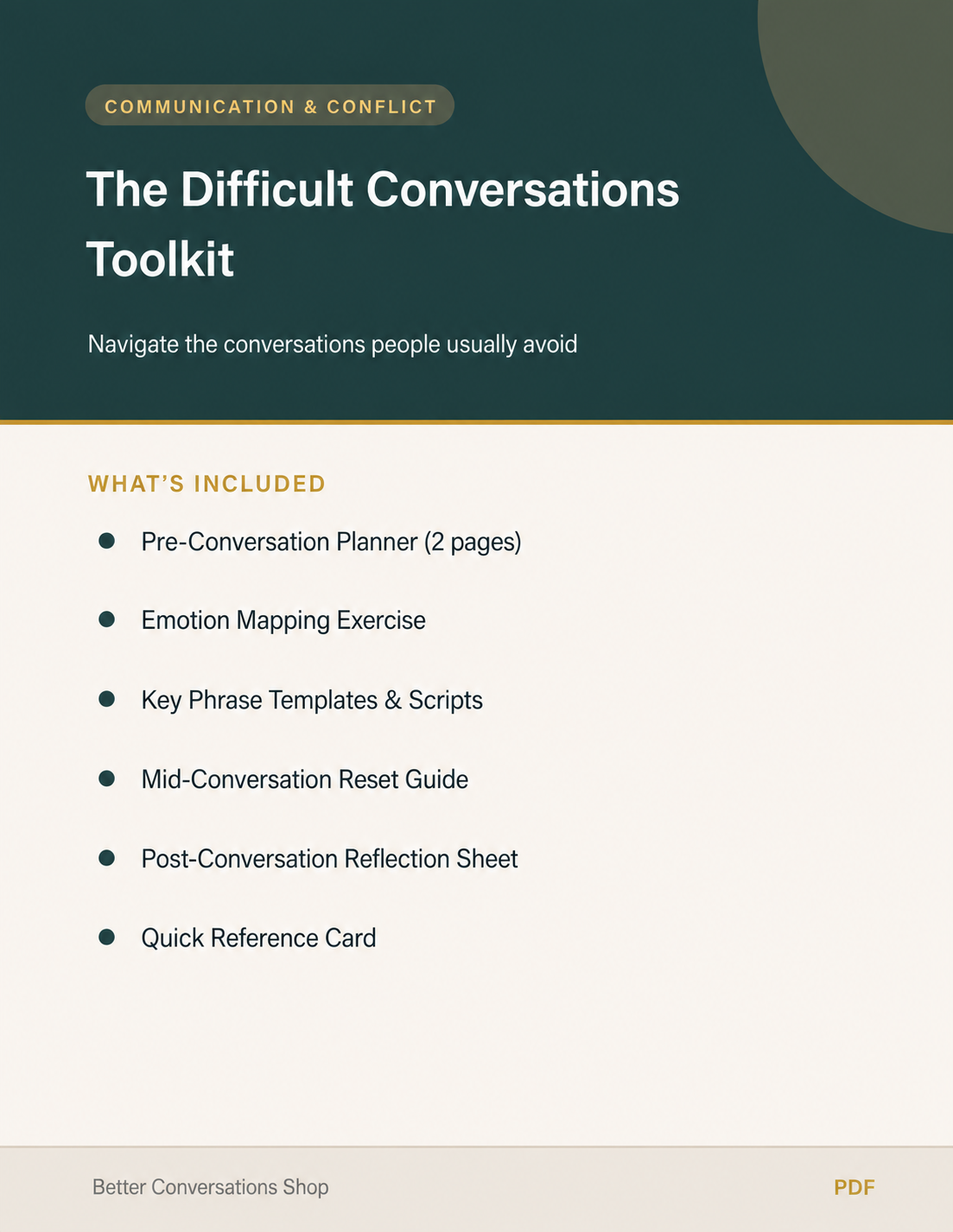
The Method Lab’s Difficult Conversations Toolkit provides a pre-conversation planner that walks you through each of these steps, plus an emotion-mapping exercise that surfaces what you’re actually worried about. When you name the worry, it loses power.
Managing Emotions in Real Time
During the conversation, two things will happen: the employee will respond in ways you didn’t predict, and your own emotions will spike. Managing both requires a reset mechanism.
If the conversation is heading off the rails, the employee is getting defensive, you’re getting frustrated, or you’ve lost track of your main point, pause. Not awkwardly. Intentionally. “I want to make sure I’m being clear. Let me take a breath and try that again.” This signals to the employee that you’re serious about being fair, not just venting.
Have three phrases ready for different scenarios:
If they’re defensive: “I hear that you see it differently. Help me understand your perspective.”
If you’re getting emotional: “This matters to me because I want you to succeed. Let me refocus on what I’m trying to say.”
If the conversation stalls: “What would help you hear this better? What would make this conversation more useful for you?”
These aren’t robotic. They’re pauses that reset the emotional temperature. The best conversations aren’t smooth, they’re honest, with natural pauses where both people recalibrate.
Scripts for Addressing Employee Behavior Issues
Scripts work when they’re not scripts. They work when they’re frameworks you’ve internalized enough to sound like yourself. Here are the structures that work for the most common difficult conversations.
For performance decline: “I’ve noticed [specific observable behavior] over the last [timeframe]. This matters because [concrete impact]. I want to understand what’s happening. What’s going on?”
This opens with observation, not judgment. You’re not saying they’re failing. You’re naming what you see and asking them to explain it. Half the time, there’s a reason you didn’t know about, a health issue, a personal crisis, a misunderstanding about priorities.
For behavioral issues affecting the team: “I need to talk about something that’s affecting the team. When [specific behavior happened], it impacted [who and how]. This isn’t about being perfect. It’s about the team being able to work together. What’s your take on this?”
Notice this doesn’t attack character. It describes impact. “You’re defensive” is a character judgment. “When you responded with ‘I already know that,’ it shut down the conversation” is observable. The employee can argue about their character. They can’t argue about what happened.
For insubordination or direct conflict: “I’m concerned about how we’re working together. [Describe the specific incident]. I need to be able to rely on you to [clear expectation]. That’s not happening right now. What do you need from me to make this work?”
This acknowledges the relationship is strained, names the specific issue, and offers a path forward. It’s not a threat. It’s a reality check.
For the conversation that needs to address consequences: “We’ve talked about this before. The pattern I’m seeing is [specific examples]. I need to be direct: if this continues, we’ll need to move to a formal performance improvement plan. I don’t want that. But I also can’t ignore what’s happening. What would help you get back on track?”
This is where documentation matters. You’re not threatening based on a feeling. You’re referencing a pattern you’ve already documented. The employee knows this is serious because you’ve been consistent.
Objective Documentation Strategies for Performance Issues
Documentation is where most managers fail. They either don’t do it at all, or they do it in a way that’s so vague or emotional it’s legally risky.
Objective documentation means you write down what happened, not what you think about what happened. “John was insubordinate” is subjective. “During the team meeting on August 15, John said ‘I’m not doing that’ when asked to revise the proposal, and then left the meeting without responding when I asked him to stay” is objective.
The pattern is: Date, Specific Observable Behavior, Impact, What You Said, Employee’s Response.
Example: “August 15, 2026: During team meeting, John stated ‘I’m not doing that’ in response to request to revise proposal. Left meeting without responding to request to discuss further. Impact: Proposal deadline at risk, team morale affected by tone. I said: ‘John, I need you to stay and talk about this.’ John’s response: Left the room.”
This is boring, specific, and defensible. It’s not a narrative. It’s a record.
Keep these notes in a dedicated file. Not emails. Not loose papers. A consistent documentation system that you can reference when you need to show a pattern. If you ever need to move toward formal disciplinary action or termination, this documentation is your evidence that you addressed the issue directly and consistently.
Performance Improvement Plan Templates and Implementation
A performance improvement plan (PIP) is a formal document that says: here’s what needs to change, here’s how we’ll measure it, here’s the timeline, and here’s what happens if it doesn’t improve. It’s not a punishment. It’s a clear contract.
Setting Clear Expectations and Accountability Measures
The PIP has three sections: what’s changing, how you’ll know it’s changed, and when you’ll check in.
What’s changing should be specific and behavioral. Not “improve attitude” or “be more professional.” Instead: “Complete all project deliverables by the agreed deadline” or “Respond to team messages within 24 hours” or “Attend all scheduled meetings on time.”
How you’ll know it’s changed means metrics. For the deadline example: “All deliverables submitted by 5 p.m. on the due date, as tracked in the project management system.” For the messaging example: “Response time logged in Slack, with exceptions documented.” You’re removing interpretation. Either it happened or it didn’t.
The timeline is usually 30, 60, or 90 days depending on severity. You’ll have check-in meetings every two weeks to discuss progress. Not to catch them failing. To acknowledge progress and troubleshoot barriers.
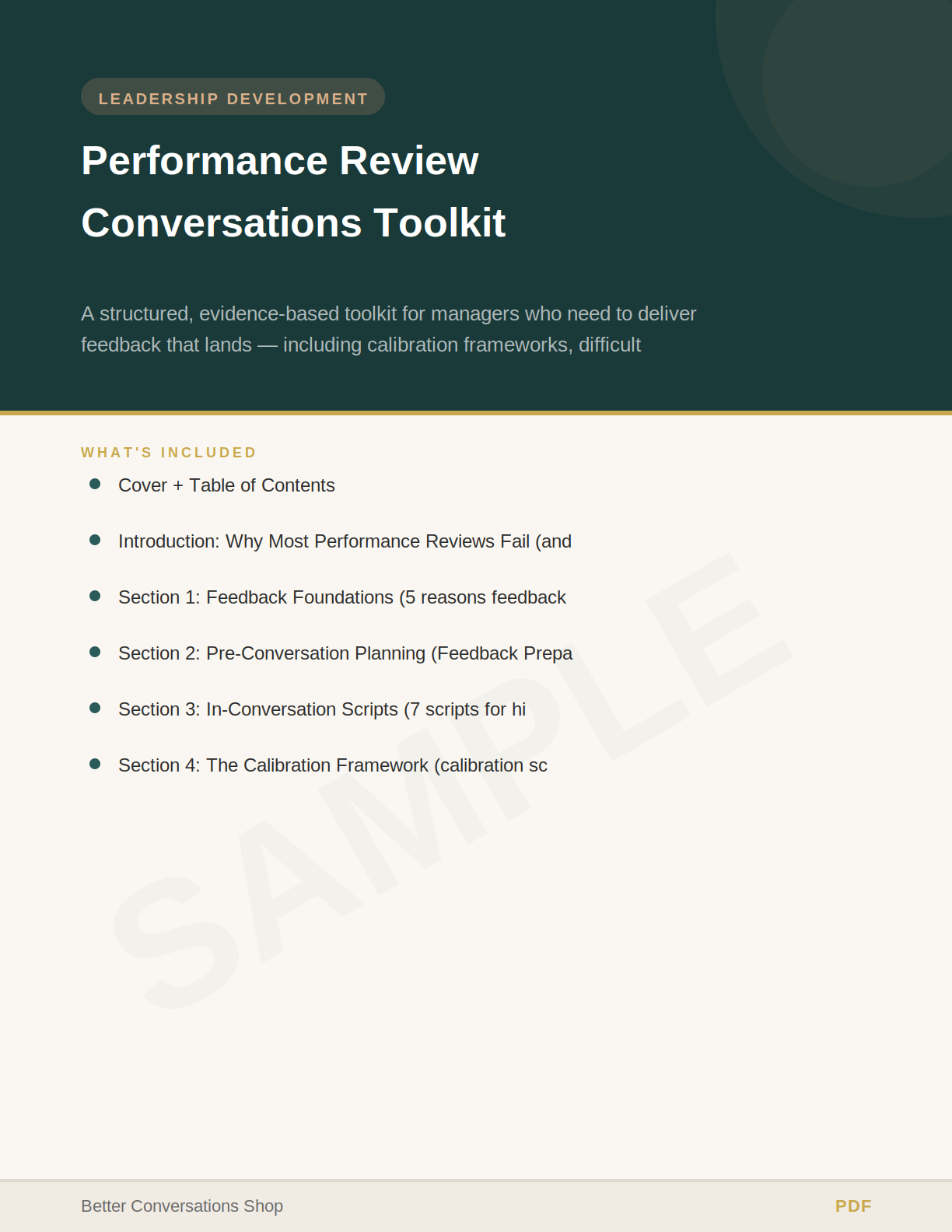
The Performance Review Conversations Toolkit includes a full PIP template with language for different scenarios. It also includes what to say in the PIP conversation itself, how to frame it as a support mechanism, not a threat.
Many employees respond to a clear PIP better than to vague feedback. They finally know what success looks like. They can see the finish line. Some turn it around completely. Others confirm they’re in the wrong role and leave voluntarily. Both outcomes are better than the alternative: months of tension with no resolution.
Active Listening and Root Cause Analysis
Most difficult conversations fail because the manager does 70% of the talking. They explain the problem, defend their position, and wonder why the employee seems resentful.
Active listening means you’re genuinely trying to understand the employee’s perspective, not just waiting for your turn to talk. It means asking questions and actually listening to the answers.

Root cause analysis means you’re asking “why” until you get to the real issue, not the surface symptom. An employee misses deadlines. The surface reason might be “I’m too busy.” But dig deeper: “What’s making you too busy?” “The requirements keep changing.” “Why do you think they’re changing?” “Because nobody’s clear on what we’re actually building.” Now you’re at the real issue. It’s not the employee’s time management. It’s unclear requirements.
Use these questions:
- “Help me understand what’s happening from your perspective.”
- “What’s making this difficult for you?”
- “What do you need to be successful here?”
- “What would change things?”
- “What am I missing?”
Then listen. Don’t interrupt. Don’t plan your response. Actually hear what they’re saying. Half the time, the employee will solve the problem themselves once they feel genuinely heard.
This is where managing difficult employees with structured tools intersects with genuine human connection. The structure gives you permission to slow down. You’re not winging it, so you can actually pay attention.
Building Psychological Safety While Maintaining Boundaries
This is the paradox most managers struggle with: How do you hold someone accountable while also making them feel safe enough to be honest?
Psychological safety for the manager means you don’t have to be perfect. You can acknowledge when you don’t know something. You can change your mind. You can admit you made a mistake in how you handled something. This signals to the employee that the conversation is about solving a problem together, not about you proving you’re right.
Boundaries mean you’re still the manager. You still have authority. You still make the final call. But you exercise that authority clearly and fairly, not arbitrarily.
Say this: “I care about you succeeding here. I’m going to be direct with you about what I’m seeing, and I need you to be direct with me. That doesn’t mean we’ll always agree, but we’ll understand each other. And if things don’t change, I’ll do what I need to do as a manager. But I’m not there yet. I’m here to help first.”
This tells the employee: you’re safe to be honest, and also this is serious. Both things are true.
The Difficult Conversations Toolkit includes specific language for creating this balance, how to be warm without being unclear, how to be firm without being cold.
Conclusion
Managing difficult employees doesn’t have to feel like managing. With the right structure, it becomes a clear process: prepare, listen, document, follow up. The employee knows where they stand. You know you’ve been fair. The organization has a record of what happened and what you did about it.
The Method Lab’s suite of tools, including the Performance Review Conversations Toolkit and The Difficult Conversations Toolkit, gives you the exact frameworks, scripts, and templates you need to navigate these situations with confidence. You’ll reduce anxiety, ensure consistency, and actually create space for change. Get Your Free Toolkit today and see how structured conversations transform your leadership.
Frequently Asked Questions
What are the most effective strategies for managing difficult employees?
Structured tools work best when combined with consistency. Start by clearly identifying observable behaviors rather than personality traits. Document specific incidents with dates and impacts. Use active listening to understand the root cause before jumping to solutions. Set clear expectations and follow up regularly. The Performance Review Conversations Toolkit provides field-tested scripts for seven high-stakes feedback scenarios, helping you address performance decline, behavioral issues, and team dynamics failures with confidence and consistency.
How do you document difficult employee behavior legally and effectively?
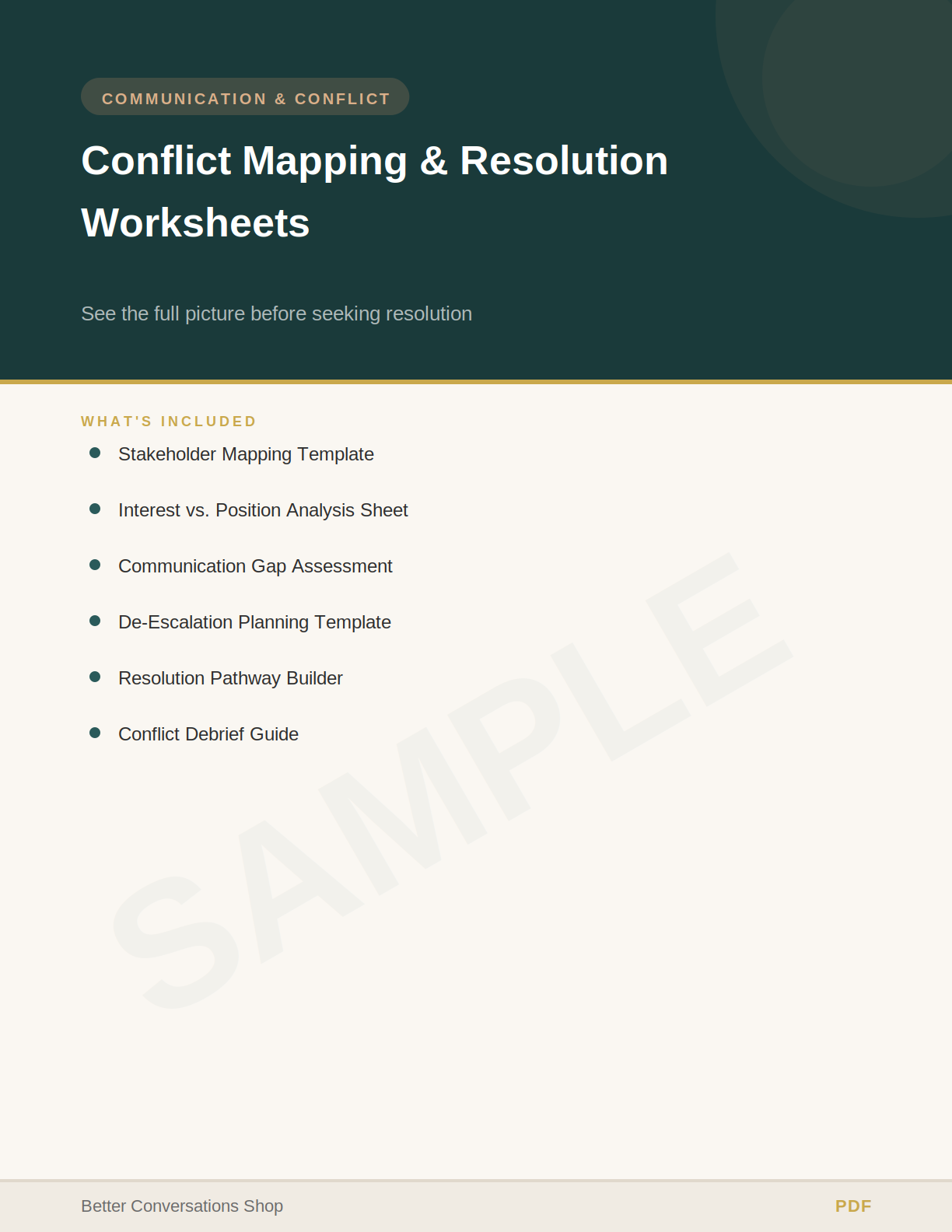
Objective documentation protects both you and the employee. Record specific, observable behaviors with dates, times, and business impacts—never personality judgments. Include what was said, what was observed, and the consequence. Keep records factual and unemotional. Document conversations, performance gaps, and any coaching provided. This creates a clear trail for HR and protects against legal exposure if disciplinary action becomes necessary. Structured worksheets help you capture the right level of detail without bias.
What role does active listening play in managing workplace conflict?
Active listening is foundational to resolving conflict. It builds trust, reveals root causes, and often defuses defensiveness before it escalates. When you listen without interrupting or planning your response, employees feel heard and are more open to feedback. This shift changes the dynamic from confrontation to collaboration. Many difficult conversations fail because managers lead with solutions before understanding the employee's perspective. Slowing down to listen first creates psychological safety and dramatically increases the likelihood of behavioral change.
How can I create a performance improvement plan that actually drives change?
A PIP only works when expectations are crystal clear and the employee understands the stakes. Start with specific, observable behaviors that need to change—not vague criticisms. Set measurable milestones with clear timelines (typically 30, 60, and 90 days). Schedule regular check-ins to provide feedback and coaching. The Performance Review Conversations Toolkit includes SMART and OSMART goal-setting frameworks plus a 30-60-90 day review structure. The key is making the path to success visible and providing consistent support, not just setting a deadline and hoping for improvement.