
Table of Contents
- Why Most Coaching Progress Measurement Fails
- 1. Goal Attainment Rate: The Core Metric for Coaching Progress
- 7. Coaching ROI Metrics: Connecting Progress to Business Impact
- Frequently Asked Questions
Last Updated: October 17, 2026
Why Most Coaching Progress Measurement Fails
Most coaching progress measurement fails because coaches track activity instead of outcomes.
Without a baseline, a target, and a cadence, the best metrics to track coaching progress become decoration. This guide covers seven measures that survive scrutiny from HR, sponsors, and the client.
The core problem is attribution. A client hits a goal, but so did a new manager, a reorganized team, and a strong quarter.
The most common failure is measuring only at the end. If you collect no baseline in week one, every later number is a guess dressed up as data.
1. Goal Attainment Rate: The Core Metric for Coaching Progress
Goal attainment rate is the share of agreed coaching goals fully met by a defined date.

Track it as a simple ratio: goals achieved divided by goals set. A client with five goals who completes four scores 80%.
(/measuring-coaching-roi-corporate-clients/) effectiveness across a program means aggregating individual results into a defensible picture for the sponsor. Most programs lose credibility here, not because coaching failed, but because reporting could not separate coaching effects from everything else happening in the organization.
Build a simple scorecard and report the same four lines every cycle: goal attainment rate, behavior change evidence, engagement, and sponsor satisfaction.
Comparing Cohorts Over Time
One engagement is an anecdote; a pattern across a cohort is evidence. Compare cohorts on the same four lines rather than a single client story:
- Same measures, same cadence. Use identical definitions and collection windows across cohorts so the comparison is fair.
- Report distribution, not just averages. A cohort where half the clients hit 100% goal attainment and half hit 40% has a different story than a cohort where everyone hit 70%, show both the mean and the spread.
- Track a comparison group where possible. If some eligible employees were not coached, or were coached in a later cohort, their trajectory on the same business measures gives you a rough counterfactual.
Attribution and Confounding Factors
Attribution is the honest naming of what else could explain the result. Use these checks before claiming coaching caused a change:
- Timing. Did the change begin after coaching started, or was it already underway?
- Specificity. Did the measures tied to the coaching goals move more than unrelated measures?
- Dose-response. Did more engaged clients improve more?
- Comparison. How did similar uncoached employees or teams perform over the same period?
- Plausible mechanism. Can the client or manager describe the specific behavior change that would produce the result?
No single check proves causation. Together they let you say “the evidence is consistent with a coaching effect” rather than “coaching caused this”, phrasing that survives a sponsor’s scrutiny.
Privacy, Consent, and Ethical Use of Coaching Data
Program-level reporting raises questions individual coaching does not. Address them before collecting a single data point:
- Get informed consent. Tell clients at the start what will be collected, who will see it, and in what form, individual, aggregated, or anonymized.
- Separate coaching notes from program reporting. Session content stays confidential; the scorecard reports aggregate measures and, where needed, individual outcomes the client has agreed to share.
- Set access rules. Decide in advance whether managers see individual scores or only cohort summaries, and document that rule in the coaching agreement.
A program scorecard that identifies individuals without consent will damage trust faster than any coaching outcome can repair it. Consent and aggregation rules belong in the coaching agreement, not in a footnote.
For program-level framing, the International Coaching Federation’s research on coaching outcomes is a reasonable reference point, but cite it for context, not as proof that your specific program caused a specific result.
7. Coaching ROI Metrics: Connecting Progress to Business Impact
Coaching ROI metrics translate individual progress into business impact: productivity, retention, project delivery, and escalation volume. This is the language sponsors fund.
Coaching Outcomes & Impact Measurement Kit →
Choose two or three business measures tied to the coaching goals and track them alongside individual metrics. A team lead coached on delegation might be measured on on-time project completion and escalation volume; a manager coached on difficult conversations on first-call resolution rate and callback volume.
A Simple ROI Formula for Coaching
Use a straightforward formula and state your assumptions openly.
ROI = (Value of benefit − Cost of coaching) ÷ Cost of coaching × 100
Worked example: if a coached team lead saves an estimated 40 hours of rework over a quarter and you value that time at a stated hourly rate, subtract the engagement cost and divide by the cost.
| Metric Type | Examples | What It Proves |
|---|---|---|
| Leading | Actions completed, engagement | Momentum |
| Lagging | Goal attainment, retention | Outcome |
| Business | Productivity, escalations | Impact |
Never present ROI as a single precise figure without showing the assumptions behind it. One challenged number can discredit the entire report.
If you want a ready-made structure for baselines, impact surveys, and ROI calculation, our Coaching Outcomes & Impact Measurement Kit at $28.99 gives you the full sequence in one place.
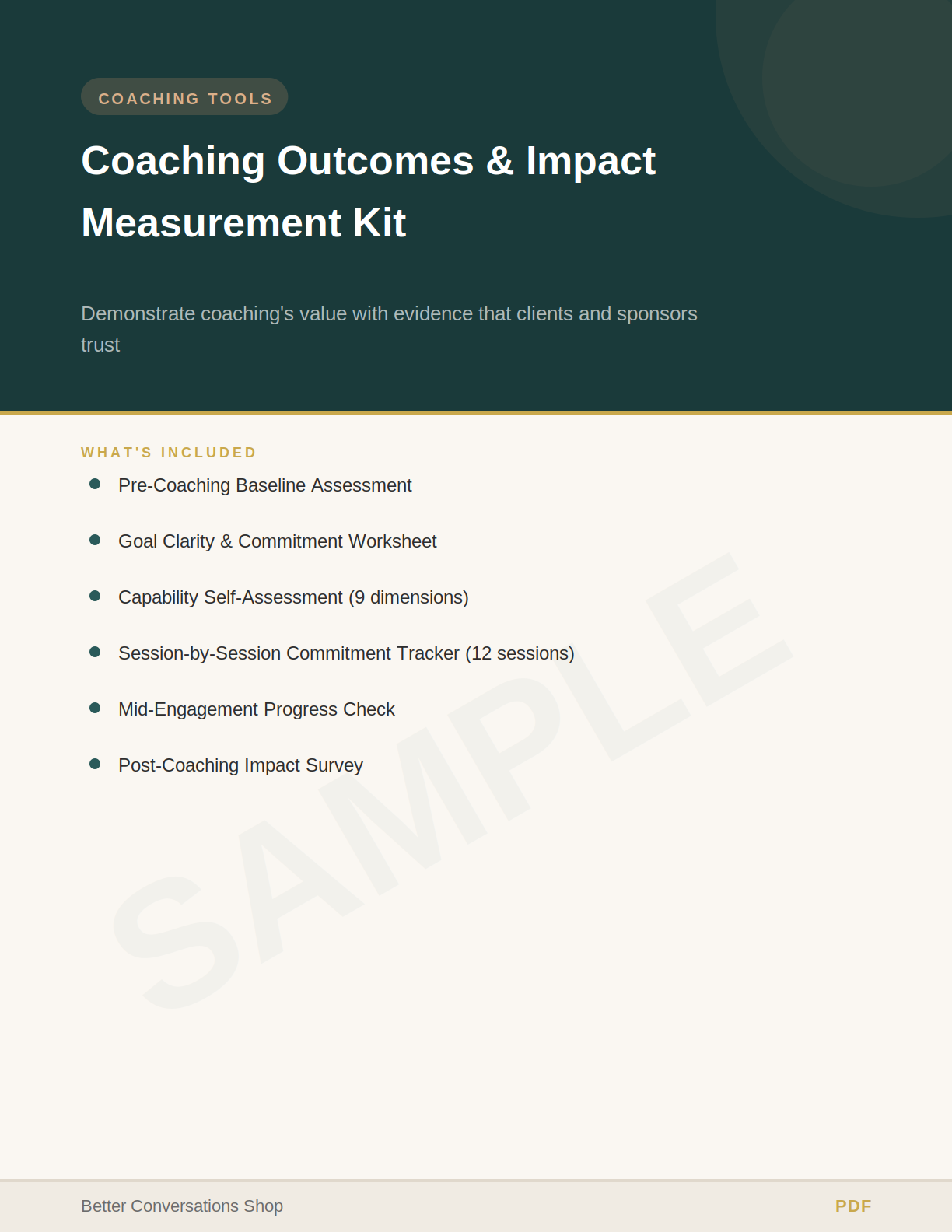
Sponsors renew when they see a baseline, a trajectory, and a defensible business case, evidence built in from session one.
The Method Lab provides structured frameworks and actionable playbooks. Get your free toolkit and start tracking coaching progress with evidence you can defend.
Frequently Asked Questions
How do you measure progress in a coaching relationship?
Measure progress by pairing a baseline taken before the engagement starts with a small set of metrics reviewed on a fixed cadence. Start with goal attainment rate, milestone completion, and a behavior change indicator. Add engagement data such as session attendance and between-session action completion. Review the numbers every four to six weeks so you can adjust the coaching plan while the engagement is still running. A written coaching progress tracking template keeps the comparison consistent from session one to close.
What are the best KPIs for a coaching program?
The strongest KPIs combine client-level and program-level data. At the client level, track goal attainment rate, on-time completion of agreed actions, and self-rated confidence or capability scores. At the program level, track participation rates, satisfaction survey results, and business impact measures such as productivity or retention. Keep the list to five to seven KPIs. More than that and the dashboard stops being actionable. Pair each lagging indicator, like a business result, with a leading indicator, like action completion, so you can spot problems early.
How can coaches measure behavior change?
Use three sources. First, a pre-engagement baseline survey that captures how often the client currently performs the target behavior. Second, a repeat survey at the midpoint and end of the engagement using the same questions. Third, observation data from the client’s manager or a 360-degree check-in. Ask clients to describe a specific situation where they applied the new behavior, which gives you evidence rather than impressions. Comparing the same questions over time is what turns behavior change into a number you can report.
How do you calculate the ROI of coaching?
Calculate ROI by dividing the monetary benefit of the coaching by its total cost, then expressing the result as a percentage. Total cost includes your fees, materials, and the client’s time away from work. Benefit comes from the business outcome the coaching targeted, such as reduced turnover, faster project completion, or higher sales. Use a conservative estimate and document your assumptions. If the engagement cost $6,000 and produced $18,000 in estimated benefit, ROI is 200 percent. Present the assumptions alongside the number so sponsors can judge the calculation.
How often should coaching progress be reviewed?
Review progress every four to six weeks during an active engagement, with a full measurement pass at the midpoint and close. Short reviews keep the coaching plan current and catch stalled goals early. A monthly check-in survey of three to five questions is usually enough between formal reviews. At the end of the engagement, run the same baseline questions again so the before-and-after comparison is clean. Schedule the review dates at the start of the engagement so they are not squeezed out by busy weeks.