
Table of Contents
- What Standardized Coaching Tools Actually Deliver
- Defining Coaching ROI and Measurable Outcomes
- Coaching Framework Best Practices for Consistent Results
- Measuring Coaching Effectiveness Metrics That Matter
- Workplace Coaching Methodology Examples and Implementation
- How to Calculate ROI from Your Coaching Investment
- Standardization vs. Customization: The Implementation Reality
- Conclusion
Last Updated: August 16, 2026
What Standardized Coaching Tools Actually Deliver
Coaching without measurement is just conversation. Standardized coaching tools create consistency across engagements while building evidence that demonstrates coaching’s impact. Unlike ad-hoc conversations, structured frameworks ensure every client receives the same foundational approach, every session captures comparable data, and outcomes are tracked against clear benchmarks.
The difference between a coach who says “my clients report feeling better” and one who says “my clients improved leadership effectiveness scores by 28 percent and retained top performers at higher rates” is the presence of a measurement system. Coaches who implement structured measurement frameworks see three immediate shifts: they close more engagements (clients see documented progress), command higher fees (they can justify investment with data), and scale faster (they can replicate proven methods across multiple clients).
Defining Coaching ROI and Measurable Outcomes
Coaching ROI means different things depending on who’s asking. A client wants to know if they’re a better leader. An HR sponsor wants to know if coaching reduced turnover or improved team performance. A coach wants to know if they can demonstrate value to justify fees and earn referrals.
Measurable outcomes fall into three categories: behavioral change (how the client acts differently), business impact (what changed in their organization), and personal development (skills, confidence, or clarity gained).
Behavioral change is easiest to observe but hardest to quantify. A client might be more direct in difficult conversations, delegate more effectively, or listen more actively in meetings. Proving this requires structured feedback from the client’s manager, peers, or direct reports.
Business impact is what organizations care about most: Did retention improve? Did team engagement scores go up? Did the client’s department hit revenue targets? These metrics exist in organizational systems already; the challenge is connecting them to coaching.
Personal development, the client’s sense of growth, matters for renewal and referrals. A client who feels they’ve gained clarity, confidence, or new skills is more likely to recommend the coach and extend the engagement.
The ROI calculation sits at the intersection of these three: measuring the value created (business impact) against the cost of coaching (coach fees, client time, tools). Standardized coaching tools reduce the time required to gather and organize this evidence.
Coaching Framework Best Practices for Consistent Results
A coaching framework is the backbone of consistency. The best frameworks share common elements: clear goal definition, structured assessment of current state, a change plan with specific behavioral targets, regular progress tracking, and documented outcomes.
Goal clarity is foundational. Vague goals (“become a better leader”) don’t measure. Specific goals do (“reduce status meeting time by 40 percent while maintaining team alignment” or “have direct reports rate feedback quality as 4 out of 5 or higher”).
Baseline assessment proves progress. A coaching framework should include pre-coaching measurement of the target behavior or outcome, a 360-degree feedback assessment, performance metrics, or structured feedback from the client’s manager. Without a baseline, you’re guessing at whether change happened.
Session structure keeps coaching focused: review last week’s commitment, discuss what’s working and stuck, identify the core issue, design a new commitment, and confirm what the client will do before the next session. This ensures every session moves the client forward.
Progress tracking between sessions creates accountability and surfaces patterns. A weekly check-in, brief call or structured form, keeps coaching active and gives the coach data about what’s working.
Post-coaching assessment completes the loop. A measurement taken at engagement end (using the same assessment as baseline) shows whether the target behavior or outcome actually changed. This is the evidence ROI depends on.
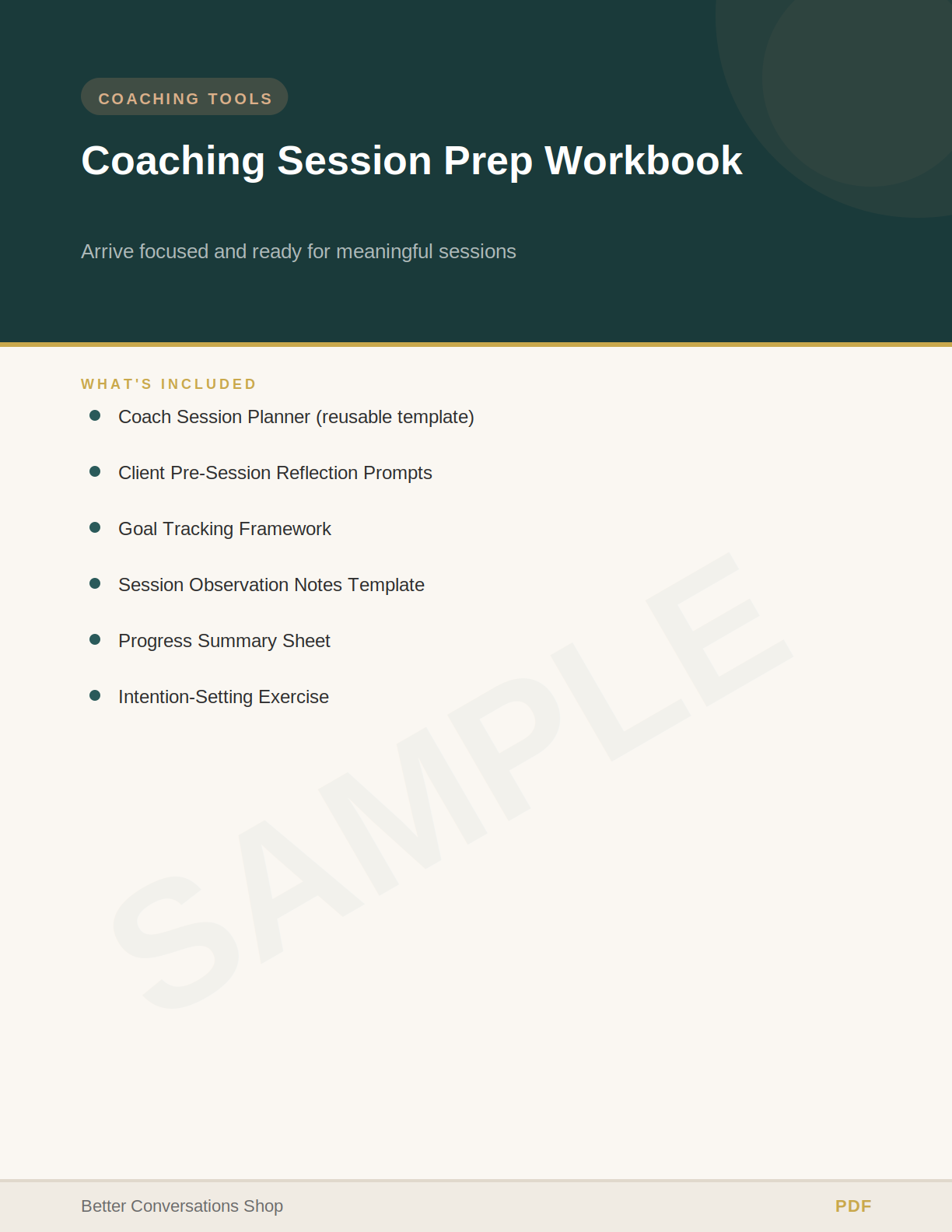
The Method Lab’s coaching frameworks emphasize this consistency. Tools like the Coaching Session Prep Workbook provide structure for both coach and client, ensuring preparation before every session and reflection after.
Measuring Coaching Effectiveness Metrics That Matter
Not all metrics are created equal. The metrics that matter connect coaching activity to business outcomes.
Output metrics measure coaching activity: number of sessions, number of clients, hours delivered. These are easy to track but tell you nothing about whether coaching worked.
Outcome metrics measure what changed as a result of coaching: behavioral change (measured through 360 feedback, manager observation, or peer feedback), business performance (retention, revenue, engagement scores, project delivery), and client satisfaction.
Leading indicators predict whether coaching will succeed: goal clarity, commitment, and environmental support. If leading indicators are weak, coaching is unlikely to succeed.
Lagging indicators show whether coaching succeeded: Did the client’s performance improve? Did they stay in their role? Did their team’s engagement scores go up?
The most defensible ROI calculation combines leading indicators (to predict success) and lagging indicators (to prove it happened).

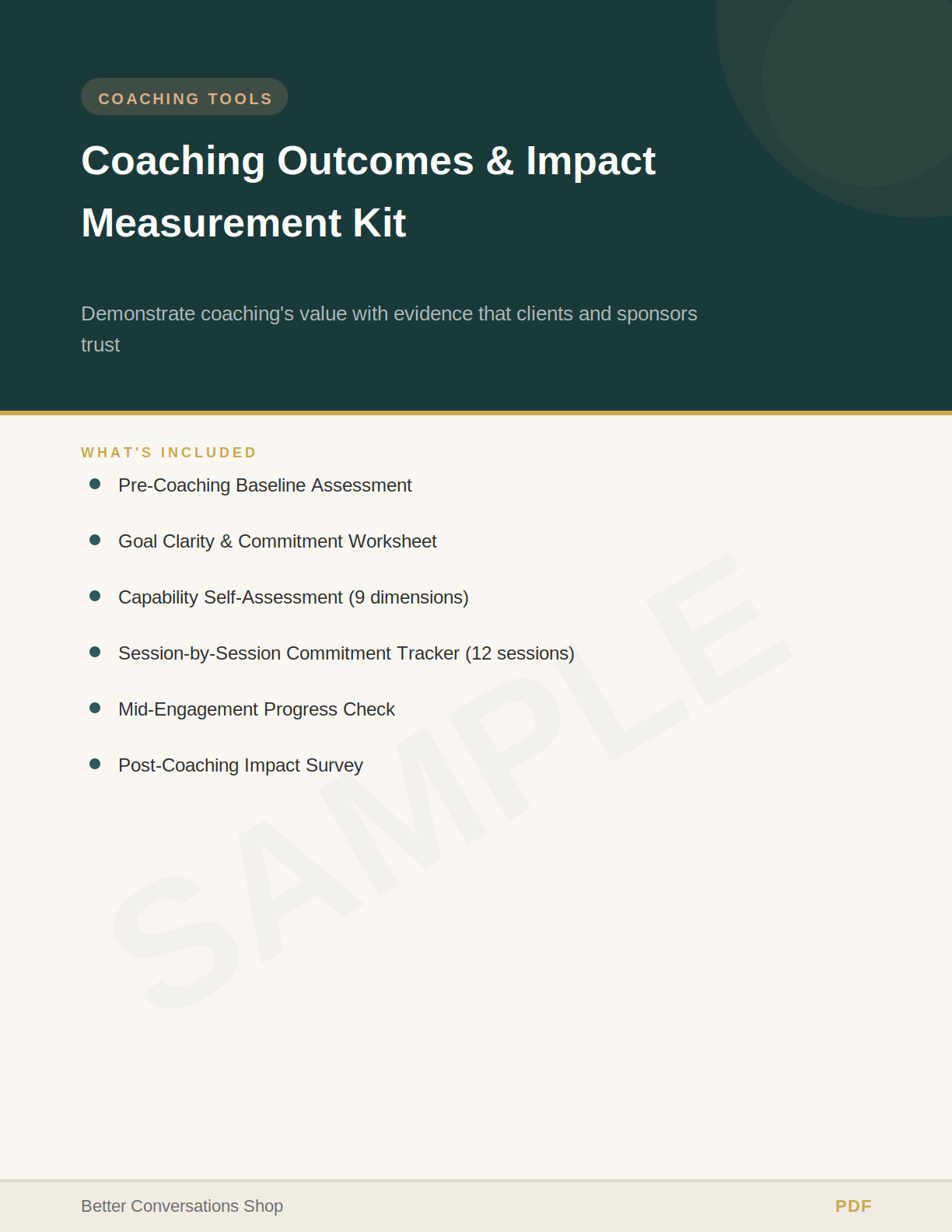
The Coaching Outcomes & Impact Measurement Kit from The Method Lab provides a complete system for capturing these metrics. It includes baseline assessment tools, progress tracking templates, and a post-coaching impact survey. Coaches using this kit can demonstrate that their clients improved on specific measures.
Workplace Coaching Methodology Examples and Implementation
The most effective workplace coaching methodologies share common logic: diagnose the real issue, design a targeted intervention, track progress, and measure outcomes.
Executive coaching typically focuses on leadership effectiveness, executive presence, or strategic decision-making. Methodology: 360 feedback (baseline), monthly sessions over 6-12 months, peer check-ins between sessions, and post-engagement 360 (outcome measurement). ROI is measured through promotion, expanded scope, or improved team engagement.
Team coaching addresses dynamics, collaboration, or performance issues. Methodology: team assessment (baseline), facilitated team sessions, between-session accountability, and post-engagement team survey. ROI is measured through improved engagement, reduced turnover, or improved project delivery.
Manager coaching helps managers improve people leadership. Methodology: manager self-assessment or 360 feedback (baseline), structured coaching on specific skills, manager implementation of new behaviors, and measurement of direct report engagement or retention.
Performance coaching targets specific behavioral or skill gaps. Methodology: clear performance target (baseline), structured practice and feedback, measurement of improvement, and transition to independence.
Implementation requires three elements: clear methodology (the framework coaches follow), consistent tooling (templates, assessments, tracking systems), and accountability (regular progress reviews and outcome measurement).
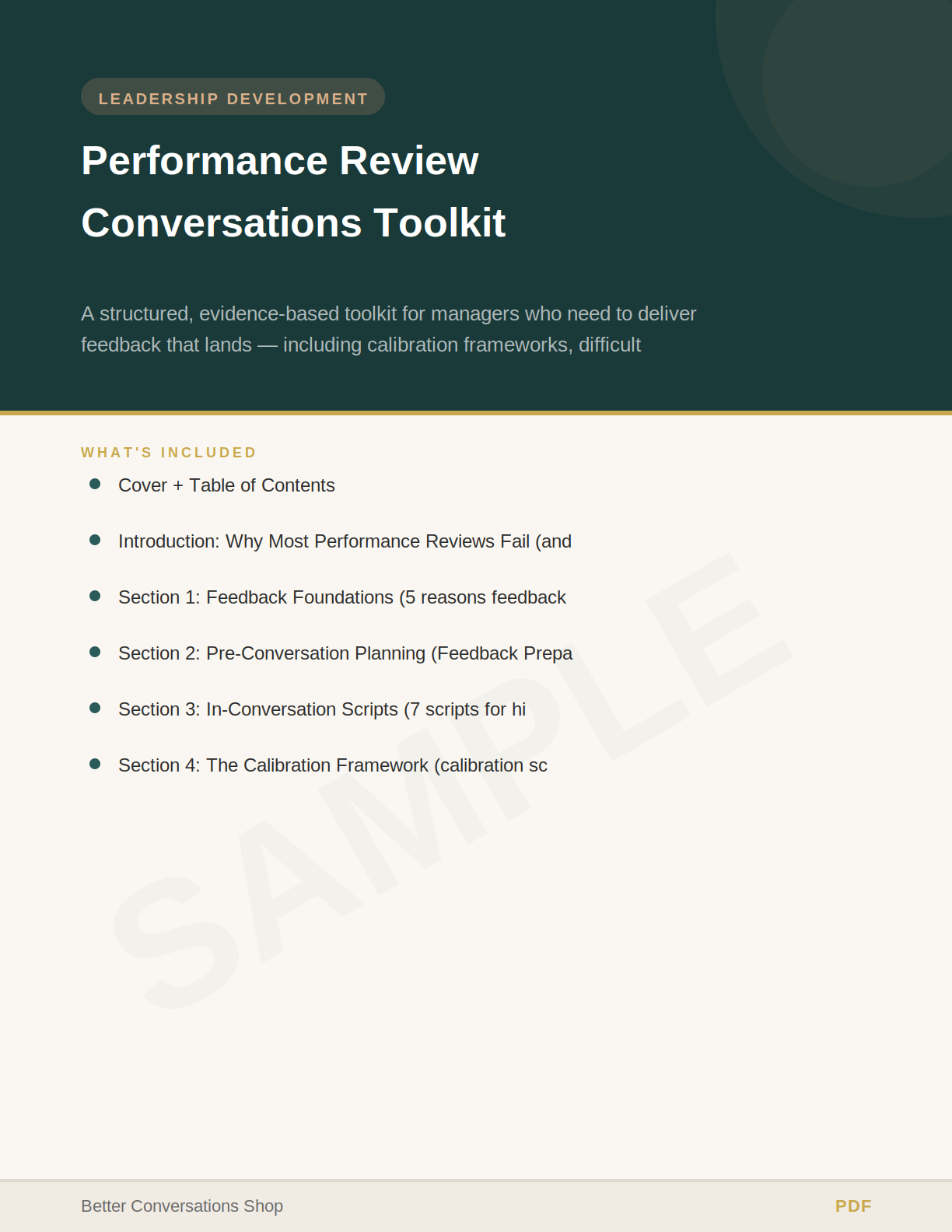
The Method Lab’s tools support implementation across all methodologies. The Performance Review Conversations Toolkit helps managers conduct feedback conversations that change behavior. The Manager’s 1:1 Meeting Mastery Kit provides structure for high-use leadership conversations. The New Leader’s First 90 Days Toolkit guides leaders through the critical early period when credibility is established.
How to Calculate ROI from Your Coaching Investment
ROI calculation for coaching is straightforward in theory but requires discipline in practice.
The formula: (Value Created – Cost of Coaching) / Cost of Coaching × 100 = ROI percentage.
Value created is where most coaches struggle. It’s tempting to estimate (“my client probably improved retention by 5 people, worth $X”). Better practice is to measure actual outcomes.
Cost of coaching includes coach fees, platform or tool costs, and the client’s time investment (typically valued at their hourly rate).
Here’s a practical example: A VP of Sales engages a coach for 6 months. Coach fees: $15,000. VP’s time investment (2 hours/week at $100/hour): $1,200. Platform tools: $300. Total cost: $16,500.
Measurement: The VP’s team improved sales forecast accuracy from 72 percent to 84 percent. Improved forecasting reduced inventory carrying costs by $8,000 and improved cash flow by $12,000. One high-performer who was considering leaving decided to stay (estimated replacement cost: $50,000).
Value created: $8,000 + $12,000 + $50,000 = $70,000.
ROI: ($70,000 – $16,500) / $16,500 × 100 = 324 percent ROI.

This calculation works because it’s grounded in actual outcomes. The key is measurement discipline: baseline measurement before coaching starts, progress tracking during coaching, and outcome measurement after coaching ends.
|
Step |
Description |
Timeline |
Evidence Source |
|---|---|---|---|
|
1. Define coaching goal |
Establish specific, measurable target (e.g., improve team retention, enhance leadership presence) |
Week 1 |
Client + Manager agreement |
|
2. Measure baseline |
Capture starting point using assessment tools or performance data |
Week 1-2 |
Baseline survey, performance metrics, 360 feedback |
|
3. Implement coaching |
Execute coaching sessions with structured framework and progress tracking |
Weeks 3-26 |
Session notes, progress tracking forms |
|
4. Track progress |
Monitor leading indicators and intermediate outcomes |
Ongoing |
Weekly check-ins, manager feedback |
|
5. Measure outcomes |
Conduct post-coaching assessment using same tools as baseline |
Week 27 |
Post-coaching survey, performance metrics, 360 feedback |
|
6. Calculate ROI |
Compare value created to total cost of coaching investment |
Week 28 |
Financial analysis, documented outcomes |
Standardized coaching tools accelerate this process. The Coaching Outcomes & Impact Measurement Kit includes baseline assessment templates, progress tracking systems, and post-coaching impact surveys, everything needed to move from “I think coaching worked” to “Here’s the measurable proof.”
Standardization vs. Customization: The Implementation Reality
Most coaching organizations face tension between standardized frameworks (which create consistency and scalability) and customization (which creates relevance and perceived value).
The answer is standardizing the framework while customizing the content.
What should be standardized: The overall coaching structure (how many sessions, what happens in each session, how progress is tracked, how outcomes are measured). The process for goal definition and baseline assessment. The format for progress tracking. The template for outcome measurement. These ensure consistency and enable comparison across clients.
What should be customized: The specific goals (every client’s situation differs). The content of coaching conversations (industry-specific challenges, organizational context, client’s personal style). The tools and assessments used. The pace and intensity.
A strong standardized framework actually enables more authentic customization because the coach isn’t reinventing the coaching structure, they’re free to focus on the client’s specific situation.
Think of medical practice: A cardiologist has a standardized diagnostic protocol (EKG, stress test, imaging). But the treatment plan is completely customized based on diagnostics. The standardization creates consistency and safety. The customization creates relevance.
Implementation reality: Start with a standardized framework (3-4 coaching sessions per month, 30-60 minute sessions, baseline and outcome measurement, progress tracking between sessions). Then customize within that framework (the client’s specific goals, topics discussed, homework assignments, measurement approach).
The Method Lab’s approach balances both. The frameworks are standardized, providing consistent structure and process, but designed to apply to different situations. The Difficult Conversations Toolkit provides a standardized preparation framework that works for performance reviews, difficult team dynamics, partnership disagreements, or family mediation. Same structure, completely different content.
Conclusion
The ROI of using standardized coaching tools depends on one thing: whether you can prove coaching worked.
Coaches who implement standardized measurement frameworks, baseline assessment, progress tracking, and post-coaching outcome measurement can demonstrate specific value. They know whether their clients improved on the target behavior. They can connect coaching to business outcomes. They can justify their fees with data and earn referrals based on documented results.
The Method Lab’s Coaching Outcomes & Impact Measurement Kit provides a complete system for capturing this evidence. It includes baseline assessment tools, progress tracking templates, and a post-coaching impact survey, everything needed to move from “I think coaching worked” to “Here’s the measurable proof.” At $28.99, it’s an investment that pays for itself the first time you use it to justify a coaching engagement to a skeptical sponsor or close a renewal with a client who saw documented progress.
Start measuring today. The ROI of using standardized coaching tools becomes obvious once you have the data to prove it.
Frequently Asked Questions
How do you measure the ROI of standardized coaching tools?
ROI measurement starts with establishing a baseline before coaching begins. Track three categories: quantitative metrics (retention rates, promotion velocity, revenue impact), qualitative outcomes (behavioral change, skill acquisition, leadership confidence), and operational gains (reduced turnover costs, faster decision-making). Use tools like the Coaching Outcomes & Impact Measurement Kit to systematically collect pre- and post-engagement data. Calculate ROI by dividing net benefits (financial gains minus coaching costs) by total investment. Most organizations see positive ROI within 6-12 months when measurement is consistent.
What are the key performance indicators for measuring coaching effectiveness metrics?
Essential metrics include employee retention (especially high-potential talent), promotion readiness and advancement speed, performance rating improvements, engagement scores, and behavioral change evidence. For leaders specifically, track direct report retention, team engagement, and strategic alignment. Financial KPIs include operating margin improvements, revenue growth attributed to coached leaders, and cost savings from reduced turnover. Qualitative indicators—such as 360-degree feedback improvements and self-reported confidence gains—provide equally important evidence. Standardized tools ensure you measure the same indicators consistently across all coaching engagements, making it easier to build a portfolio of impact data.
Why do 60% of coaches struggle to demonstrate coaching ROI?
Most coaches lack structured measurement systems. Without standardized assessment tools, they rely on anecdotal feedback or informal observations rather than data-driven evidence. This creates two problems: sponsors can't justify continued investment, and coaches miss the opportunity to refine their methodology based on what actually works. Standardized coaching tools solve this by providing pre-engagement baselines, session-by-session tracking, and post-engagement impact surveys. This transforms subjective impressions into quantifiable outcomes that satisfy organizational stakeholders and support renewal and referral decisions.
What's the difference between short-term and long-term ROI in coaching programs?
Short-term ROI (3-6 months) typically shows behavioral change, skill acquisition, and early performance improvements. Long-term ROI (12+ months) captures sustainable habit formation, promotion velocity, retention gains, and organizational culture shifts. A leader might show improved communication skills within weeks, but revenue impact from better team decisions takes longer to materialize. Standardized measurement systems track both timeframes—early wins build stakeholder confidence, while long-term data demonstrates lasting value. Most organizations see the strongest business case when they measure both, showing sponsors that coaching delivers immediate behavioral shifts and compounds into significant organizational performance gains over time.