Table of Contents
- Harmony Strategies vs Custom Coaching Frameworks: Core Differences
- Coaching Framework Examples: What Each Approach Delivers
- How to Build a Coaching Framework That Fits Your Organization
- Measuring Coaching Effectiveness: ROI and Impact Assessment
- Leadership Development Through Structured Coaching Models
- Implementation Timeline and Change Management Considerations
- Which Approach Wins: Decision Framework for Your Organization
Last Updated: August 15, 2026
Harmony Strategies vs Custom Coaching Frameworks: Core Differences
Harmony strategies vs custom coaching frameworks represent two fundamentally different philosophies about how coaching delivers value. Harmony strategies are pre-built, standardized methodologies with established protocols and built-in measurement systems. Custom coaching frameworks are purpose-built systems designed specifically for your organization’s culture, challenges, and strategic priorities.
Pre-built strategies reduce risk and accelerate implementation. Custom frameworks maximize relevance and often generate stronger behavioral change because they’re built for your specific context. Understanding where each wins is the core decision leaders face when designing coaching initiatives.
At The Method Lab, we’ve worked with organizations that tried both approaches. The ones that succeeded didn’t pick one and ignore the other. They understood the tradeoffs and made deliberate choices about which problems each approach solved best.
Coaching Framework Examples: What Each Approach Delivers
Pre-built coaching methodologies come in several recognizable forms: behavioral frameworks focused on measurable outcomes, values-based models aligning decisions with core principles, strengths-focused approaches building on what people do well, and transformational coaching emphasizing mindset shifts.
Custom frameworks start with your organization’s specific challenges. If your problem is cross-functional conflict, you design around facilitated dialogue. If it’s leadership pipeline gaps, you emphasize skill acquisition and mentorship. If it’s strategic misalignment, you target decision-making processes.
A harmony strategy arrives with training materials, facilitator guides, and session templates. You can launch in weeks. A custom framework requires discovery work, design sprints, and testing. You launch in months. But when the custom framework lands, it speaks your organization’s language and feels relevant, not generic.
The Harvard Business Review’s research on coaching effectiveness found that coaches who tailor their approach to organizational context see significantly higher engagement and sustained behavior change compared to those using standardized models alone.
Harmony strategies come with built-in metrics because they’ve been used across hundreds of organizations. Custom frameworks require you to define success first, then build measurement around it. That’s harder upfront but often more meaningful because you’re measuring what actually matters to your business.
How to Build a Coaching Framework That Fits Your Organization
Building a custom coaching framework starts with clarity about what problem you’re solving. Not “we need better leaders,” but “our managers struggle with difficult conversations” or “our cross-functional teams can’t make decisions together.”

Map your current state: How do leaders currently handle these situations? What language do they already use? A framework that contradicts your existing culture will face resistance. One that builds on what’s already working will feel natural.
Design the core coaching sequence: What’s the first conversation? What happens in the middle? How does it conclude? What’s the rhythm? This is where you decide whether your framework emphasizes behavioral change, mindset work, strategic alignment, or skill development.
Test with a pilot group of 5-10 leaders spanning different departments and experience levels. Watch what sticks and what creates friction. Refine based on real feedback, not assumptions.
The implementation timeline for a custom framework typically spans 4-6 months from discovery to full rollout. Harmony strategies compress this to 2-4 weeks.
One critical decision: will you build this internally or partner with an external consultant? Internal builds take longer but create ownership. External partnerships accelerate development but require more translation work on your end.
Measuring Coaching Effectiveness: ROI and Impact Assessment
Pre-built frameworks come with measurement systems already calibrated. Custom frameworks require you to define success metrics first, then track them.
Effective coaching measurement works at three levels: Individual (Did the coached leader change behavior?), Team (Did coaching improve collaboration, decision speed, or psychological safety?), and Organizational (Did coaching correlate with business outcomes?).
The Society for Human Resource Management’s 2026 coaching research found that organizations with formal measurement systems for coaching initiatives see 3-4x higher ROI than those without.
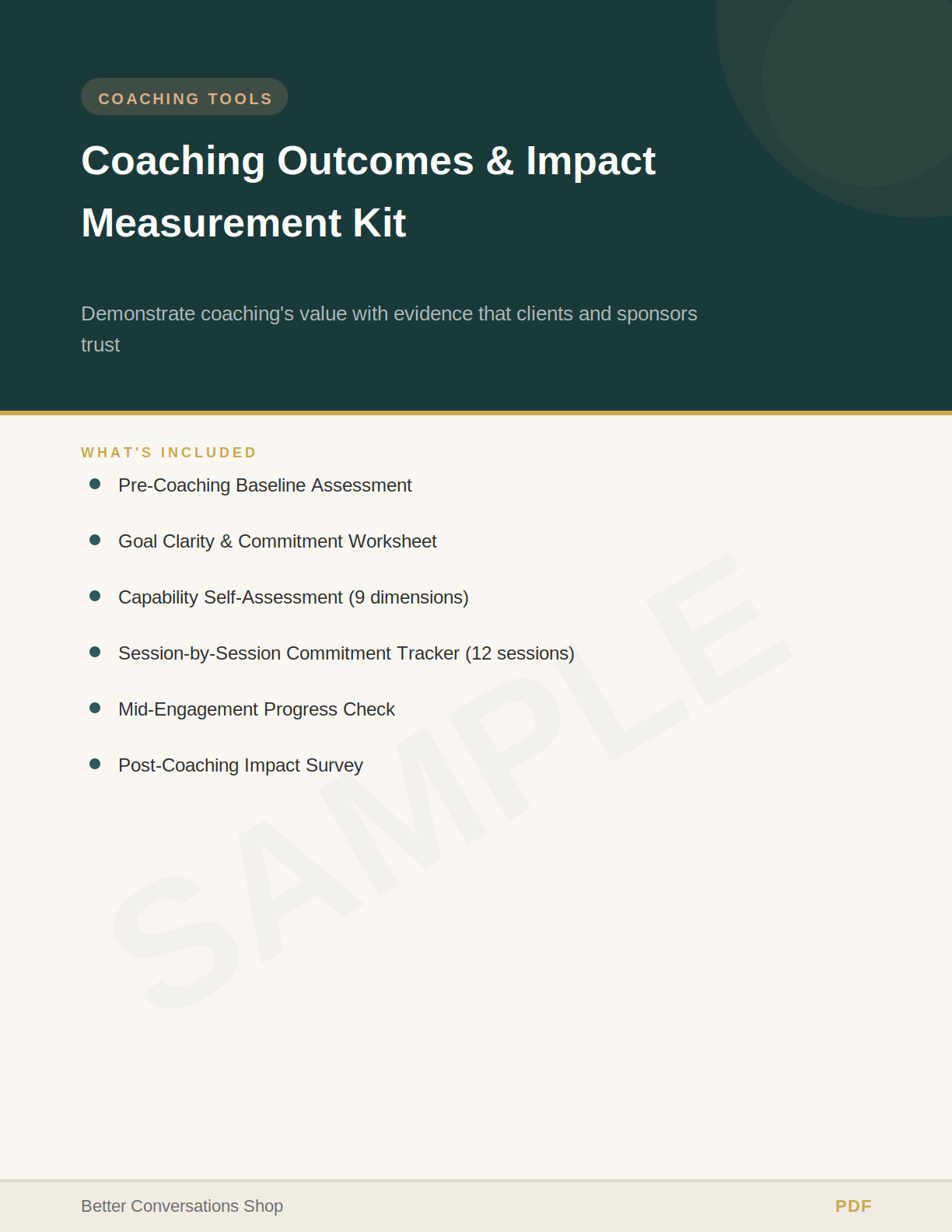
The Method Lab’s Coaching Outcomes & Impact Measurement Kit provides a complete measurement system from pre-coaching baseline through post-engagement impact survey and ROI calculation.
For custom frameworks, build your own measurement approach based on your specific challenge. If your framework targets conflict resolution, measure through team surveys about psychological safety. If it targets leadership pipeline development, measure through promotion rates and retention. If it targets strategic alignment, measure through decision speed and goal achievement.
Focus on behavioral indicators: what are people doing differently after coaching, not just whether they enjoyed it.
Leadership Development Through Structured Coaching Models
Structured coaching models create predictable pathways for leadership growth. Without structure, coaching becomes reactive. With structure, you build leadership capacity systematically.
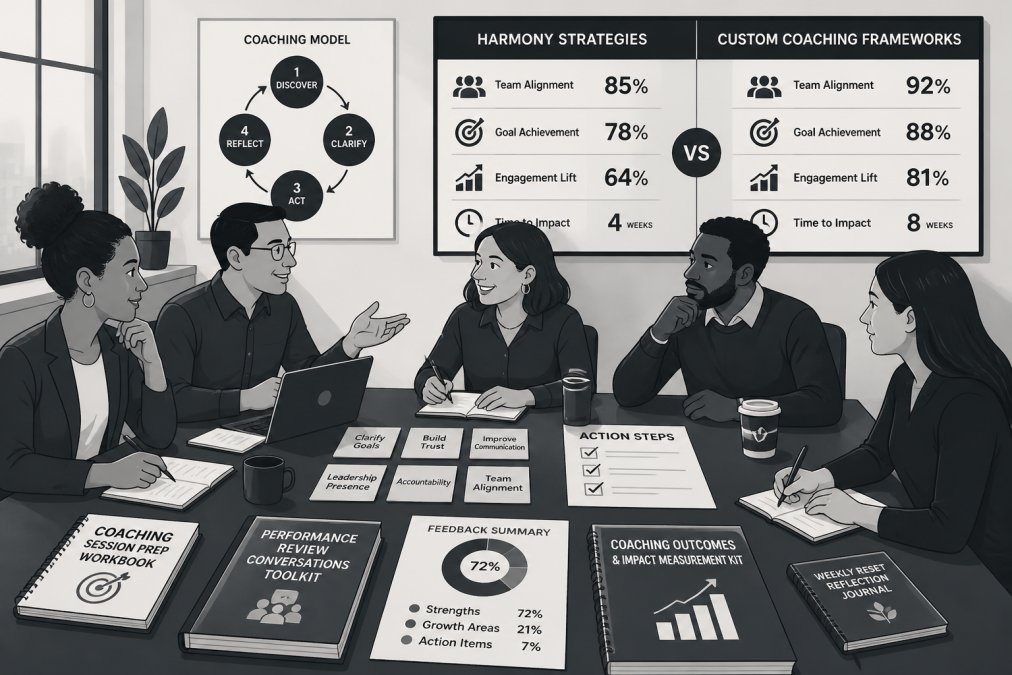
Effective leadership development models typically include assessment, coaching on specific competencies, peer exchange, feedback loops, and integration with real work challenges.
A harmony strategy might emphasize emotional intelligence across all leaders. A custom framework recognizes that mid-level managers need different development than senior executives. Your new managers need onboarding and confidence building. Your experienced leaders need strategic thinking and organizational influence.
Structured models also create accountability. When coaching is structured, you can track participation, focus areas, and achievements. When it’s ad-hoc, it’s invisible.
The best models also build in peer learning. Leaders learn from coaches and from each other through peer coaching groups, peer mentoring, and facilitated peer exchange.
Implementation Timeline and Change Management Considerations
A harmony strategy can launch in 2-4 weeks. Quick implementation means you see results faster and less time for resistance to build.
Custom frameworks require 4-6 months minimum: discovery (2-3 weeks), design (3-4 weeks), pilot testing (4-6 weeks), refinement (2-3 weeks), and training/launch (2-3 weeks). That’s a long runway, and during it, people wonder if this is real or another fading initiative.
Harmony strategies feel lower-risk because they’re proven elsewhere. Custom frameworks feel riskier because they’re new. Manage perception by involving people in design, sharing progress regularly, and celebrating early wins from pilots.
Consider how you’ll scale. If you’re starting with 20 leaders and planning to eventually coach 500, you need different infrastructure. Harmony strategies scale more easily because the model is standardized. Custom frameworks require you to build scalability into the design from the beginning.
Remote and hybrid work changes the calculus. Harmony strategies designed for in-person coaching may need adjustment for virtual delivery. Custom frameworks can be designed for virtual delivery from the start.
Which Approach Wins: Decision Framework for Your Organization
The choice isn’t about which is objectively better. It’s about which matches your situation, timeline, and constraints.
Choose a harmony strategy if you need to launch within 2-3 months, lack internal expertise in framework design, want a proven model with built-in measurement, face common coaching challenges, prefer lower risk, or have constrained budgets.
Choose a custom framework if your challenges are organization-specific, you have 4-6 months for design and pilot, have internal design capability, want maximum cultural alignment, are willing to invest more upfront, or operate in a unique context where generic models miss important nuances.
Many successful organizations use a hybrid approach: a harmony strategy as foundation, customized for their context.
|
Decision Factor |
Harmony Strategy |
Custom Framework |
|---|---|---|
|
Implementation Timeline |
2-4 weeks |
4-6 months |
|
Upfront Design Cost |
Low |
High |
|
Measurement System |
Pre-built |
You design |
|
Cultural Alignment |
Requires adaptation |
Built-in |
|
Scalability |
High (proven model) |
Requires planning |
|
Risk Level |
Lower |
Higher |
|
Long-term Impact |
Good |
Often higher |
|
Best For |
Speed and standardization |
Precision and fit |
Choosing between harmony strategies and custom coaching frameworks comes down to your timeline, your team’s capacity, and how specific your coaching challenge is. The Method Lab helps organizations navigate this decision by providing measurement tools, session prep resources, and alignment assessments that work with either approach. Whether you choose a proven harmony strategy or invest in a custom framework, start with clarity about what problem you’re solving and how you’ll know when coaching is working.
Frequently Asked Questions
What's the difference between Harmony Strategies and a custom coaching framework?
Harmony Strategies provides a pre-built, standardized coaching methodology designed for broad organizational use with minimal customization. Custom coaching frameworks are tailored to your specific organizational culture, leadership competencies, and performance management systems. Harmony Strategies offers faster implementation and lower upfront cost, while custom frameworks align directly with your strategic priorities and employee engagement goals. The choice depends on your organization's size, complexity, and budget for framework development and integration with existing HR tools.
How do you measure coaching effectiveness with either approach?
Measuring coaching effectiveness requires establishing baseline metrics before coaching begins, tracking behavioral change during engagement, and assessing business outcomes post-coaching. Both approaches benefit from tools that capture goal clarity, session-to-session progress, and ROI calculation. The Coaching Outcomes & Impact Measurement Kit provides a complete measurement system from pre-coaching baseline through impact survey and ROI calculation, helping coaches demonstrate value regardless of which coaching framework you choose. Track metrics like employee engagement scores, retention, promotion readiness, and 360-degree feedback improvements.
Are custom coaching frameworks worth the investment for small teams?
Custom frameworks typically make sense for organizations with 50+ employees where the ROI justifies development costs ($15,000–$50,000+). Smaller teams of 5–20 people often benefit more from adapting an established coaching methodology to their context rather than building from scratch. A hybrid approach works well: start with a proven framework like Harmony Strategies, then customize specific elements (conflict resolution language, feedback loops, decision matrices) to match your culture. This reduces implementation time and cost while maintaining strategic alignment.
How long does it take to implement a coaching framework?
Pre-built frameworks like Harmony Strategies typically deploy in 4–8 weeks: 1–2 weeks for team training, 2–4 weeks for initial coaching cycles, and 2–4 weeks for feedback and refinement. Custom frameworks require 3–6 months: 2–4 weeks for needs assessment and design, 6–8 weeks for development and testing, 2–4 weeks for trainer certification, and ongoing refinement. Remote and hybrid teams may need an additional 2–3 weeks for asynchronous training and digital tool integration. Success depends on clear change management, executive sponsorship, and early feedback loops to adjust as needed.