Table of Contents
- Why Small Teams Need Structured Coaching Frameworks
- Coaching Models for Team Leaders: Choosing the Right Fit
- Step 1: Assess Your Team’s Current Coaching Readiness
- Step 2: Select and Customize Your Coaching Framework
- Team Coaching Best Practices: Building Authenticity Into Structure
- Challenges of Team Coaching Implementation and How to Solve Them
- Coaching Framework Templates: What to Include and How to Use Them
- Measuring Success: How to Know Your Coaching Framework Is Working
Implementing Coaching Frameworks in Small Teams: A 7-Step Guide
Last Updated: July 28, 2026
Implementing coaching frameworks in small teams requires a different approach than enterprise-level programs. Small teams face unique constraints: limited budgets, fewer HR resources, and the challenge of maintaining authentic relationships while introducing structure. Teams that implement structured coaching frameworks report stronger retention, faster skill development, and more confident leaders. Below, we’ll show you exactly how to build a coaching framework that fits your team’s size, culture, and capacity.
Why Small Teams Need Structured Coaching Frameworks
The biggest misconception about small teams is that they don’t need frameworks. The opposite is true. When you have five people instead of fifty, every conversation matters more. A coaching framework isn’t bureaucracy, it’s permission to have conversations that move the needle without worrying you’re doing it wrong.
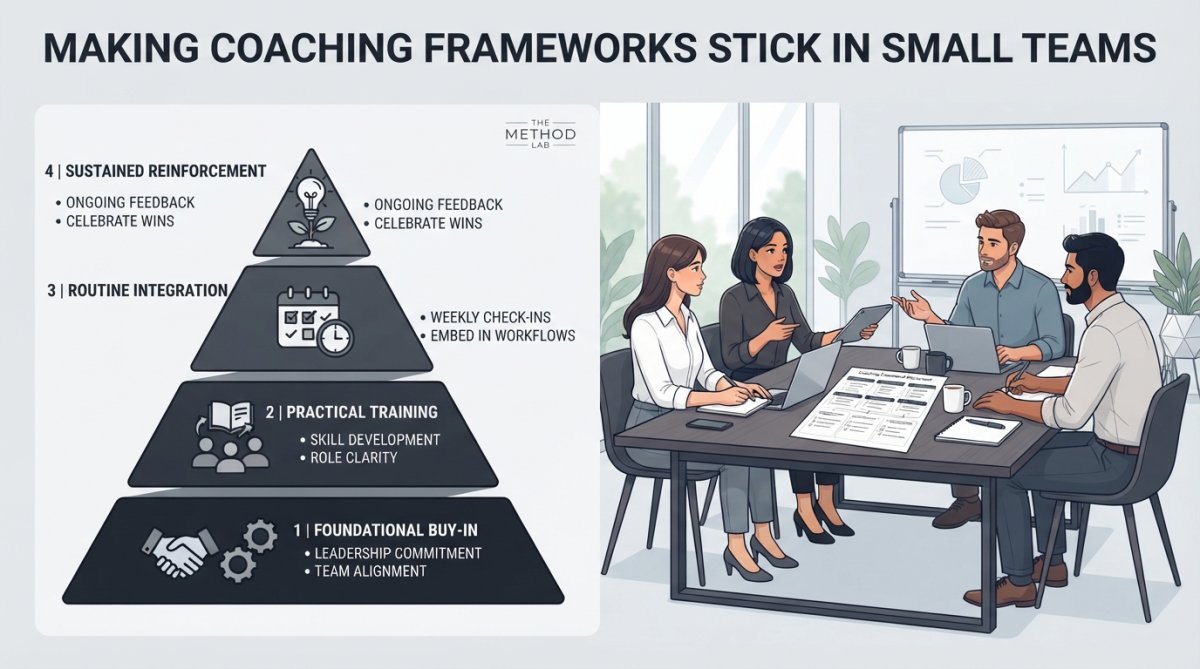
Without structure, relationships become inconsistent. One manager coaches through questions; another jumps straight to solutions. One person gets weekly check-ins; another gets none. A framework levels this playing field. According to research from the Society for Human Resource Management, organizations with structured coaching practices see 70% higher employee engagement. For small teams, the stakes feel higher because every member’s contribution is visible and essential. When people feel coached and developed, they stay longer and perform better.
Coaching Models for Team Leaders: Choosing the Right Fit
Your choice between one-on-one and group models, and between structured and conversational approaches, will shape how your team experiences coaching and how sustainable it is for you as a leader.
One-on-One vs. Group Coaching Models
One-on-one coaching is the foundation. These individual conversations between a leader and team member focus on that person’s growth, challenges, or performance. For small teams, one-on-one coaching is non-negotiable.
Group coaching brings the whole team together to work through a shared challenge or skill. A team struggling with communication might do group coaching on active listening. Group coaching is efficient and creates peer learning, but it’s not a replacement for individual conversations.
The ideal model for small teams is hybrid: monthly or bi-weekly one-on-one coaching conversations with each team member, plus quarterly group coaching sessions on topics that affect everyone.
Structured vs. Conversational Approaches
Structured coaching uses a defined framework, a set of questions, steps, or formats you follow consistently. The GROW model (Goal, Reality, Options, Will) is a classic example. Conversational coaching is more organic and can feel more authentic, but it’s inconsistent. One person gets deep coaching; another gets surface-level advice.
For small teams, a structured-but-flexible approach works best. Use a framework as your backbone, but allow conversations to deviate when it makes sense. The framework is your safety net, not your prison.
Step 1: Assess Your Team’s Current Coaching Readiness
Before implementing a framework, understand where your team actually is. Start by asking yourself: Do people trust you enough to be vulnerable? Have they experienced good coaching before? What’s the current communication style? Are people overworked, or do they have capacity for development conversations? What’s their experience with structure?
The answers shape how you introduce your framework. If your team has never experienced structured coaching, you’ll need to explain why and how it benefits them. If trust is low, start with smaller, lower-stakes conversations. If people are burned out, make coaching feel like support, not another task.
A practical way to assess readiness is a short conversation with each team member. Ask: “What would helpful coaching look like to you?” Listen for what they say and don’t say. Do they want structure or flexibility? Do they want feedback or support?
Step 2: Select and Customize Your Coaching Framework
You have three options: adopt an existing framework, customize an existing framework, or build one from scratch. Most small teams should start with an existing framework and customize it. The GROW model works well because it’s simple and flexible. So does the OSCAR model (Outcome, Situation, Choices, Actions, Review).
When you customize a framework, answer these questions: What’s the purpose of each coaching conversation? How long should conversations take? What questions will you ask? How will you document discussions? How often will you coach? What will you measure?
Let’s say you choose GROW. Your customization might look like this:
- Purpose: Help team members solve problems and develop skills
- Duration: 30 minutes per conversation
- Frequency: Bi-weekly for new team members, monthly for experienced ones
- Questions: “What’s your goal here?” “What’s the reality?” “What options do you see?” “What will you commit to?”
- Documentation: A simple one-page note with the goal, key insights, and commitment
- Success metric: Did the person take action on their commitment?
Involve your team in customization. Ask: “Does this framework feel right for how we work?” “What would make it more useful?” When people help shape the framework, they’re more likely to use it.
Team Coaching Best Practices: Building Authenticity Into Structure
This is where many frameworks fail. Leaders implement structure and sound like robots. Authenticity and structure aren’t opposites, they’re partners.
Staying Human While Using Frameworks
The biggest mistake is treating the framework like a checklist. A framework is a thinking tool, not a performance requirement. If a conversation naturally answers questions in a different order, that’s fine. If you realize the person needs advice more than coaching, that’s fine too.
Authenticity comes from genuinely caring about the person’s success and being honest about what you observe. If someone is struggling, say so. If you see potential they’re not seeing, point it out. The framework gives you permission to ask hard questions without overthinking them.
Use the framework as your thinking structure, not your speaking structure. Internalize the questions so you’re not reading them. Listen more than you talk. Follow the person’s energy.
Adapting Frameworks to Your Team’s Culture
Every team has a culture. Some teams are direct and fast-moving. Others are collaborative. Some work in crisis mode; others have predictable rhythms. Your framework needs to fit your culture, not fight it.
If your team is direct and fast-moving, your framework should be too. Short conversations, clear outcomes, quick action. If your team is collaborative, build in space for dialogue. If your team is results-focused, ask “What’s the business impact?” If your team is people-focused, ask “How will this affect the team?”
A framework that fights your culture will be abandoned. A framework that aligns with your culture will become how you work.
Challenges of Team Coaching Implementation and How to Solve Them
Real teams face real obstacles. Here’s what commonly gets in the way and how to solve it.
Resistance to Structured Conversations
People resist structure because it feels unfamiliar or threatening. Some worry that structure means less authenticity or that coaching is only for people struggling.
The solution is transparency. Before launching your framework, explain why you’re doing this. “I want to make sure I’m developing each of you well and consistently. I’m going to structure our one-on-ones so we’re actually talking about your growth, not just updates.”
In your first structured conversation, acknowledge the structure. “I’m going to try something a little different today. I want to make sure we’re using our time well and addressing what matters to you.” Most people relax once they understand the purpose.
Time and Resource Constraints
Small teams are stretched thin. Coaching conversations take time, and leaders often feel they don’t have any to spare. The reality is that coaching saves time. A 30-minute conversation that helps someone solve a problem prevents hours of crisis management later.
Start small and prove the model. Don’t commit to coaching everyone monthly right away. Start with bi-weekly conversations with two people. Track what happens. Do they solve problems faster? Do they need less of your time? After a month or two, expand to the rest of the team.
A 20-minute conversation counts. A quick check-in where you ask “What’s your biggest challenge right now?” and listen for 10 minutes is coaching. Consider batching all one-on-ones in a single day or block of days so coaching isn’t scattered throughout the week.
Inconsistent Framework Adoption
You implement a framework and the first month feels good. By month three, people drift back to old habits. Consistency requires discipline and reinforcement.
Document your framework and make it visible. Reference it regularly. When you have a coaching conversation, remind the person what framework you’re using. Coach your team on coaching. If you want them to use the framework in peer coaching, teach them how.
Build accountability into the system. At team meetings, ask people to share what they’re working on from their coaching conversations. After three months, ask your team: “Is this working? What’s working well? What needs to change?” The framework should evolve based on real feedback.
Coaching Framework Templates: What to Include and How to Use Them
A template is the difference between “I should coach” and “I can coach right now.” Templates remove friction and give you a starting point.
Core Elements of a Usable Template
A good coaching template includes: the person’s name and date, the topic or goal, the current reality, options or ideas to explore, the person’s commitment, and a follow-up date.
COACHING CONVERSATION TEMPLATE
Date: [Date] | Person: [Name] | Topic: [What are we coaching on?]
Goal: What does the person want to achieve or address?
Current Reality: What’s the situation right now? What have they already tried?
Options: What are possible ways forward?
Commitment: What will they do? By when?
Follow-up: When will we check in on this?
Notes: Any key insights or context for next time?
That’s a template you can actually use. It takes five minutes to fill out after a coaching conversation and gives you something to reference next time.
Customizing Templates for Different Conversation Types
A problem-solving template focuses on the issue, what’s been tried, and what options exist. It’s short and action-oriented.
A development template focuses on skills the person wants to build, what’s working, what’s not, and a development plan.
A performance template is more structured because it might be documented for HR purposes. It includes specific observations, the impact, what needs to change, and the support you’ll provide.
You don’t need five different templates. Two or three is plenty.
Measuring Success: How to Know Your Coaching Framework Is Working
Start with leading indicators. Are coaching conversations happening regularly? Are people bringing real issues? Are they taking action on their commitments?
Then look at business outcomes. Are people solving problems faster? Are they taking more initiative? Is retention improving? Are people asking for more responsibility?
Ask people directly. In one-on-ones or surveys, ask: “Do you feel coached and developed here?” “Are these conversations helpful?” This feedback tells you whether your framework is actually landing.
Also notice what’s not happening. Are people less defensive? Are they bringing problems earlier? Are they helping each other more? These are subtle signs that coaching is changing your team’s culture.
Give coaching three to six months before expecting real changes. In the first month, you’re building the habit. By month four or five, you’re seeing behavioral changes.
Implementing coaching frameworks in small teams is one of the highest-impact things a leader can do. It’s how you develop people faster, build trust, and create a culture where people feel invested in. The challenge is doing it consistently when you’re busy. That’s where having a clear framework and templates makes all the difference. The Method Lab provides ready-to-use coaching frameworks and conversation guides specifically built for small teams and high-stakes situations. These tools eliminate the guesswork and give you the structure and confidence to coach effectively from day one. Get your free toolkit and start implementing coaching frameworks that actually fit how your team works.
Frequently Asked Questions
What are the most effective coaching frameworks for small teams?
Effective coaching frameworks for small teams balance structure with flexibility. GROW (Goal, Reality, Options, Will), COACH (Curiosity, Ownership, Authenticity, Clarity, Help), and situational coaching models work well because they fit diverse conversations without feeling rigid. The best framework for your team depends on your industry, team size, and the types of conversations you need to facilitate most often. Choose one that your team can remember and apply consistently without requiring extensive training.
How do you introduce a coaching framework to a small team without it feeling robotic?
Introduce frameworks as conversation guides, not scripts. Start by explaining the framework's purpose and showing how it supports authentic dialogue rather than replacing it. Practice together in low-stakes settings first. Share real examples of how the framework helped you navigate a difficult conversation. Emphasize that the framework is a thinking tool—team members should adapt it to their style. Acknowledge that structure feels awkward initially but builds confidence over time. Regular feedback helps refine how your team applies the framework naturally.
What challenges might arise when implementing coaching frameworks in small teams, and how can they be overcome?
Common challenges include resistance to structured conversations, time constraints, and inconsistent adoption across the team. To overcome resistance, involve team members in selecting or customizing the framework so they feel ownership. For time constraints, start with one framework for one conversation type rather than overhauling everything at once. Build adoption by modeling the framework consistently, providing templates and quick-reference guides, and celebrating early wins. Address concerns about authenticity by emphasizing that frameworks enable genuine conversations, not limit them. Regular check-ins help identify barriers early.
How can I measure the success of implementing coaching frameworks in small teams?
Track both leading and lagging indicators. Leading indicators include framework adoption rate (how often team members use it), confidence levels before and after conversations, and quality of feedback from coaching conversations. Lagging indicators include improved employee engagement, faster conflict resolution, clearer goal progress, and reduced escalations. Gather qualitative feedback through brief surveys or one-on-ones asking whether coaching conversations felt more productive. Document specific examples of improved outcomes tied to framework use. Set a 60-90 day checkpoint to assess progress and adjust your approach if needed.