
Table of Contents
- What Coaching Frameworks Actually Deliver
- Measuring Coaching Framework ROI
- Coaching Framework Examples That Work
- How to Choose a Coaching Framework for Your Practice
- The Framework Trap: When Structure Becomes Limitation
- Building Client Buy-In and Demonstrating Value
- Conclusion
Last Updated: August 14, 2026

What Coaching Frameworks Actually Deliver
Coaching frameworks are operational blueprints that determine whether a coaching engagement produces measurable results or drifts into unfocused conversation. Coaches with structured methodologies report higher client retention, faster goal attainment, and significantly stronger ROI conversations with organizational sponsors.
Structure creates accountability on both sides. When a coach and client follow a defined process, both parties know what success looks like before they start. The client can articulate progress. The coach can defend the engagement’s value in concrete terms.
The frameworks worth your time share three characteristics: they’re repeatable across different clients and niches, they’re transparent so clients understand the methodology, and they’re measurable with natural checkpoints where outcomes become visible.
Measuring Coaching Framework ROI
Without a measurement system, you’re relying on client testimonials and subjective satisfaction. With one, you have data.
Coaching ROI looks different depending on context. For an executive coach, ROI might be measured in leadership effectiveness or team retention. For a performance coach working with sales teams, it’s revenue impact. For a life coach, it’s goal completion and behavioral change. A framework that includes built-in measurement checkpoints lets you capture the right metrics from day one.
Here’s the measurement framework that works: Start with a baseline assessment capturing the client’s current state. At regular intervals (typically every 3-4 sessions), collect progress data using the same assessment. At engagement conclusion, measure against the baseline and calculate the gap closed.
The most credible ROI metrics are specific to the client’s world:
- For leaders: 360-degree feedback scores, team engagement metrics, promotion or expanded scope
- For sales professionals: pipeline growth, deal velocity, win rate improvement
- For teams: retention rates, internal promotion rates, cross-functional collaboration quality
- For individuals: goal completion percentage, behavioral change evidence, skill acquisition proof
Coaches who track outcomes see higher renewal rates because they can show value. They attract organizational buyers because they speak the language of impact. They build referral networks because their results are documented, not anecdotal.
Coaching Framework Examples That Work
The frameworks worth your investment are battle-tested methodologies that coaches use in real engagements with real clients.
GROW Model: Goal-Reality-Options-Will
The GROW model remains the most widely adopted framework in professional coaching because it’s simple, scalable, and it works.
Goal establishes what success looks like, specific, measurable, and time-bound. A client doesn’t say “I want to be a better leader.” They say “I want to increase my team’s engagement score by 15 points in the next six months.”
Reality examines the current state honestly. What’s actually happening now? What evidence do they have? The gap between goal and reality is where the work lives.
Options explores possibilities without judgment. What could they do? What have others in similar situations tried? A good coach expands the client’s sense of what’s possible rather than prescribing solutions.
Will is the commitment phase. Of all the options explored, which will the client actually commit to? When? How will they measure progress? This is where intention becomes action.
The GROW model works because it mirrors how people actually solve problems. It’s linear enough to be easy to teach and apply, but flexible enough to work across industries and coaching niches.
CLEAR Model: Contracting-Listening-Exploring-Action-Review
The CLEAR model is more comprehensive than GROW and includes elements that GROW assumes but doesn’t name explicitly. It’s particularly valuable for coaches working in organizational contexts.
Contracting determines whether an engagement succeeds or fails. This is where you and the client agree on what you’re coaching on, how long it will take, what success looks like, and what the client’s role is. Many coaching relationships derail because the client and coach had different assumptions from the start.
Listening is the coach’s ability to hear what the client is actually saying beneath the words, the values, fears, patterns, and assumptions. This phase requires full presence and genuine curiosity.
Exploring examines the client’s situation from multiple angles, including beliefs and assumptions that might be limiting their thinking. A coach might ask: “Where did you learn that approach?” or “What would change if you believed the opposite?”
Action is the commitment and planning phase with contingency planning and accountability structures built in.
Review happens at the end of each session and at engagement conclusion. What worked? What didn’t? What’s the client noticing about themselves? This creates a feedback loop that strengthens the coaching relationship.
The CLEAR model is particularly strong for coaches working with organizations because it emphasizes the contracting phase, where misalignment typically emerges.
OSCAR Model: Outcome-Situation-Choices-Actions-Review
The OSCAR model is solution-focused, assuming the client already has resources and solutions inside them. The coach’s job is to help them surface and apply them. This framework is particularly effective for high-performing clients who are action-oriented.
Outcome asks “What would be different if this was solved?” instead of “What do you want?” This moves the client from thinking about the problem to imagining the solution.
Situation gets curious about what’s happening now without dwelling on the problem. The coach asks “What’s working right now, even partially?” or “When was this situation slightly better?”
Choices identifies what options are available. OSCAR positions the client as the source of possibilities rather than the coach.
Actions is framed as an experiment rather than a directive. The coach asks “On a scale of 1-10, how confident are you that you’ll do this?” If the number is below 7, the action needs adjustment.
Review happens at the next session. What did you try? What happened? What did you learn?
The OSCAR model works exceptionally well for executive and performance coaching because it’s efficient and assumes the client is capable.

How to Choose a Coaching Framework for Your Practice
The framework you choose should match your coaching niche, your client’s needs, and your own coaching style.
Start by identifying what you’re actually coaching on. Are you working with leaders on executive presence? Are you working with teams on collaboration? Are you working with individuals on career transitions? Different niches have different natural frameworks.
GROW is the default choice if you’re working across multiple niches or if you’re new to coaching. It’s flexible enough to apply to almost any situation.
CLEAR is the better choice if you’re working in organizational contexts where the coaching engagement is formal and sponsored. The contracting phase is critical when you’re coaching a leader at the request of their organization.
OSCAR is the better choice if you’re working with high-performing clients who are already solution-focused and action-oriented.
Consider what measurement system you’ll use alongside your framework. The framework tells you HOW to coach. The measurement system tells you WHAT to track so you can prove it worked. Choose your framework and measurement approach together so that your framework naturally generates the data you’ll need to demonstrate ROI.
Many successful coaches customize a standard framework for their niche. An executive coach might add a 360-degree feedback component to GROW. A sales coach might add a pipeline review component. The framework is the foundation; your niche expertise is what you build on top of it.
|
Framework |
Best For |
Session Length |
Measurement Focus |
Customization Opportunity |
|---|---|---|---|---|
|
GROW |
General coaching, multiple niches, new coaches |
30-50 min |
Goal attainment |
Add niche-specific metrics |
|
CLEAR |
Organizational coaching, formal engagements, HR-sponsored |
45-60 min |
Behavioral change + ROI |
Add organizational metrics |
|
OSCAR |
Executive coaching, high-performers, efficiency |
30-45 min |
Solution generation |
Add performance metrics |
The Framework Trap: When Structure Becomes Limitation
Many coaches adopt a framework and start using it as a checklist instead of a thinking tool. They move through each phase because that’s the model, not because the client needs to go deeper. The framework that was supposed to create clarity becomes a rigid constraint.
The first trap is treating the framework as a script. You ask the questions in order and call it coaching. But frameworks are guides, not scripts. A skilled coach recognizes when a client needs to spend more time exploring assumptions or when they’re ready to move forward.
The second trap is using the same framework for every client regardless of what they actually need. Choosing the framework based on the client’s needs, not just your preference, separates adequate coaching from excellent coaching.
The third trap is confusing the framework with the coaching. The framework is the structure. The coaching is what happens inside that structure, the quality of your listening, the depth of your curiosity, the relevance of your questions, your genuine presence.
Treat the framework as a thinking tool, not a checklist. Before each session, decide which framework elements your client actually needs. During the session, stay flexible about the sequence. After the session, reflect on whether you went deep enough or moved too quickly.
Building Client Buy-In and Demonstrating Value
Many coaching engagements fail not because the coaching is poor but because the client doesn’t see the value or doesn’t understand what’s changed.
Start with expectation-setting. Be explicit about what coaching can and can’t do. Coaching can help a client clarify goals, explore options, build accountability, and develop new skills. Coaching can’t fix structural organizational problems or guarantee a promotion. Realistic expectations lead to satisfied clients.
Throughout the engagement, create regular touchpoints where progress becomes visible. If you established baseline metrics at the start, show progress against those metrics at regular intervals. Visibility creates momentum and reinforces the value of the coaching.
Use language that connects coaching activities to business outcomes. Don’t just say “We explored your communication style.” Say “We identified three communication patterns limiting your influence with your board, and you’ve practiced the new approach in three meetings. Your board feedback has shifted from ‘sometimes unclear’ to ‘clearly articulates the vision.'”
Create accountability structures that involve the client’s world, not just your coaching sessions. When the client brings evidence from their actual work into the coaching conversation, it reinforces that the coaching is producing real change.
For organizational buyers, create a simple one-page impact summary at engagement conclusion. What was the baseline? What’s the current state? What’s the evidence? What’s the business impact? Organizational buyers care about three things: Did it work? How do you know? What should we do next?
Conclusion
Every coach uses a framework, either consciously with intention and measurement built in, or unconsciously, hoping conversations lead somewhere productive. The real investment is in choosing a framework deliberately and backing it up with a measurement system that proves its value.
The frameworks that work, GROW, CLEAR, OSCAR, are worth your time because they create predictability, accountability, and measurable results. The investment isn’t in the framework itself. It’s in the discipline of using it consistently, measuring what matters, and building your coaching practice on evidence instead of intuition.
Frequently Asked Questions
How do you measure the ROI of a coaching framework?
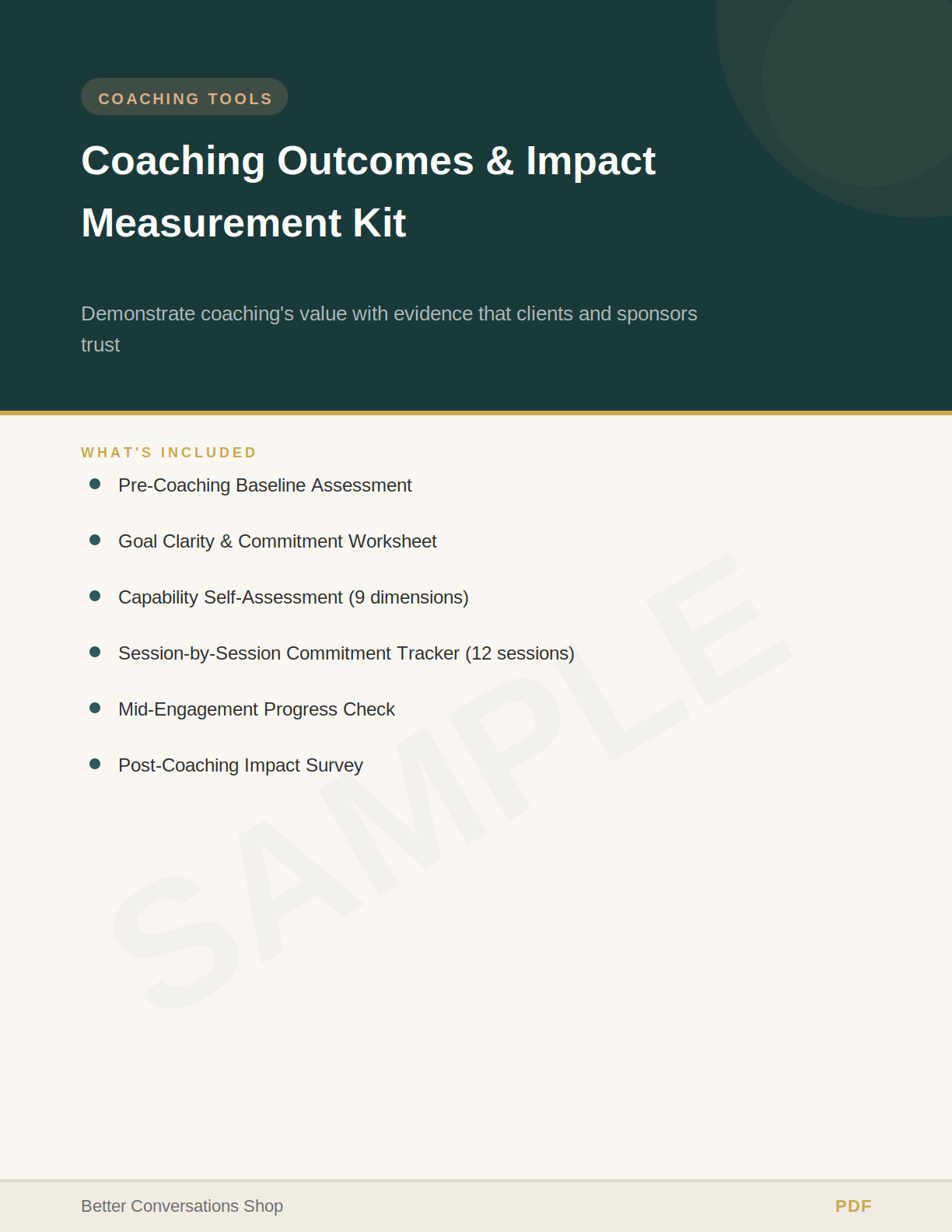
ROI measurement starts with baseline data before coaching begins. Track goal clarity, behavioral change, and business outcomes using pre- and post-engagement assessments. The Coaching Outcomes & Impact Measurement Kit ($28.99) provides a complete system for establishing baselines, capturing progress across sessions, and calculating coaching ROI. Most frameworks become valuable when coaches can articulate specific outcomes: client retention rates, performance improvements, or organizational impact. Document these metrics consistently to demonstrate value to sponsors and drive referrals.
What are the most effective coaching frameworks for business growth?
The GROW, CLEAR, and OSCAR models are widely recognized for business coaching because they balance structure with flexibility. GROW excels at goal-setting and accountability. CLEAR emphasizes listening and exploration, building stronger client relationships. OSCAR adds a review cycle, ensuring behavioral change sticks. Effectiveness depends on your coaching niche and client needs. A framework aligned with your specific industry—executive coaching, leadership development, or organizational transformation—delivers better outcomes than a generic approach. Test a framework with 5-10 clients before committing to it organization-wide.
Are coaching frameworks worth the investment for small coaching practices?
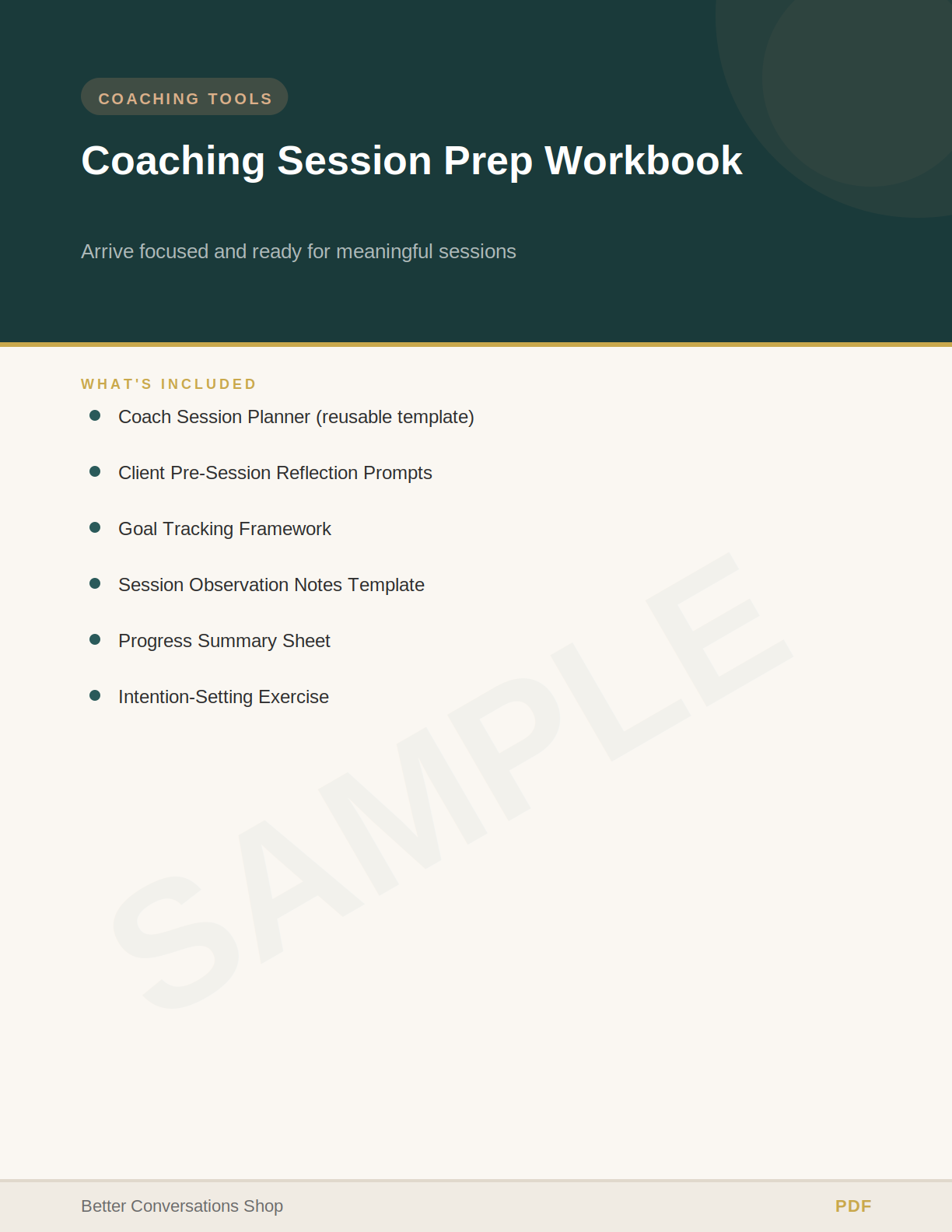
Yes, especially if you're building credibility or moving into corporate markets. Frameworks aren't overkill for small teams; they're essential for demonstrating predictable outcomes. A structured approach helps you charge premium rates, earn referrals, and scale your practice. Start with one framework ($17.99–$28.99 tools like the Facilitation Debrief Toolkit or Coaching Session Prep Workbook) rather than investing in multiple systems. The ROI comes from client retention, faster goal attainment, and the ability to articulate your methodology to potential sponsors or corporate clients.
Can I stay authentic while using a structured coaching framework?
Frameworks provide the skeleton, not the script. The best coaches use frameworks as preparation guides, not word-for-word templates. Your personality, intuition, and emotional intelligence remain central to the coaching relationship. Frameworks help you ask better questions, stay on track, and remember key conversation steps—especially under pressure. Think of them like a conversation outline: you follow the structure but adapt your language and pacing to the client. This balance between structure and authenticity actually builds more trust because clients see you're prepared and intentional, not robotic.
What's the difference between a coaching framework and informal mentorship?
Coaching frameworks provide predictable structure, measurable outcomes, and accountability mechanisms. Mentorship is typically advice-based and relationship-driven, without formal goal-setting or progress tracking. Frameworks ensure consistency across multiple clients and make outcomes repeatable. They also create documentation that supports professional credibility and ICF certification requirements. If you're coaching in corporate environments or working with executive sponsors, frameworks are essential because they demonstrate ROI and strategic alignment. Mentorship works for relationship-based learning; frameworks work when you need to prove value and scale impact.